
Most 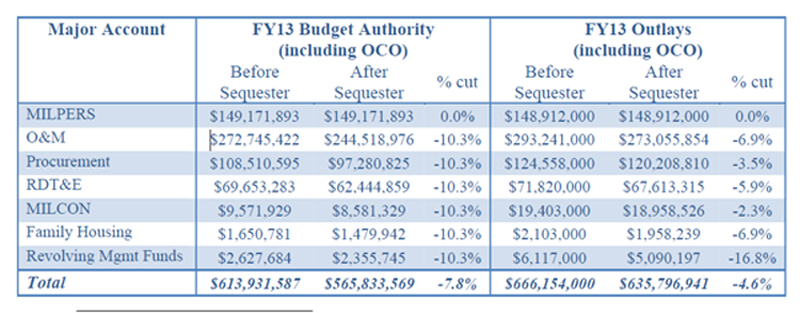 defense companies won’t feel the full impact of sequestration for three or four years because of the speed at which the Defense Department typically spends money, said Todd Harrison, senior fellow for defense budget studies at the Center for Strategic and Budgetary Assessments. Even though sequestration will require DOD to uniformly cut non-exempt budget lines—military personnel accounts are exempt—by 10.3 percent in Fiscal 2013 to meet the required $491 billion defense-wide spending cap outlined in the Budget Control Act, the immediate cuts actually will vary, explained Harrison during an Aug 24 briefing in Washington, D.C. For example, about two-thirds of funding from DOD’s operations and maintenance accounts are spent in the same year they are appropriated, he said. That means contractors that perform maintenance or other support functions are likely to feel the pain of sequestration much sooner than those that develop weapons systems. That’s because only 22 percent of procurement funds and 49 percent of research, development, test, and evaluation funds are spent the same year they are appropriated, said Harrison. This provides “some insulation for defense companies because it allows more time for adjustment,” he wrote in a new CSBA backgrounder brief.
U.S. Northern Command plans to sign an agreement with its European and Pacific counterparts to enhance coordination and close security seams in the Arctic, a strategically vital region that spans all three commands. The agreement comes at an important moment in NORTHCOM's evolution, as its mission grows more complex.
