
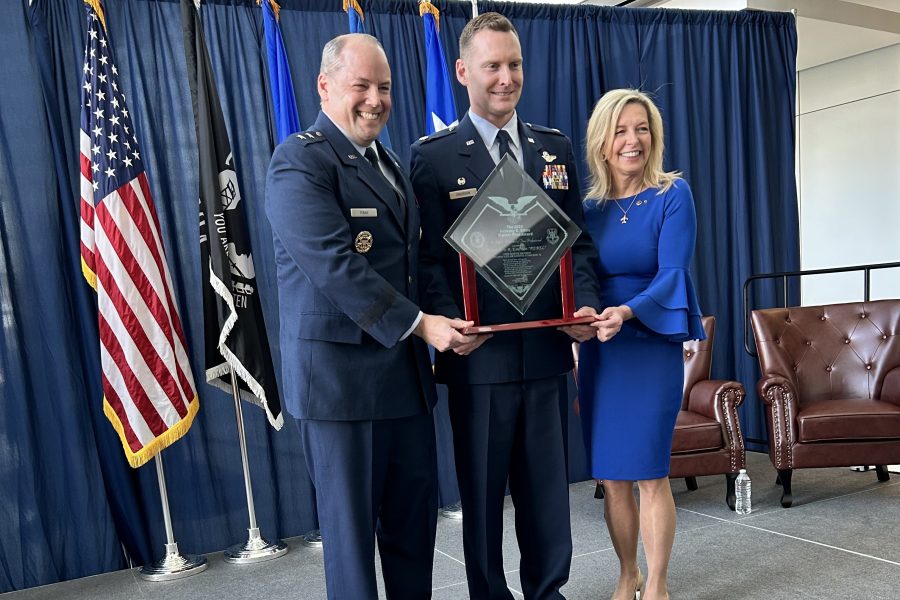
JOINT BASE ANDREWS, Md.—Air Force F-16 pilot Lt. Col. Eric R. Emerson, who commanded a small quick reaction force of fighters responding to Iranian-backed militia groups in 2024, became the first Air National Guardsman presented with the Anthony C. Shine Award during a ceremony here Feb. 10.
The award is given annually to an Air Force fighter pilot, major or below, who most exemplifies the character, professionalism, and tactical proficiency of its namesake.
Lt. Col. Anthony C. Shine flew more than 100 combat missions in the Vietnam War before his A-7 Corsair disappeared beneath a cloud covering the border of North Vietnam and Laos in 1972.
“He had just strafed an enemy convoy and descended a cloud covering for reconnaissance. His wingman lost touch. Search and rescue efforts proved futile, and he was listed as missing in action,” Shine’s daughter, Colleen, said during the award ceremony.
After more than two decades of uncertainty, Colleen made three trips to Vietnam in the mid-1990s to discover her father’s fate. Her journey led her to a villager who had discovered pieces of his aircraft and gave her a pilot’s helmet with her father’s name in it. The discovery reignited government searches, and in 1996, her father’s remains were unearthed and repatriated to U.S. soil and buried at Arlington National Cemetery.
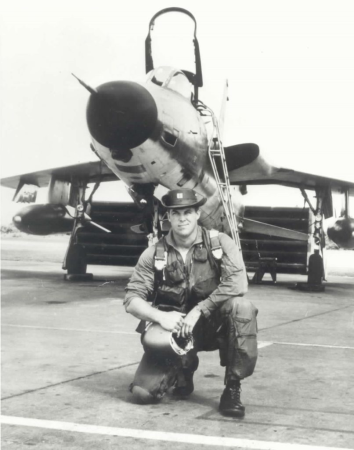
Colleen’s mother and Anthony’s wife, Bonnie, established the Shine Award in 1980 to carry on his legacy.
Emerson, who was a major in 2024, served as director of the New Jersey Air Guard’s 119th Fighter Squadron. During that year, Emerson, whose callsign is Rebel, developed a 2,900-hour flying hour program to keep the unit’s 32 pilots at a 95 percent combat mission ready rate. He served as the 119th’s instructor pilot of record for over 40 aircraft upgrade events while also performing over 850 hours of the U.S. homeland defense.
He also orchestrated the movement of over 150 personnel and 12 F-16 Fighting Falcons across four countries in the Middle East, and at the same time, he was commanding a 24/7 quick reaction force to support U.S. naval forces in the Red Sea.
During that period, Houthi rebels backed by Iran were lobbing rockets and missiles at commercial vessels in the area, causing major disruptions to global trade. The U.S. Navy sent multiple ships to the region as part of Operation Prosperity Guardian to respond to the attacks, and the Air Force provided air support and conducted multiple rounds of strikes.
“Reading through Rebel’s nomination package … I was awed by the phenomenal amount of responsibility he’s had,” Colleen said.
During its four months in the Middle East, Emerson’s unit operated out of Prince Sultan Air Base in Saudi Arabia as well as other undisclosed locations. For Emerson, the most challenging experience was leading a group of six F-16s as the quick reaction force.
“During that time, myself and five other pilots flew to ‘said’ country and we set up operations in less than 24 hours to support the U.S. Navy in the Red Sea against the Houthis that were firing against Israel,” said Emerson, who would not give specific details for operational security.
“We had no logistic support at that time. We had no maintenance support because our maintenance folks were at Prince Sultan Air Base in Saudi as well as in Bahrain,” he said. “We ended up flying 50 hours of combat missions in the Red Sea and supporting the U.S. Navy without any logistics or maintenance.”
When they were needed, Emerson’s QRF would fly 10-hour missions. “We would launch out of that country, fly to the Red Sea and support the Navy. Then we rendezvoused with tankers over the Red Sea.”
Coordinating operations for his unit and flying those missions was “an absolute challenge,” he said.
“We landed at night; we took off at night,” he said. “We serviced the jets, refueled them, serviced oil and hydro—stuff that pilots typically don’t do.”
All the while, Emerson said he was working to “figure out classified communications, how to get our different diplomatic clearances to fly in different countries, what the mission actually was, what were we doing? What were we going to do?”
He had a laundry bag with three pairs of underwear, socks, and shirts. “That was it,” Emerson said. “We didn’t know how long we’re going to be there. We ended up being there for about two weeks.”
During the ceremony, Maj. Gen. Duke A. Pirak, acting director of the Air National Guard, said being a fighter requires “100 percent of your focus to the mission at hand. It’s not a 9-to-5 job. It’s all encompassing. And it has to be because physics is undefeated and the jet wants to kill you.”
There are certain leaders “who shape organizations by the weight of their presence and the strength of their example,” Pirak said, who added that like Shine, Emerson is such a leader.
“It’s such a tremendous honor to preside over the ceremony and recognize an outstanding Airmen such as Rebel in winning the Shine Award,” Pirak said. “You represent the best of your National Guard, rooted in the community, with lethal capabilities and an unwavering dedication to each and every mission, you are truly an example the best of our profession.”
Along with the award, Colleen presented Emerson with a “hand-crafted survival knife” since her father “always carried one with him,” she said.
Emerson said he had wanted to be a pilot since he was a boy. As he got older, he was inspired by reading accounts of pilots, like Shine, who served in the Vietnam War.
“I just want to say, what an honor it is to be selected by you and your family to carry on the legacy of your father,” Emerson said. “This is amazing.”