


The Air 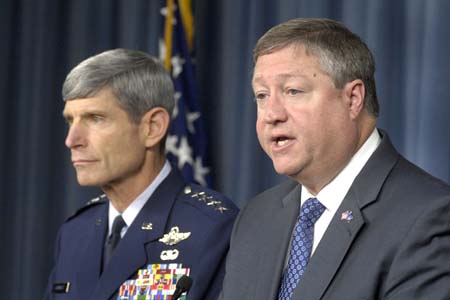 Force’s leadership announced yesterday that it has taken administrative action against six general officers and nine colonels for their leadership “deficiencies” in overseeing the service’s ICBM force that led to the errant shipment of four Minuteman III nosecone assemblies to Taiwan in 2006. “These officers are good people with otherwise distinguished careers spent in faithful service to the nation,” Gen. Norton Schwartz, Chief of Staff, said during a Pentagon press briefing with Acting Air Force Secretary Michael Donley. Schwartz continued: “They are not accused of intentional wrongdoing. But they did not do enough to carry out their leadership responsibilities for nuclear oversight. For that, they must be held accountable.” Of the six generals, Lt. Gen. Kevin Sullivan received the harshest sentence with a letter of reprimand; he has requested retirement. The remaining five received letters of admonishment. They are: Lt. Gen. Michael Hamel, who had already planned to retire before the Taiwan incident came to light in March; Maj. Gen. Roger Burg, who will remain in his current post; Maj. Gen. Kathleen Close, who will stay in her position; Brig. Gen. Francis Bruno, who, like Hamel, had previously planned to retire, effective Oct. 1; and Brig Gen. Arthur Cameron, who had finished his tour and moved on to a new assignment prior to this discipline. Of the nine colonels, none of whom was identified by name, five received reprimands, three admonishments, and one a letter of counseling. Of the reprimanded colonels, two were removed from command, with one opting to retire. Donley and Schwartz said they made their decisions based on the recommendations in the report by Adm. Kirkland Donald who investigated the Taiwan incident, as well as the Air Force’s own look into accountability. Donley said he and Schwartz acted after reviewing each individual case with a three-member advisory panel they established in July, comprising retired Air Force Gen. Thomas Moorman, Martin Faga, ex-USAF assistant secretary for space, and Gen. Stephen Lorenz, commander of Air Education and Training Command. (Transcript of press brief)
The Pentagon has concluded a new agreement to buy laser-guidance kits that turn rockets into drone-killing weapons. BAE Systems and the Defense Department announced a framework deal of up to seven years for 25,000 Advanced Precision Kill Weapon System guidance kits annually for the U.S. military.