
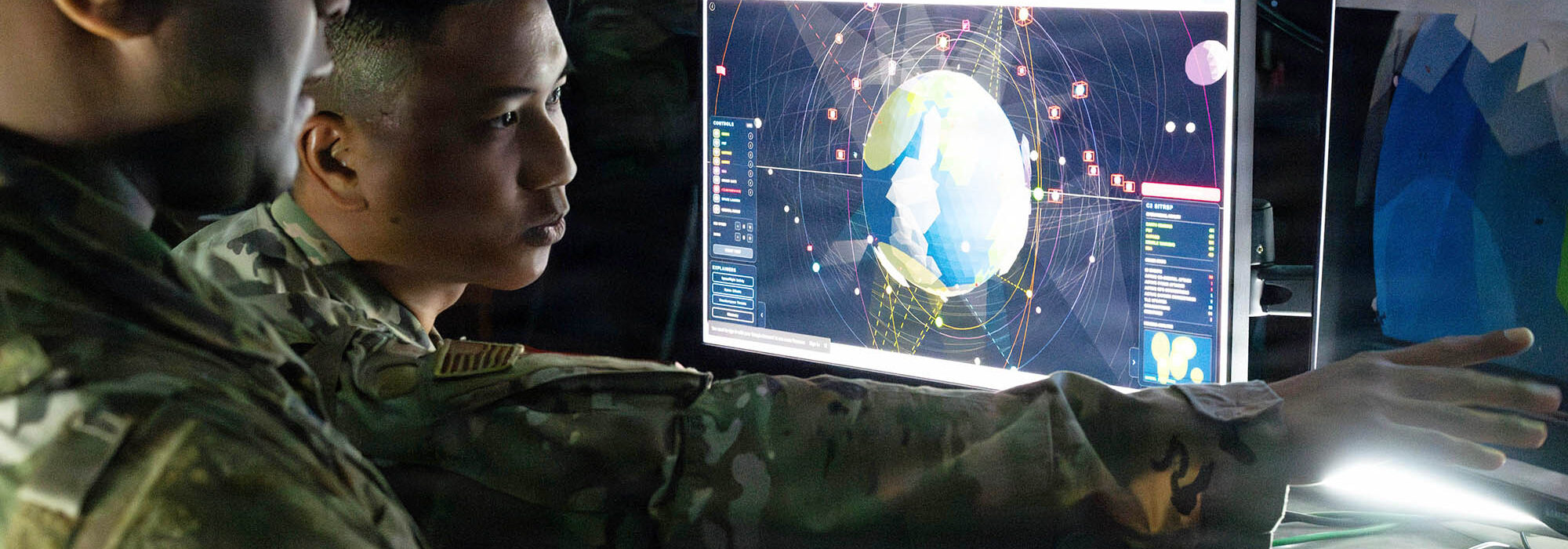
The Space Force has spent the past few years preparing for war. Now, it has fought one.
The U.S. military has chronicled its strikes by sea and air on Iranian military sites in Operation Epic Fury, as well as its extensive efforts to intercept Tehran’s persistent missile and drone attacks.
Underpinning all that activity was space.
“When the order came for Epic Fury, the Space Force was a part of the decision calculus on whether we executed the joint campaign at all,” Chief of Space Operations Gen. Douglas Schiess said. “The joint force made it clear: Without the Space Force’s capabilities, the joint force could not—and would not—move forward.”
As in other campaigns, the Space Force’s Global Positioning System satellites enabled U.S. forces to carry out precision strikes against Iran’s missile forces, defense industry, and a broad array of targets. But before the U.S. Navy unleashed Tomahawk cruise missiles from the sea and the Air Force and carrier-based warplanes dropped air-launched cruise missiles and guided bombs from the sky, America’s space operators opened up the operation from the heavens, using electronic warfare to disrupt Iranian air defenses and clear a path for U.S. strike aircraft.
Space operators, noted Chairman of the Joint Chiefs of Staff Gen. Dan Caine, were the “first movers” in the campaign.
The Space Force also nominated targets to the Combined Air Operations Center, which ran the strike campaign under Air Forces Central, focusing on Iranian satellite communications nodes and Iranian jammers, among them some that targeted Air Force MQ-9 Reaper drones.
“Guardians, what are we providing: just look at our doctrine, and it’ll tell you everything,” said Chief Master Sergeant of the Space Force John F. Bentivegna during AFA’s Air, Space & Cyber Conference. “It’s all things that underpin the lethality of the joint force. So all the Guardians were involved.”
ADVERSARIES NOTICE
Iran, which suffered the result of the Space Force’s work, took note, which is why U.S. space and missile defense assets have been prime targets for Iranian missiles and drones. Iran proved more effective than many imagined in striking and damaging radar sites, communications, and command and control nodes throughout the region.
“If the past few months have taught us anything—if current overseas operations have taught us anything—it’s that our adversaries are targeting space and missile defense assets like never before,” said Gen. Stephen Whiting, the head of U.S. Space Command, in August. “Let’s be blunt and specific: Iran is a medium-sized military power, and they’re choosing to fire at space and missile defense targets. When bullets cost so much, you take great care with your aim. You only shoot at your adversaries’ most valuable targets.”
As head of Army Space and Missile Defense Command, Lt. Gen. John Rafferty said his service helped with “setting the conditions for space to be thrust into the starting lineup.”
While the Space Force suffered no fatalities, Soldiers specializing in space operations did. Army Sgt. Benjamin N. Pennington, of the Army’s 1st Space Battalion, 1st Space Brigade—part of U.S. Army Space and Missile Defense Command, the service’s component to U.S. Space Command—was injured and later died from wounds suffered in Iran’s March 1 retaliatory attacks on U.S. forces at Prince Sultan Air Base, Saudi Arabia.
Notably, Iran has also used space in its attacks, along with cyber and electronic warfare. It used Chinese commercial satellite imagery to aid in its targeting, U.S. Space Command concluded in a report on space warfighting, and used its cyber and electronic warfare systems to attack U.S. communications and navigation and interfere with precision-guided weapons. “Iran [employed] asymmetric capabilities to disrupt U.S. space capabilities—far beyond what its limited presence in orbit would suggest,” the report stated.
Iran also leveraged commercial space systems to attack U.S. forces, SPACECOM said: “Iran’s reported use of commercially sourced, AI-enhanced satellite imagery, including imagery provided through Chinese commercial entities, to improve targeting against U.S. positions reflects how commercially accessible imagery, automated analysis, and publicly available data are eroding precision-strike advantages once held primarily by major powers.”
In May, the State Department announced sanctions against four companies it said provided Iran satellite imagery that “enables Iran’s strikes against U.S. forces in the Middle East.”
China’s use of commercial space to target the U.S. is a game-changer.
“That was a capability that we took for granted for all those years,” Rafferty said of air defense. U.S. forces “operated under the protection of [U.S. missile defense] and nobody ever tested it.”
Rafferty said his command has worked hard to improve its missile defenses over the past few months, and Schiess said the Space Force sees missile warning as a solemn duty.
“The folks that are doing that each and every day are incredible, and they are saving lives,” Schiess said of Guardians conducting missile warning.
For the Space Force, the challenge of protecting its assets has raised an interesting question: How can the Space Force better protect its terrestrial assets?
“I think the whole joint force is learning a lot from Operation Epic Fury,” Schiess said in a press event at AFA’s Air, Space & Cyber Conference. “What needs to be in underground facilities? What maybe can we do from remote locations? … Obviously, sometimes we have to be within the footprint of the satellite, and so that’s why Guardians go into harm’s way. But we are taking those lessons and looking at them across the board. You could also look at what can we do from space,” reducing the number of Guardians needed to operate in war zones.
Coming under attack in a combat theater was new for USSF, Bentivegna said. “As a service, reconstitution in a combat environment … is something we kind of hadn’t really worked on before.”
CENTRAL ROLE
Key to U.S. efforts to use space to wage war against Iran was Space Forces Central, known as SPACECENT, the Space Force’s component at U.S. Central Command, MacDill Air Force Base, Fla., and deployed to U.S. bases in the Middle East. Less than 4 years old, SPACECENT remains relatively small, comprised of dozens of Guardians.
“Your Space Force is in the fight,” said Brig. Gen. Todd Benson, SPACECENT commander and the Combined Forces Space Component Commander for CENTCOM. “We’re in harm’s way. We’re doing all the things that any other service would do. We’re defending. We’re attacking.”
Space experts have had a presence at the Combined Air Operations Center under Air Forces Central for decades. In the old construct, notable space leaders held key roles as Director of Space for Air Forces Central. These included then-Col. John Hyten (2006), who went on to be the four-star Vice Chairman of the Joint Chiefs of Staff; then-Col. John “Jay” Raymond (2006-2007), the first Chief of Space Operations after the Space Force was established; and then-Col. David Thompson (2009-2010), who went on to be Raymond’s deputy as Vice Chief of Space Operations. Schiess (2015) also held the job. Other Space Force component commanders also served in the old Director of Space Forces role in CENTCOM.
Schiess’ predecessor as CSO, Gen. B. Chance Saltzman, established the space component commands, beginning with Space Forces Pacific in late 2022.
Saltzman was the two-star Deputy Combined Forces Air Component Commander at CENTCOM and deputy commander of AFCENT, a role no Guardian is likely to ever hold again. It was after becoming the three-star Deputy CSO for Operations, or S-3, that Saltzman argued that the Space Force needed a better way to present forces to the combatant commands, and set about creating a parallel structure to those of the other military services.
CENTCOM was quick to get on board. Its commander at the time, Marine Corps Gen. Kenneth McKenzie, advocated for a Space Force component and wanted one established during his tenure, people familiar with the matter said. After McKenzie retired in April 2022, he handed the reins to Gen. Michael “Erik” Kurilla, who also supported establishing a Space Force service component in CENTCOM.
Space Forces Central was established on Dec. 2, 2022, only about a month after Saltzman became CSO. Col. Christopher Putman was the inaugural commander, having previously been Director of Space Forces for Air Forces Central.
Since Space Forces Central’s commander also serves as the Combined Forces Space Component Commander and Space Coordinating Authority for CENTCOM, this officer can issue Space Tasking Orders, direct capabilities, and coordinate space operations without routing requests through the air component.
“Now you have a space component commander solely focused on space,” Benson said in an interview with Air & Space Forces Magazine. “We want to remove the ability for the adversary to have any space capabilities, and we’re going to use every domain possible.”
With CENTCOM in off-and-on conflict since Hamas’ Oct. 7, 2023, attack on Israel, with operations against the Houthis in Yemen, defending Israel from Iranian drone and missile attacks, and supporting Operations Midnight Hammer and Epic Fury against Iran, Space Forces Central had to rise to the occasion.
“There was a moment in time between December and April where no one on our team had a single day off for over 100 days in a row—averaging 12 to 15 hours [of work] a day,” Benson said in an interview. “That’s how we had to do it. It’s just brute force and grit. It’s no magic recipe. A lot of learning by fire, figuratively and literally.”
Benson estimated SPACECENT has scaled its operations “10- to 20-fold” over the past year, though he declined to say how big the component currently is. Eventually, he wants to grow his command more permanently in the next few years—around five times the size SPACECENT is now.
“We’ve grown a lot and have a lot more assets at play than we did when we were a fledgling service,” said Benson, who commands SPACECENT from CENTCOM headquarters at MacDill Air Force Base, Fla. “I walk through our ops floor, and I can see one or two Guardians commanding and controlling many forces downrange. And by the way, they’re not all Space Force forces—because we have that joint hat, and they’re 24/7.” In addition to Guardians, there are Soldiers, Marines, and Airmen who fall under the space component.
But the command is still small. At one point, SPACECENT had just two Guardians represented in a targeting process involving some 1,000 personnel, Benson said.
Space operators play a role in both offense and defense, and coordination is essential because actions taken to support one combat element can impact others.
“Whether it’s air, land, sea, maritime or cyber, they’re able to support me with their domain to meet our objectives. If there’s a space issue out there, an adversary’s capability, I leverage the other components, asking them if they can support our objectives. Now we’re not only providing them what they need, but also, they’re providing things that help us achieve our goals.”
When it comes to space assets, SPACECENT must also work within the Space Force, getting support from Space Forces Space and its counterpart components in the Pacific, Europe, and Africa.
“Space is a global capability and can be specifically a regional capability,” Benson said, declining to discuss many of those operational capabilities.
Space-based electronic warfare has disrupted Iranian air defenses, while the positioning, timing, and navigation satellites help U.S. GPS-guided weapons hit their targets, U.S. officials have said. Satellites also help transmit voice and data transmissions, enabling aircraft to communicate beyond the horizon.
Space-based sensors have detected incoming Iranian missiles, providing critical minutes of warning to allow service members to escape to cover and helping base air defenders to be ready to combat the threats with Patriot and THAAD ballistic missile interceptors.
“You don’t have to think too hard to understand what it is that Guardians are bringing to the fight,” Saltzman said in April. “All of the missions that we do—missile warning, satellite communications. The links are vital. Over-the-horizon communications is as important now as it has ever been.”
But increasingly, Space Force contributions include disrupting integrated air defense systems—offensive activity not previously acknowledged.
“The adversary is using satellite communications to synchronize their situational awareness, and if we can disrupt that, then we can help create envelopes of protection for people going into harm’s way—whether that’s extracting pilots that are on the ground or protecting assets that are going into an IADS,” Saltzman told Air & Space Forces Magazine in one of his final interviews as CSO, referring to Operations Epic Fury, Midnight Hammer, and Absolute Resolve in Venezuela. “If we weren’t there, it would have gone far differently.”
Added Schiess in September: “In the electromagnetic warfare area, we have both offensive and defensive [capabilities], and so we have both of those systems out there.”
GPS, satellite communications, and missile warning systems have been used by the U.S. in the Middle East since Operation Desert Storm 35 years ago. But today, adversaries have means to try to counter those advantages and seek to deny them to U.S. forces. For years, U.S. specialists focused on protecting space capabilities from high-end threats posed by China, notes retired Space Force Col. Charles Galbreath, now the Director and Senior Resident Fellow for Space Studies at AFA’s Mitchell Institute’s Spacepower Advantage Center of Excellence.
“But the far more likely, and now proven, threat is a country like Iran leveraging foreign-provided space-based intelligence to target and attack our space capabilities,” Galbreath said.
The ubiquity of satellite imagery makes hiding and deception far harder than in the past, what Benson calls “hyper-
transparent warfare.”
“Nothing you do today is without being seen,” Benson said. “You just can’t hide anymore, and so that’s great for us for our advantage. But you have to assume that any adversary will find some way to access imagery. So we have to use that, and we have to operate knowing that we can be seen.”
“You don’t have to be a national world power to be a spacefaring nation; everybody’s got access. Everyone can see everything that everyone is doing in the world,” Benson said. “We cannot be under the belief that somebody’s not watching us, and the adversary as well has to know they can’t hide.”
That transparency has put U.S. service members and Guardians at risk, but has also given them newfound credibility with other services.
“Guardians on the front lines, in body armor, taking fire, and then staying on their posts to be able to do effects that protect the joint force,” Benson said. “You wouldn’t believe how far that goes with the other services. Now they know what we do, and we show them.”
That has led to practical lessons too.
“We’re learning some of the lessons that other services have learned over decades, if not centuries, to start to learn how to do logistics and sustainment,” Benson said. “They’re starting to think a little bit more about warfighting. It became pretty real. It’s unusual for us to say in our community that they’ve led their troops in combat operations. It’s more true than you’ll ever know.”
To help rally his Guardians, SPACECENT has held what he calls “Benson’s Bunker Talks” with Guardians deployed in the Middle East.
“We go there and we sit there because it’s hot, it’s uncomfortable, and you talk about real-life things about what’s going to happen in war,” Benson said.
GUARDIAN POWER
During a speech at AFA’s Air, Space & Cyber Conference in September, Schiess shared a dramatic example of the Space Force’s electronic warfare efforts.
A Guardian he referred to only as Specialist Gray was deployed to the Middle East with the 42nd Electronic Warfare Detachment in the opening hours of Operation Epic Fury.
“She received a priority target package with one critical objective: Reconfigure her weapon system and execute critical nonkinetic fires,” Schiess said.
Gray continued to operate this key electronic warfare capability even as Iranian missiles targeted her unidentified base, forcing fellow service members to take cover.
“Even as Alarm Red sirens were blaring and incoming missiles targeted her site,” Schiess said, “she courageously held the line—protecting forces, denying adversary capability, and delivering space effects until her commander had to literally pull her from the console to safety.”