
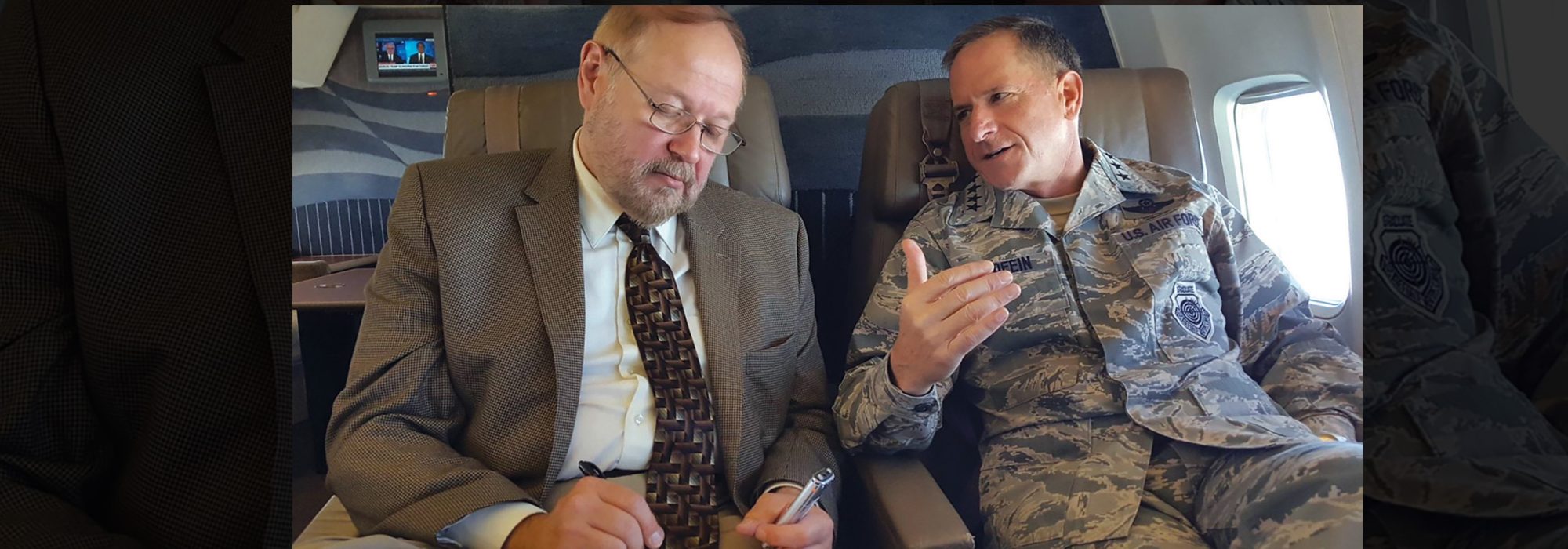
Retiring after 40 years of aerospace and defense journalism—31 years with Air & Space Forces Magazine—John Tirpak offers observations and advice on how to tell the Air Force’s continuing story.
O
ver the past few decades, the Air Force’s cumulative budget has lagged that of the Army and Navy to the tune of more than $1 trillion. Why? They clearly do a better job telling their story. It’s past time for the Air Force to step up and do a better job making its case for a bigger share of the military budget. Its leaders shouldn’t be afraid to do so.
In 40 years covering the Air Force, I’ve found it frustratingly allergic to telling its own story. It has a good story to tell, but remains excessively modest with the press and general media. Too many times I’ve seen the Air Force teed up to explain how it accomplished major military miracles, only to kick at the ground and wave it away with an “aw shucks, we just did our bit.”
The other services have no such reluctance in touting their roles and showcasing their contributions to national defense, arguing effectively that they deserve all the money the nation can throw at them.
Stop Being So Purple
The Air Force’s default communication strategy is, laudably, to emphasize jointness. But in doing so it dilutes the message that it is most often “the first force”; the one that underwrites and enables all others. USAF sets the conditions for victory by denying an enemy the ability to hide or operate without being observed and attacked.
Consider this missed communication opportunity from Operation Inherent Resolve (OIR), in which the Air Force led and sustained the bulk of the anti-ISIS campaign. While small teams of special operators engaged on the ground, the Air Force carried out the majority of the strikes and, overall, 70 to 80 percent of the sorties; a combination of ISR, resupply, tanking, fighter cover, and close air support.
Meanwhile, the Navy embarked a conga line of journalists aboard the aircraft carrier USS Harry Truman, where they were told that the aircraft carrier was the “nerve center” of the fight, launching the bulk of the anti-ISIS attack sorties. This was the account that made it to American living rooms; the Air Force’s role remained largely invisible.
NBC News anchor Lester Holt took a film crew to a forward Air Force base, where an impressive photo op was staged with an F-22 Raptor, an RQ-4 Global Hawk ISR drone, and bleachers filled with Airmen. In front of them, Holt asked the provisional wing commander what the Air Force was doing in the war.
It was a tailor-made opportunity for the Air Force to tout its lopsided contribution to the fight, but instead the officer played it down, replying, “We’re just part of the team.”
Perhaps he’d been instructed not to get into details, due to host-nation sensitivities. Maybe NBC told him to keep his answer under 10 seconds. But in any case, the real story didn’t get out, and as it happened, few other such opportunities arose during the conflict. The Air Force’s central role in the OIR victory went largely unsung and unnoticed.
This mindset often comes down from on high.
In 2012, in an exit interview with the departing Chief of Staff, Gen. Norton Schwartz, I asked if he thought he’d been a strong advocate for the Air Force during his tenure. He replied that the service’s accomplishments make their own case.
“There is still wisdom in your performance speaking for your institution,” he said. Schwartz had made a “conscious choice,” he said, not to be a cheerleader for the service. And while he acknowledged that budgets are a “competitive environment,” and that it’s important for “decision-makers, both on the policy and resourcing side, to appreciate the contributions of their Air Force,” he preferred to leave it to the next Chief to decide whether to “change that formula.”
Here’s an observation: If you keep telling people you’re nothing special, eventually they’ll believe you. Corollary: If you are silent and let the other services talk about why they need resources and you don’t, their story gets heard and they get the funding. Out of sight, out of mind … out of money.
Tell the Story: Loudly and Often
The Air Force—and airpower—drove victory in the wars the U.S. and its allies have won over the past 40 years. Without control of the air, you don’t fly your ISR and support aircraft wherever and whenever you want, and you don’t get to hit the enemy at the time and place of your choosing. Without air dominance, the situation on the ground remains chaotic and unresolvable.
In 1991, six weeks of applied airpower whittled down the Iraqi military—then the fourth-largest in the world—to a level where the U.S. Army and coalition allies could mop up in four days. The Army likes to promote Desert Storm as the “100-hour war,” but it was the preceding two months of strategic bombing and “tank plinking” that made that 100 hours possible.
Airpower alone forced Serb forces to quit their “ethnic cleansing” campaign in Kosovo, with no U.S. or NATO ground forces ever committed to the fight.
For a current example, look at Ukraine, where neither side has control of the air. Nearly four years into this grinding war of attrition, neither side has a decisive edge. Absent airpower, winning is elusive. We learned this in World War II and have relearned it in every conflict since.
Dominant airpower won the fights in Iraq, the former Yugoslavia, Libya, Syria, and Iran. The Air Force needs to make this point, simply and loudly, until the public and Congress recognize it as the maxim it is: You can’t win without control of the air. And control of the air requires investment.
React Quickly
Bad news—or wrong news—can’t be ignored, and it gets worse with age. In a 24-7 news cycle, you’ve got to head off bad news by meeting it head-on. You have to trust your public affairs people to know their business and to provide a good, fast response. Too often, the Air Force hedges and falls behind the news cycle.
One example of many: In the 1990s, the absurd notion was spread that the B-2’s stealth treatments were so delicate that they “melt in the rain.” Rather than instantly moving to shut down this insinuation, Air Force leaders held back, trying to formulate a perfect response. But by the time USAF came out with its well-reasoned rebuttal, it was too late. The baseless charge had become conventional wisdom. Even now, 30 years later, you still hear this canard.
Did it hurt? Probably. How many B-2s did the nation wind up buying? Just 21. Other factors also led to that outcome, but the object lesson remains: If you dither, you miss your chance to shape the conversation.
Celebrate Your Successes
By all accounts, the B-21 bomber—the first new bomber in 30 years—is performing well: It’s on schedule and on budget. But when the time came for its first flight in November 2023, no media event was scheduled. The only photos taken were by private photographers, who had camped out at the end of the runway. It took weeks for a couple of official images of the B-21 in flight to be released. What was gained by this reticence? If the decision rested with defense officials at higher echelons of command, did the Air Force fight hard enough to argue its case? This was yet another lost opportunity to tell a really positive Air Force story.
The recent Operation Midnight Hammer, which set Iran’s nuclear weapons ambitions back significantly, was a mostly Air Force mission. USAF B-2 bombers delivered the central punch, while its F-35s deftly executed one of their first combat missions. Many other Air Force assets played key roles, as well. Chairman of the Joint Chiefs of Staff Gen. Dan Caine offered an authoritative account appropriately emphasizing the jointness of the operation. But a repeatedly promised, more detailed and airpower-centric press briefing has, regrettably, yet to take place.
Lesson: If it’s a good news story, tell it. If someone wants to hide it, fight for your voice.
Yes, There’s Risk—But Courage is Part of the Job
Airmen know risk is part of military service. Every time they step to the aircraft or outside the wire they know there’s danger ahead, no matter how safe and professional they are. Risk can never be eliminated, and the courage to face risk is part of the job. They do it because they know: It’s worth it.
In the lead-up to Operation Desert Storm, then-Chief of Staff Gen. Mike Dugan told reporters how airpower could deliver victory through attacks on command and control, leadership and other key targets. He knew that airpower, properly applied, could save the lives of thousands of ground troops. But his frank talk discomfited the Defense leadership, and Dugan was fired after just 79 days on the job.
Of course, airpower wound up winning that war just as Dugan predicted. His revelations seem not to have helped the Iraqis in the slightest.
Dugan’s successor, Gen. Tony McPeak, briefed the press after the war to explain the Air Force’s singular contribution in Desert Storm, only to be criticized by the other services and many in the media for executing a parochial stunt. They derided him for claiming the war had been won by USAF alone, though he never said that.
“All the services made a very important contribution, and of course, all our allies, as well,” he said. The air campaign was simply “my piece … to talk about.”
McPeak said airpower set the conditions for victory by inflicting, by far, the greatest amount of destruction on the enemy, and the enemy’s ability to coordinate its own defense. All true.
The Army howled at McPeak’s assertion that Desert Storm marked “the first time in history that a field army has been defeated by airpower.” That service ignored his next comment: While “it was a remarkable performance by the coalition air forces … there are some things airpower can do and does very well, and some things it can’t do … that is, move in on the terrain and dictate terms to the enemy. Our ground forces did that. … I think they did a magnificent job.”
Similar criticism was later leveled at Lt. Gen. Mike Short, who led the NATO airpower-only campaign against Serbia in Operation Deliberate Force in 1999. In postwar comments, Short asserted that airpower alone had dislodged an entrenched ground force. But he added that it wasn’t “tank-plinking” Serb armored vehicles that achieved the war’s goals—but strategic airstrikes on Slobodan Milosevic’s “centers of gravity” in Belgrade that did the trick. Only airpower could strike those targets, pressuring the Serb leadership, and Short felt it was important to highlight how modern warfare was changing.
Perhaps the most notorious modern-day case of leaders slapped down for airpower advocacy came in 2008, when both Chief of Staff Gen. T. Michael “Buzz” Moseley, and the Secretary of the Air Force, Mike Wynne, were fired by then-Defense Secretary Robert Gates. He blamed them for incidents of lax handling of nuclear weapons and for blocking drone technology, but clearly, neither charge was true: The record shows both were deeply involved in correcting post-Cold War nuclear neglect, and in rapidly advancing unmanned systems.
The real reason, as Gates alluded to in his memoir, was that Wynne and Moseley campaigned for dominant future airpower: specifically, for continuing F-22 production. Gates, locked in counterinsurgency campaigns in Afghanistan and Iraq, viewed the F-22 as an irrelevant, “exquisite” system, ill-suited to the fights on his plate. Moseley and Wynne suffered from “Next-War-itis,” he charged, arguing that China wouldn’t come up with anything comparable to the Raptor for 20 to 25 years.
Gates was wrong. Wynne and Moseley correctly saw that the F-22 would be a linchpin of future conventional deterrence. Today, China has twice as many J-20s—its answer to the Raptor—as the Air Force has combat-ready F-22s. This reality strongly affects the calculus of any Pacific theater war. Wynne and Moseley were right.
The Air Force has always had to fight to get its views accepted. But doing so puts you in good company: Billy Mitchell set us this model a century ago, in 1925. Air Force leaders have to be willing to fight for what they know to be true.
Fix the Press-Phobic Culture
We raise our Airmen to believe in meritocracy. It’s considered bad form for an Airman to get his name in the newspaper, as if this is showing off. The institution warns: “you don’t have to tell us you’re good. If you are, we’ll notice you, and you’ll get promoted.”
This works just fine at the enlisted and junior officer levels. But what happens when junior officers move up, and it’s crucial that they advocate for their wing, their mission, their program? They’ve been trained to avoid the press, decline the interview. Their unit, program or system goes unexplained, unjustified and unsupported, and some other service, better at advocacy, gets the funding.
A Public Affairs officer once asked if I would be willing to interview the then-new Vice Chief of Staff. When he pitched the interview to the general the next day, saying, “Sir, I’d like to get you started doing some media,” the conversation-ending response was, “now why in the world would I want to do that?”
Media-shy four-star generals have actually said to me, “that’s out of my lane” or “that’s above my paygrade.” Pro tip: if you’re at that level, you’re expected to know, and to be able to talk with fluency about all Air Force issues. If you don’t speak up for the service, who will?
I once gave a ride to a couple of young Marine infantrymen in Arlington, Va., who were looking for the Marine Corps Memorial; the statue depicting the iconic raising of the flag on Iwo Jima. When the conversation turned to aviation, they were fully versed in the V-22 tilt-rotor: how many their service wanted, why, what it cost, and why they thought it was worth it. An Airman would never have ventured such comments. The Marines, at least, don’t have the Air Force’s shyness problem.
At all levels, Air Force education should emphasize that it’s every Airman’s and Guardian’s job to be an ambassador for the Department of the Air Force—its capabilities, its primary needs, and why it gives excellent value for the resources it gets. This is essential at a time when fewer and fewer Americans have any direct connection with the U.S. military. Who else is going to tell the Air Force and Space Force story?
My colleagues at the Mitchell Institute for Aerospace Studies have gone hoarse warning that today’s Air Force is smaller and older than it’s ever been. Readiness overall is way down, pilot flying hours are brutally low, and the service is at least a decade behind the power curve in modernization.
This is why the Air Force needs to get better at telling its own story, now: to make the compelling argument for the equipment and manpower it needs to carry out the nation’s critical missions. If it doesn’t, its steady decline in readiness will almost certainly continue. Sooner rather than later, “making do” won’t cut it any longer, and an operational failure will be inevitable.
The Air Force has had good evangelists for aerospace power—Billy Mitchell, Curt LeMay, Bennie Schriever and Dave Deptula come immediately to mind. The service needs to tell its story; while backing up and promoting those that do it well. It’s a critical part of the mission of ensuring it has the resources needed to secure air superiority in the future.