
Modern warfare depends on the ability to move, integrate, protect, and exploit data at speed and scale. Yet operational timelines continue to compress, and military sensors, autonomous systems, and proliferated satellite constellations are generating increasing volumes of data.
Designed for an era characterized by lower data volumes, more predictable communication flows, and uncontested access to space and the electromagnetic (EM) spectrum, yesterday’s information architecture is inadequate for today’s data demands under the strains of a contested environment.
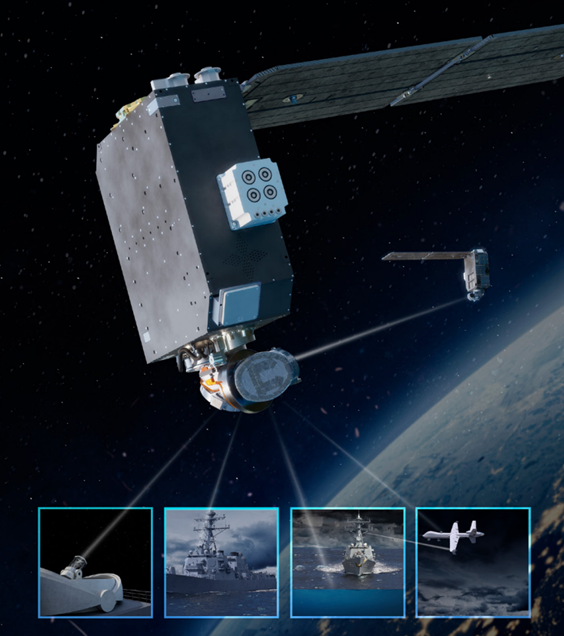
The answer is a hybrid RF-optical communications architecture that combines RF’s resilience and ubiquity with the far greater transport capacity and security of optical communications.
Historically, military space systems supported mission sets such as missile warning, strategic communications, and positioning, navigation, and timing. Data volumes were modest, and communications were largely linear and centralized. As a result, architectures prioritized reliability and global coverage over scalability, flexibility, and rapid data integration.
Adapted from War at the Speed of Information: Data Transport, Decision Advantage, & the Future of Military Space Communications. The author is a fellow at the Mitchell Institute’s Spacepower Advantage Center of Excellence.
Today, however, demand for the Space Force’s Satellite Control Network exceeds industry standards and much of the infrastructure is aged; its newest major ground station was completed in 1991. Back then, fewer than 2,000 operational satellites existed worldwide; today, there are more than 17,000 satellites on orbit, with tens of thousands more satellites planned. An architecture operating near capacity is inherently vulnerable, less able to absorb disruptions during conflict.
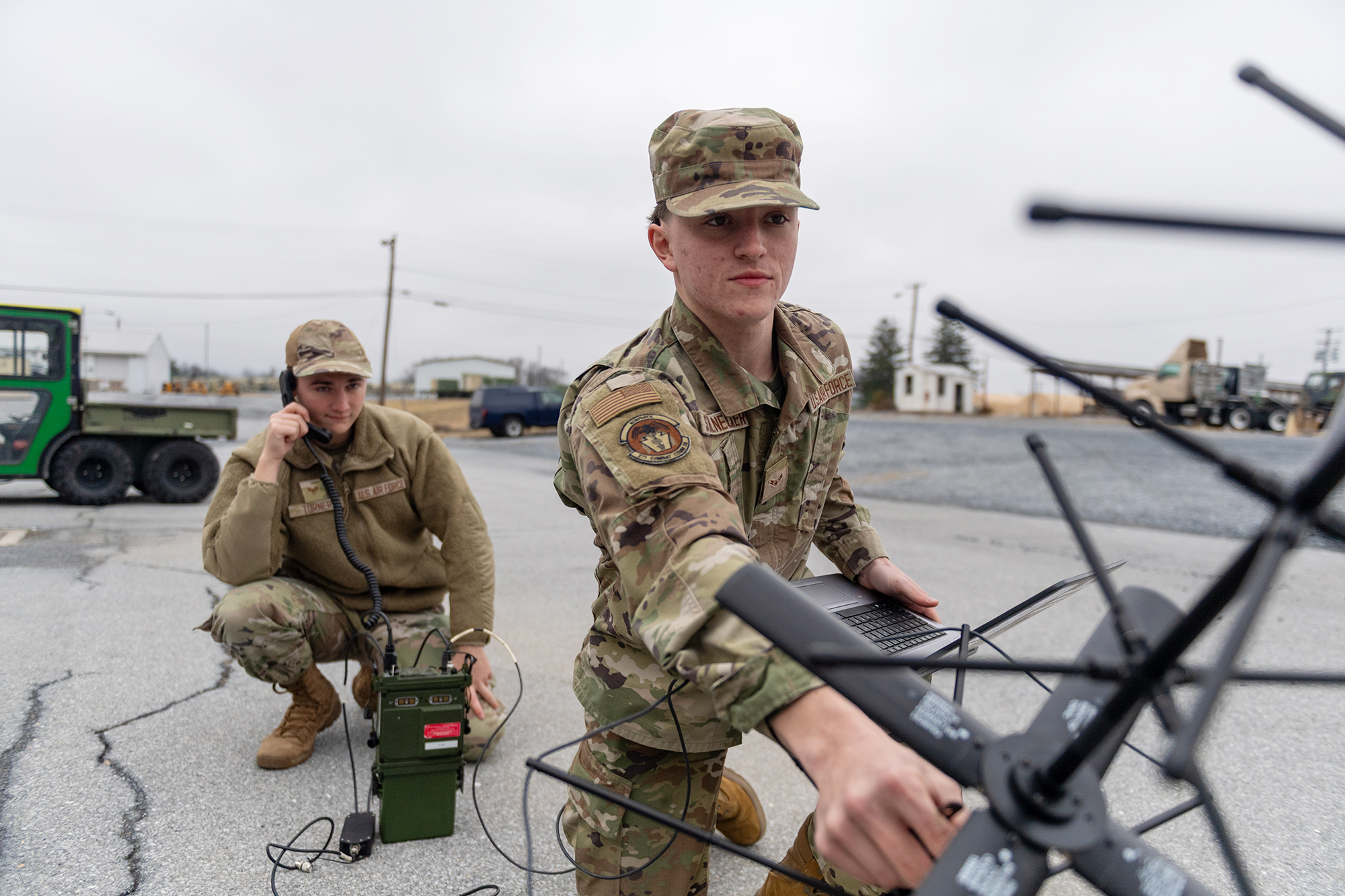
Modern networks must enable forces to detect, process, and act on information faster than an adversary. To be effective, they must be able to distribute large volumes of data quickly, securely, and reliably across the force. Information that cannot reach commanders or weapons systems in minutes or even seconds rapidly grows obsolete. Indeed, latency can be an operational liability. Adversaries target communications using electronic warfare, cyberattacks, and signal interception. Russian operations in Ukraine target communications to degrade command and control and reduce operational effectiveness.
In future conflict, nations that move, protect, and exploit data more effectively will gain decision advantage and the strategic initiative. This is why the Space Force included billions of dollars for the development of its Space Data Network (SDN) in its fiscal 2027 budget request. The initiative seeks to integrate military, commercial, and proliferated space capabilities into a hybrid architecture capable of rapidly transferring large volumes of data across domains.
Architecture Vulnerabilities Today
RF communications are inherently observable and easily contested. Unlike wired or physically isolated communications pathways, RF transmissions propagate openly through the atmosphere, exposing them to detection, interception, geolocation, interference, and exploitation. The Space Force’s Future Operating Environment projects that future conflicts will treat the EM spectrum as contested terrain, where competition extends beyond platforms to the signals themselves. Recent operations demonstrate that electronic attack, spectrum denial, and signal exploitation are already routine features of modern warfare.
Ukraine serves as a modern case study. Russian electronic warfare activities have repeatedly degraded drone operations, communications, and battlefield coordination. Collaterally, GPS interference in the Baltic region has disrupted aviation and navigation.
As military forces increasingly rely on networked command and control and rapid data exchange, disruptions to communications can degrade coordination and slow decision-making. The more systems are interconnected, the greater the risk of disruptions having cascading effects on command and control, targeting, navigation, sensing, logistics, and distributed decision-making.
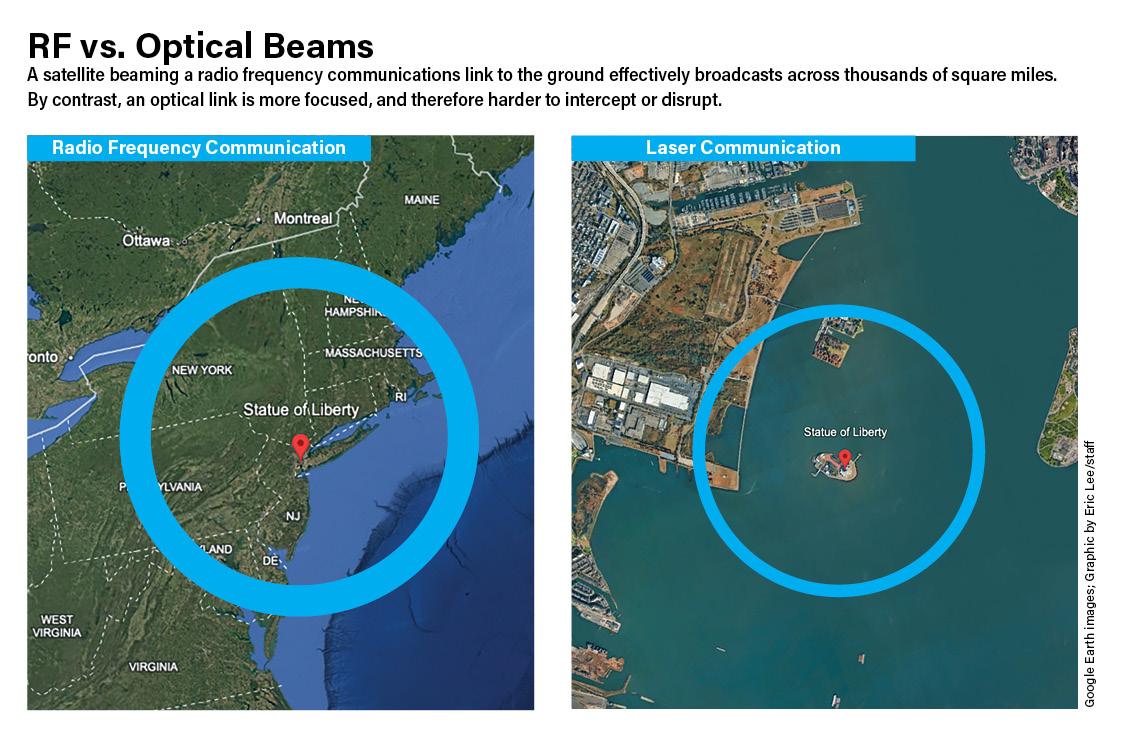
Optical communications can reduce this vulnerability. Unlike RF transmission, whose energy spreads over distance even when transmitted through directional antennas, optical communications concentrate energy into extremely narrow beams that remain tightly focused over long distances. They are harder to detect, intercept, geolocate, and disrupt, and because they operate at the speed of light, enable substantially greater data transport capacity. Simply put, optical links provide a more discrete and resilient pathway for moving large volumes of mission-critical data between satellites, ground nodes, and operational forces.
Yet optical communications should be seen as a complement to—not a replacement for—RF. Optical technology carries its own technical and environmental challenges, particularly for atmospheric transmission. Future military networks should combine the strengths of both technologies to create more resilient communications architectures.
The Data Absorption Problem
Emerging operational concepts such as Joint All-Domain Command and Control (JADC2) are dependent on continuously connected networks linking sensors, decision-makers, and operational forces across multiple domains in near real-time.
Central to this concept is the explosive growth in the number of satellites supporting these missions. Unlike earlier architectures that relied on relatively few highly capable satellites, modern proliferated architectures operating in low-Earth orbit distribute sensing, communications, and networking functions across many interconnected platforms. The Space Development Agency’s (SDA) planned data transport layer, for example, is forecast to have more than 100 satellites in LEO by 2027.
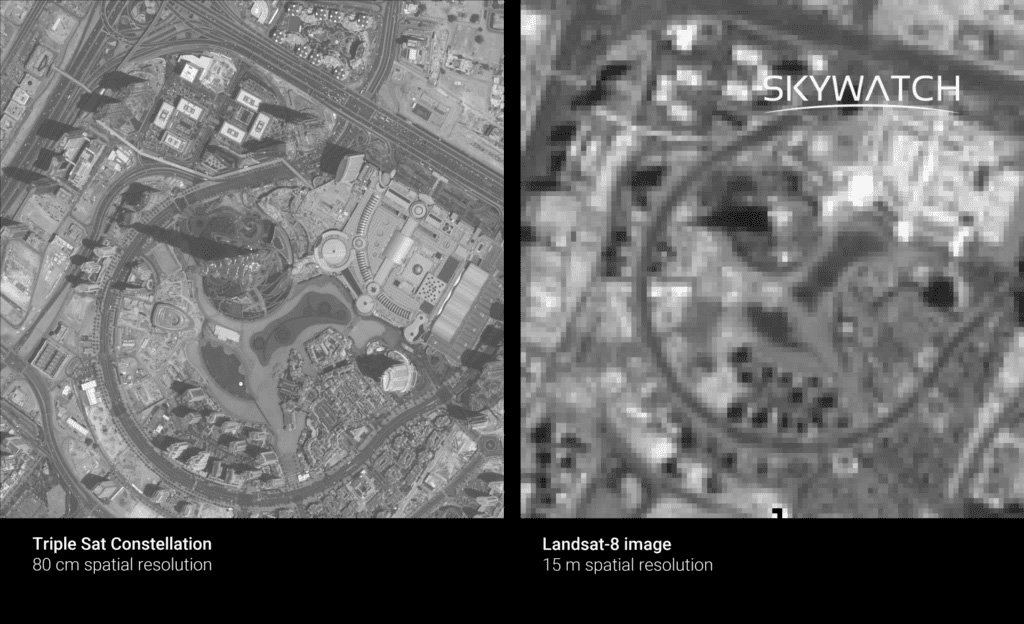
At the same time, orbiting sensors are generating dramatically larger datasets: The National Academies of Sciences notes that improvements in sensor resolution, persistence, and revisit rates have driven a 200-fold increase in data output over the past 20 years, straining communications architectures already operating near capacity. A single high-resolution satellite image can exceed 2 GB.
Existing RF links operate within a finite, regulated, and shared spectrum and cannot simply be expanded to match demand. Spectrum availability, transmission power limitations, orbital coordination requirements, and shared access constraints collectively impose hard ceilings on transport capacity.
In practice, this requires a hierarchical means of prioritization. Missile-warning and command-and-control traffic might trump imagery transmission, delay delivery and/or require data compression.
Incremental improvements such as adaptive waveforms, spectrum sharing, and more efficient RF management can mitigate, but will not solve this mismatch between rapidly growing data production and finite transport capacity.
A New Strategic Competition
Not surprisingly, therefore, space communications are now a central arena for strategic competition. China is also developing proliferated constellations, advanced networking systems, and laser communications capabilities to its own data-intensive military operations. In the race for communications advantage, the early mover promises to gain disproportionate influence over the standards, interoperability frameworks, and integration pathways that define future systems. This is especially true as regards to optical links from space to ground stations.
The 5G experience offers a cautionary example. China’s early and coordinated push into 5G, spectrum policy, and international standardsgave it significant influence over the technical and commercial environment in which future commercial cellular networks would operate. Although the United States remained a leader in telecommunications innovation, China’s muscle and scale gave it advantages in the standards ecosystem and international cellular market.
Similar dynamics will shape the market for optical terminal interfaces, crosslink standards, data-relay architectures, and allied interoperability. Failure to lead therefore risks more than a technological disadvantage: It could ultimately force the United States to operate within communications architectures and standards shaped by competitors.
Hybrid RF-Optical Communications
Optical communications use frequencies thousands of times faster than those used in traditional RF systems. This enables a “step-change” improvement—particularly for space-to-space applications without having to pass through the Earth’s atmosphere.
Optical crosslinks between satellites enable data transfers across proliferated constellations using through networks similar to mesh-style Wi-Fi networks on the ground. Rather than routing information through terrestrial infrastructure for redistribution, optical networks can dynamically move data across multiple satellites until it reaches the most effective downlink station to reach operational users. Dependence on fixed ground infrastructure is reduced while resilience, routing flexibility, and continuity of operations is enhanced.
Amazon’s Project Kuiper has demonstrated optical intersatellite data transmission at 100 gigabits per second over approximately 1,000 kilometers without relying on ground relays.
Defense programs are demonstrating similar maturity. In 2025, SDA has made intersatellite links foundational to its future transport architecture. General Atomics Electromagnetic Systems demonstrated an interoperable air-to-space optical link using an SDA-compatible terminal and a commercial satellite, validating a multivendor laser communications architecture supporting the Proliferated Warfighter Space Architecture.
Optical communications also offer advantages in contested electromagnetic environments. Operating outside traditional spectrum constraints, they not only offer faster transmission, but also greater security: Their narrow beams are substantially more difficult to detect, intercept, geolocate, or jam than traditional RF signals.
By combining the strengths of both optical and RF communications, future space architectures can take advantage of the best of both worlds. RF provides broad-area coverage and all-weather communications, while optical links offer higher throughput, lower probability of intercept, and efficient movement of large data volumes. Optical communications can therefore relieve pressure on congested RF pathways while improving overall network resilience and scalability.
Commercial developments reinforce this concept. SpaceX’s Starlink constellation has deployed intersatellite links at unprecedented scale. In 2024 began, SpaceX began offering optical terminals to third-party satellite operators. Muon Space subsequently announced plans to integrate these terminals into its Halo architecture, enabling connectivity to Starlink’s optical mesh network at data rates up to 25 gigabits per second. According to Muon, this could increase network availability from just 10 to 30 percent to 70 to 80 percent, while reducing data delays from 20 minutes to near real-time.
For the Pentagon, therefore, the question is no longer whether this technology will work but how quickly it can make it part of the resilient, integrated networks the joint force needs to fight.
Moving Less Data Faster
A growing set of technologies, including onboard processing, AI-enabled analytics, data compression, and on-orbit data management, can further reduce transmission requirements while preserving the operational value of time-sensitive data. Onboard processing and artificial intelligence can reduce the volume of data transmission by analyzing data at or near the point of collection, determining whether data must be transmitted immediately, which can be compressed or delayed, and which can be discarded.
Recently, the European Space Agency’s Phisat-2 demonstrated how to reduce communications demands with its wildfire-detection application, developed by Thales Alenia space. The application identifies fires directly from satellite imagery, prioritizing mission-relevant information before downlinking it to Earth. Rather than transmitting massive amounts of raw imagery for later analysis, this approach could deliver actionable information faster while reducing the burden on communications networks.
AI is well suited to data filtering, anomaly detection, sensor cueing, and information prioritization, while more complex operational decisions involving adversary deception, ambiguous conditions, or the use of force should continue to rely on human oversight.
Data compression and advanced encoding techniques can relieve network congestion by reducing redundancy and maximizing the amount of usable information transmitted within each link. European Space Agency’s ROSE-L radar satellite, for example, is projected to generate approximately 20,000 gigabytes of data per day, illustrating the enormous volumes modern sensing systems generate. Onboard compression and processing can help reduce bandwidth required for transmission and accelerate delivery of the most valuable information.
Commercial firms and defense planners are also exploring orbital data centers and distributed architectures that process, store, and route information directly within space-based networks rather than continuously transmitting raw data to Earth. By reducing unnecessary transport and enabling analysis closer to the point of collection, these architectures can reduce latency and accelerate sensor-to-decision timelines in an age of maneuverable hypersonic weapons.
SpaceX’s Starlink constellation employs distributed data management in orbit, while services such as Microsoft’s Azure Orbital Cloud Access seek to connect space assets directly with cloud infrastructure. Together, these developments demonstrate architectural principles that could help future military networks move less data overall but move the data that matters faster.
Optimizing RF Performance
RF communications, meanwhile, remain crucial to support today’s command and control, navigation, sensing, targeting, missile warning, and distributed coordination missions. The Department of Defense’s Electromagnetic Spectrum Superiority Strategy emphasizes that future systems must be capable of operating even as adversaries attempt to disrupt, degrade, or deny electromagnetic access through jamming, interference, spoofing, and other forms of electronic warfare.
The challenge, therefore, is not replacing RF but improving its survivability, adaptability, security, and efficiency while integrating it into higher-capacity hybrid architectures.
Anti-jam and resilient waveform approaches, including spread-spectrum techniques, frequency hopping, low-probability-of-intercept/low-probability-of-detection (LPI/LPD), adaptive modulation, and advanced coding, complicate adversary targeting and improve communications survivability. Protected Tactical Waveform (PTW), for example, employs many of these techniques to maintain connectivity during active jamming. Emerging capabilities such as cognitive radio and dynamic spectrum management can help systems avoid interference, use bandwidth more efficiently, and adapt to congested and contested environments.
Proliferated downlink architectures are another means of improving RF performance. Expanding data transport across geographically dispersed stations, relay pathways, and interconnected communications assets can reduce congestion, distribute network loads, and provide alternate pathways when individual nodes become unavailable.
Meanwhile, data security must be ensured. Distributed architectures can reduce single points of failure, but by increasing the number of nodes, pathways, and interfaces in the network, they also can create new opportunities for cyber intrusion and data exploitation. Thus, encryption, secure transmission protocols, hardened network architectures, and protected data-handling procedures are required to ensure operational information remains trustworthy and usable in contested environments.
Buy, Build, Standardize
The Space Force’s communications modernization efforts must be seen as a long-term operational imperative, and should be resourced accordingly. Stable, sustained investment, adaptive acquisition approaches, and deliberate integration of legacy and emerging capabilities are all central requirements to field resilient hybrid RF-optical architectures at operational scale.
The Department of Defense and the U.S. Space Force should begin by accelerating operational integration of hybrid RF-
optical communications architectures. Hybrid architectures must be incorporated into operational concepts, training, exercises, network management, and day-to-day force employment and must become operational capabilities rather than promising technical concepts. Leaders should leverage relevant commercial capabilities and lessons from proliferated and distributed commercial communications architectures already in use.

Finally, the Department of Defense and the Space Force should assert a leadership role in shaping interoperability standards, integration frameworks, and partnership models to help define the future of military communications ecosystems. The United States must act now to shape these frameworks to accelerate innovation, enable interoperability across military, allied, and commercial networks, and to strengthen collaboration with commercial providers. Vendor-agnostic and pathway-diverse architectures should be encouraged to reduce dependence on singular links, providers, or technical solutions.
Leading the development of standards and frameworks can strengthen coalition effectiveness, accelerate innovation, and shape the communications environment in ways that favor U.S. and allied operations.
Last Word
Competitors are already investing in proliferated networks, advanced transport architectures, and data-centric concepts designed for contested environments. The United States cannot afford to treat communications modernization as a supporting technical issue because is something much bigger: a warfighting imperative. The decisions made now about what is funded, what gets built, and which standards are selected will determine whether U.S. forces gain decision advantage at the speed of war.