
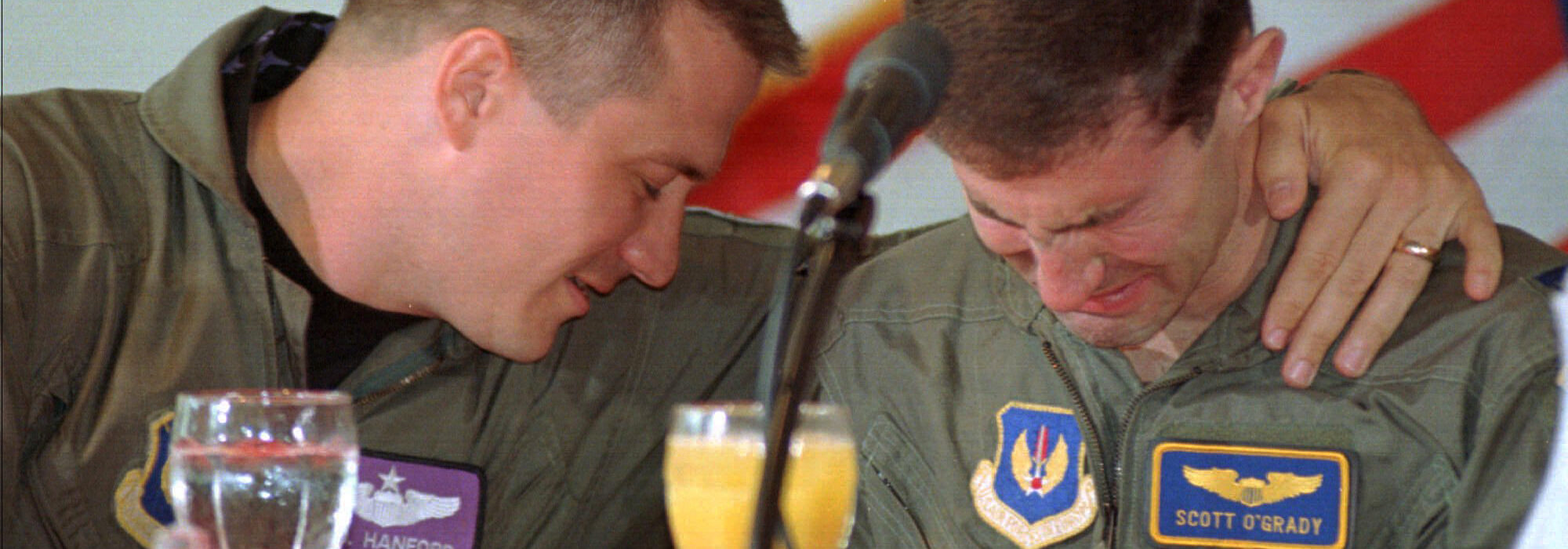
The first Friday of the month was usually a welcome break for the pilots of the 510th and 555th Fighter Squadrons, both part of the 31st Fighter Wing at Aviano Air Base in northern Italy. The pilots and families would gather, share food and stories at a cookout, enjoying the unique, reinforcing camaraderie of the wing.
But Friday, June 2, 1995, was no typical first Friday: Earlier that day, during Operation Deny Flight, a UN peacekeeping mission over Bosnia, Serbian forces had shot down an American F-16 piloted by Capt. Scott O’Grady. No one was sure if O’Grady had survived.
Capt. Thomas “T.O.” Hanford headed to the monthly cookout unaware of what had happened. He was among the most experienced fighter pilots in the wing, a graduate of the U.S. Air Force Fighter Weapons School, and the wing’s tactical expert on air combat and weapons employment. Hanford counted O’Grady as a friend, and when he learned what happened, he was crushed.
Hanford had lost other friends to training accidents, but this was a combat loss, and the fate of his friend was undetermined. With all that at play, the cookout was canceled and the families headed home to commiserate. There was nothing else they could do.
THE SHOOTDOWN
Early the next day, Hanford sought Capt. Robert ‘‘Wilbur’’ Wright, the flight lead on the prior day’s mission. Wright related the mission, its location, the aerial refueling, the less-lethal SAM radars they registered looking at them periodically. None of that was unusual.
O’Grady and Wright were flying in a spread formation about 1.5 miles abreast when O’Grady called out indications of an SA-6 missile site. Wright immediately saw the SAM, flying up between their formation, closely followed by a second missile, which flew straight into the belly of O’Grady’s jet.
There was no time to react. Wright saw the impact and the explosion that followed, watched the two enflamed halves of O’Grady’s jet separate and begin to tumble down into the clouds below. What he didn’t see was a parachute.
Around the unit, there was talk of a memorial service, but it was not clear what had happened, and plans were set aside.
By Monday, there was new information: BBC Television aired footage of the crash site filmed by local news crews. This was evidence, and intelligence analysts and the Aviano pilots studied the images frame by frame, searching for clues. The wreckage was catastrophic, but details were scant nonetheless. No conclusion could be drawn on O’Grady’s fate.
ALIVE!
Unknown to the Americans, O’Grady had managed to eject, and now he was desperately trying to survive. Unlike his fellow countrymen, Serbian forces had seen his parachute coming down—and they had raced to locate him. But the Serbs had been no more successful in doing so.
Having seen a Serbian vehicle tracking his descent as he floated down to Earth, O’Grady landed in hostile territory near the town of Mrkonjic Grad in western Bosnia. For five days, he concealed himself in mud and vegetation, surviving on insects and rainwater. He had with him a small survival radio, but used it sparingly for fear it might betray his location to the enemy. He transmitted only brief signals at intervals.
NATO aircraft flying overhead did detect occasional faint emergency beacon signals, but they were inconsistent and weak, and far from the location where they believed he might be. Some analysts worried Serbian forces were broadcasting false signals in hopes they could lure rescue aircraft into missile traps.
In fact, the radio’s short range and the mountainous terrain hindered clear transmissions. U.S. forces, concerned about Serbia’s clearly capable mobile missile threat, kept search flights over the Adriatic Sea to guard against further shootdowns.
NOT LETTING GO
On the evening of Wed., June 7, the fifth day after the shootdown, Hanford was preparing for a Deny Flight mission, a routine combat air patrol (CAP) mission, this time over the Adriatic Sea instead of over land due to concerns about surface-to-air missile threats like the one that had shot down O’Grady.
Hanford remained bothered by the lack of information on O’Grady’s status. If O’Grady had been captured or even found dead, he figured, the Serbs would have paraded him or his body in front of the cameras, seeking political leverage. But since he remained missing, Basher 52—O’Grady’s call sign from the June 2 mission—might very well be on the run.
Before departing that evening, Hanford checked his survival radio frequency, discovering that the frequency programmed into O’Grady’s survival radio the day he was shot down was not the same. Frequencies were changed routinely as a security procedure, and while rescue forces were sure to have had the correct frequency, pilots flying CAP did not.
Hanford sent his wingman, 1st Lt. Clark “Griz” Highstreet, to retrieve O’Grady’s frequency from the squadron vault; he wanted to have it with him when he was flying that night, along with the eight-digit secret word of the day that O’Grady had flown with. Armed with that information, the two pilots set out on their Deny Flight mission.
Hanford’s call sign that night was BASHER 11.
LAST CHANCE
Hanford and Griz took off in their F-16s and began their mission over the Adriatic, flying a routine Deny Flight CAP mission controlled by a NATO Airborne Early Warning and Control (AWACS) aircraft using the call sign “MAGIC.”
Before O’Grady’s shootdown, the CAP positions had been inland over Bosnia and Croatia, but after his loss, the CAPs were moved westward over the Adriatic. This kept the aircraft out of the SA-6 threat ring but also put them farther from O’Grady’s position on the ground and hindered O’Grady’s ability to communicate with his survival radio due to its limited line-of-sight range. After about 45 minutes of patrol, they took a brief break to air refuel and returned to their assigned CAP position over the Adriatic.
After refueling, Hanford checked in with MAGIC.
“BASHER 11, you are cleared to RTB,” the AWACS crew said, short for “return to base.”
Hanford declined. “BASHER 11 will remain on station until our replacements arrive,” he said. Now MAGIC replied: “There are no replacements.” NATO was closing the mission for the night.
“BASHER 11, you are cleared to RTB.”
It was now about 1:15 in the morning. With a full load of fuel, Hanford was surprised and upset that NATO was abandoning their 24-hour air presence. Turning north toward Aviano, as directed, Hanford had a nagging feeling his friend was out there, fighting for his life. So he turned back south to the CAP area.
NATO might have given up on finding O’Grady, but Hanford would not. Back on the radio, Hanford advised MAGIC he wanted “15 minutes of play time.”
Knowing radio waves travel farther at night due to lack of interference from solar radiation, Hanford thought there would be no better time to listen for O’Grady’s low-powered radio signal. He tuned in to O’Grady’s search and rescue frequency and turned off the squelch, increasing static noise but also the chance for a weak broadcast to come through.
With Griz Highstreet holding on MAGIC’s frequency and keeping an open mic back to Hanford on their intra-flight channel, Hanford shut off MAGIC and began making radio calls on the rescue frequency, “This is BASHER 11 looking for BASHER 52 on Alpha,” he said, and then listened for a response. He repeated the process every 30 to 45 seconds.
Now it was 0130 local time, and MAGIC was again itching to call it a night. When Griz transmitted on the inter-flight radio “BASHER 11, MAGIC wants to know if we’re ready to RTB,” Hanford said no.
“Tell MAGIC we have another 15 minutes of play time.”
Hanford resumed his radio calls, repeating himself every 30 to 45 seconds: “This is BASHER 11, looking for BASHER 52 on Alpha.” He was not about to abandon his search while he still had fuel to burn.
At 0145, MAGIC again urged Hanford to RTB. Hanford again called for another 15 minutes.
At around 0200, Hanford began noticing something—a pattern in the radio static that seemed to change slightly after he made his transmissions, as if someone were trying to answer him. He closed his eyes and tried to listen. “What is that noise?” he asked himself.
Now Griz came on the radio for the fourth time, “MAGIC wants to know if we are ready to RTB.” Frustrated as the distraction broke his concentration, Hanford switched over to MAGIC’s frequency: “MAGIC, this is BASHER 11. I will tell you when we are ready to RTB.” Then he adjusted his course toward the Croatian coastline.
BREAKING THE RULES
Approaching land, the signal Hanford sensed seemed to grow stronger, but getting closer still would violate orders. NATO aircraft were not to enter Croatian airspace. MAGIC warned Hanford they were over restricted territory and ordered him and Griz to turn back.
Hanford began a turn back, then abruptly reversed back toward restricted airspace. The pattern he detected in the faint responses to his broadcasts could not be ignored. “The mission to find O’Grady was more important than any risks from Serbian anti-aircraft activity,” Hanford would later recall.
At 0207, time was running out. The audible voice warning in Hanford’s F-16 announced “BINGO, BINGO,” meaning his fuel was low and he had to return to base. But simultaneously, through the static, Hanford heard what sounded like a very tired human voice. Hanford keyed his microphone: “This is BASHER 11. Say your call sign.”
For a moment, there was silence. Then the voice returned, weak but unmistakable: “BASHER 52 … this is BASHER 52.”
Hanford estimated he was 85 miles away from the area of the shoot-down when he received the broadcast,which was near the upper limits of the line-of-sight broadcast range of the PRC-112 survival radio O’Grady was using.
But Hanford was skeptical nonetheless. The words were clear, but he didn’t recognize O’Grady’s voice.
“Understand, you are BASHER 52?”
“Roger that. This is BASHER 52. I’m alive!”
Hanford wanted an extra level of confirmation to be sure he wasn’t being played. Knowing that, years earlier, O’Grady had been assigned to Kunsan Air Base, Korea, with the 80th Fighter Squadron, also known as the Juvats, Hanford fished for an answer no Serb would know: “What was your squadron in Korea?”
O’Grady responded immediately: “JUVATS, JUVATS … I’M ALIVE!”
Hanford had all the confirmation he needed. Trying to mask his emotions, he excitedly replied, “COPY THAT, YOU’RE ALIVE. GREAT TO HEAR YOUR VOICE!”
BASHER 52, missing in action for five days, was alive!
HOLDING THE LINE
O’Grady transmitted a series of letters that Hanford wrote down on his kneeboard. Hanford understood this would be a code, but he couldn’t figure out how it was encrypted. He told O’Grady to lie low and conserve his batteries and departed the area to refuel.
Hanford and Highstreet headed south, reporting to MAGIC on a secure frequency that he had made “positive radio contact with BASHER 52.”
“Say again?” MAGIC responded.
Hanford repeated his radio call, and MAGIC agreed to vector a tanker north so BASHER 11 could refuel. It was now 0220, Thurs., June 6.
Flying at 500 mph over a pitch-black Adriatic Sea toward the promised tanker, Hanford agonized over the encrypted message, holding a flashlight over the letters on his kneeboard, trying to decipher the message. What he didn’t know was that O’Grady and Flight Lead Wright had developed this cypher on their own, so it was up to Hanford to decipher it. After some trial and error, he turned the eight-letter word into numbers, realizing that O’Grady had revealed his coordinates. He was only a few miles from the crash site, in a wooded area near Mrkonjic Grad.
“THAT’S WHERE HE IS!” Hanford said to himself, poking a hole in his paper map with a pen to mark the location. Hanford passed the coordinates to MAGIC via a separate secure frequency.
After refueling, Hanford and Highstreet continued to relay information between O’Grady and MAGIC. Rescue forces were being assembled, he was told, but there was not much he could relay to O’Grady other than telling him to “lie low, turn his radio off, and check back in on 15-minute intervals.”
The sun would be coming up soon, and Serbian search teams again would be moving through the area. Hanford worried his radio communications might have alerted the Serbs.
Now MAGIC had a message, telling Hanford to “ask BASHER 52 his condition and tell him the word ‘mañana’,” which Hanford interpreted as notification that the rescue would take place tomorrow. (Hanford later recalled the incident with irony, noting, “It’s a secure code word because obviously the Serbs don’t speak Spanish.”)
“BASHER 52, what is your condition?” Hanford asked O’Grady.
“I’m OK, I’m OK.”
“BASHER 52, they want me to pass you the word, ‘mañana.’”
“NEGATIVE, I need to get out tonight!” O’Grady responded.
With no more to go on than gut, Hanford told O’Grady, “Hang in there and turn off your radio for another 30 minutes.” Then he radioed MAGIC.
“MAGIC, where are the rescue forces?”
“They’re waking up the generals now,” came the response.
Time ticked by slowly. After about 40 minutes, Hanford again returned to the tanker, the fourth time he would refuel. O’Grady’s voice conveyed disappointment.
“Understand they are going to get me tomorrow?”
Organizing a rescue in hostile territory is not an instant endeavor. All across Italy and the region, units were being alerted and directed: Close air support, electronic countermeasures, Suppression of Enemy Air Defense (SEAD)—all in addition to rescue crews. O’Grady would learn later that some A-10 pilots arrived at their planes before their crew chiefs, forcing them to start their aircraft without their ground crews.
Hanford did his best to keep O’Grady calm.
“The whole world is behind you!” Hanford said. “We’re going to get you out! Now just turn your radio off, save your batteries, and I’ll be back in 30 minutes.”
The sun was coming up over the horizon when Hanford checked in with MAGIC next.
“The rescue forces are airborne,” MAGIC said.
Now, at last, Hanford had good news to report. Switching to O’Grady’s frequency, he called, “BASHER 52, are you up?”
Yes.
“They’re coming to get you!”
Now Hanford had to get O’Grady ready for rescue. “If you’re on a mountain, get to flat ground and look for a good landing spot for a helicopter,” he told him. “Have your signaling devices ready and turn off your radio for another 15 minutes.”
THE RESCUE
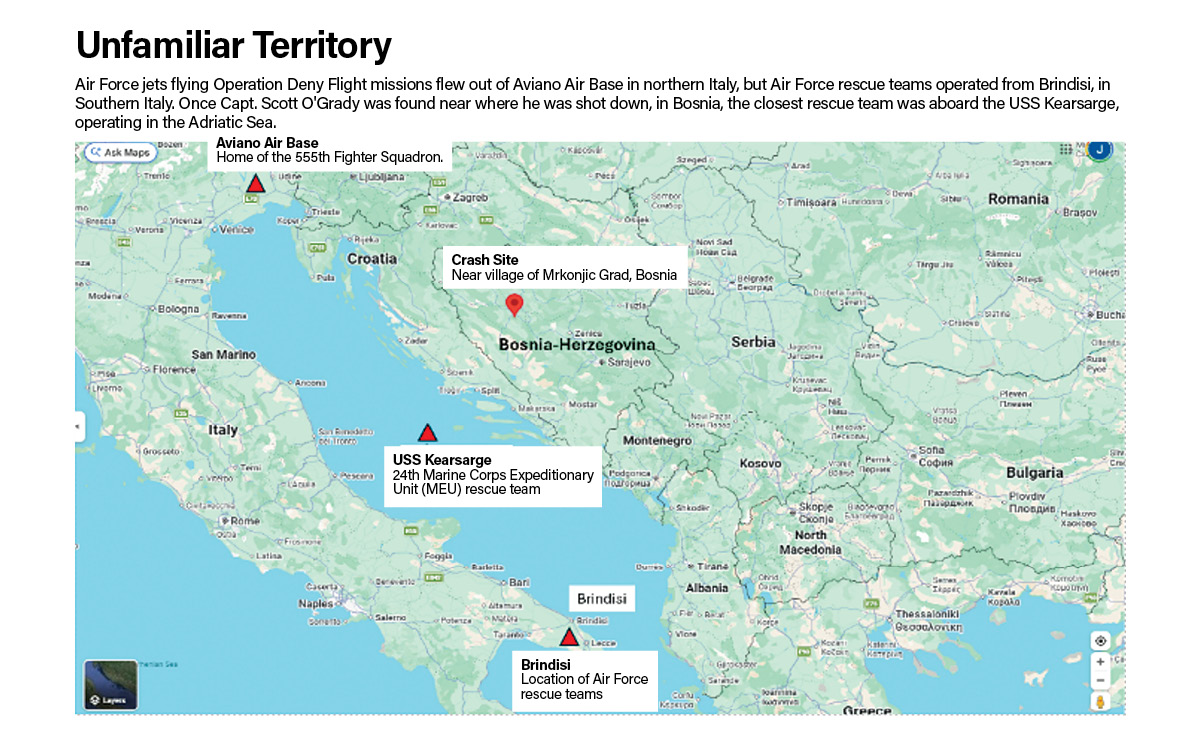
The Air Force rescue assets operating under NATO Command were headquartered at Brindisi, Italy, far down the Adriatic Coast in the “heel” of the boot of Italy. They were part of a Joint Special Operations Task Force (JSOTF) and flew MH-53 Super Jolly Green Giants, crewed by four aircrew (two pilots and two gunners), with a complement of two pararescuemen (PJs), a combat controller, and five shooters, either Army Special Forces or Navy SEALs.
But other forces were closer. The 24th Marine Corps Expeditionary Unit (MEU) Tactical Recovery of Air Personnel (TRAP) team was deployed on the USS Kearsarge, LHD-3, which had taken up a position off the Croatian coast earlier in the week. The Kearsarge had moved there to support a possible recovery operation and as a contingency in the event any additional aircraft went missing. The MEU, having been monitoring the developing situation through the night, had begun preparing for a possible tasking and the TRAP team was trained for just such a mission. Although a daylight mission would entail greater risk, the Marines were ready, capable, and closer than NATO forces in Brindisi.
Two giant CH-53E Super Sea Stallion helicopters carrying a platoon of Marine mortarmen turned rescuers launched from the Kearsarge, speeding toward Bosnia, escorted by two AH-1 Cobra gunships and four AV-8B Harrier attack aircraft.
Joining them in what was becoming cramped airspace were Air Force tankers, fighters, and surveillance platforms coordinating the operation.
Hanford, running low on fuel again, requested another tanker and was directed to a Navy refueler. But that plane was not equipped to refuel his F-16, and when Hanford asked MAGIC for another tanker, he was refused.
“The general says he knows he is your bud, but you have to go home!” Magic said. Hanford and Highstreet finally returned to base, landing at Aviano around 0700. Still in their flight gear, the two tired pilots crowded around the squadron’s operations desk with dozens of their squadron mates, where the 31st Wing commander was monitoring the rescue mission radio broadcasts and sharing play-by-play with the assembled pilots.
The Marines flew directly into hostile territory to O’Grady’s position, which Hanford had correctly deciphered. Within minutes after landing, the Marines had O’Grady aboard, and began the race back to Kearsarge. Serb forces had engaged, with fire from small arms, anti-aircraft guns, and shoulder-launched missiles. Three of four helicopters were hit.
NATO rules of engagement didn’t help. The Marines had to egress along the same corridor they had taken in, a predictable route that made it easier to target them. But all successfully evaded the worst of the fire and they returned safely to the ship at sea.
Back at Aviano, the tension increased as the wing awaited word of O’Grady’s fate. Finally, the commander broke the silence: “They got him on the boat!”
Chaos erupted. Grown men yelled and hugged, emotions raw enough that some fought back tears.
THE AFTERMATH
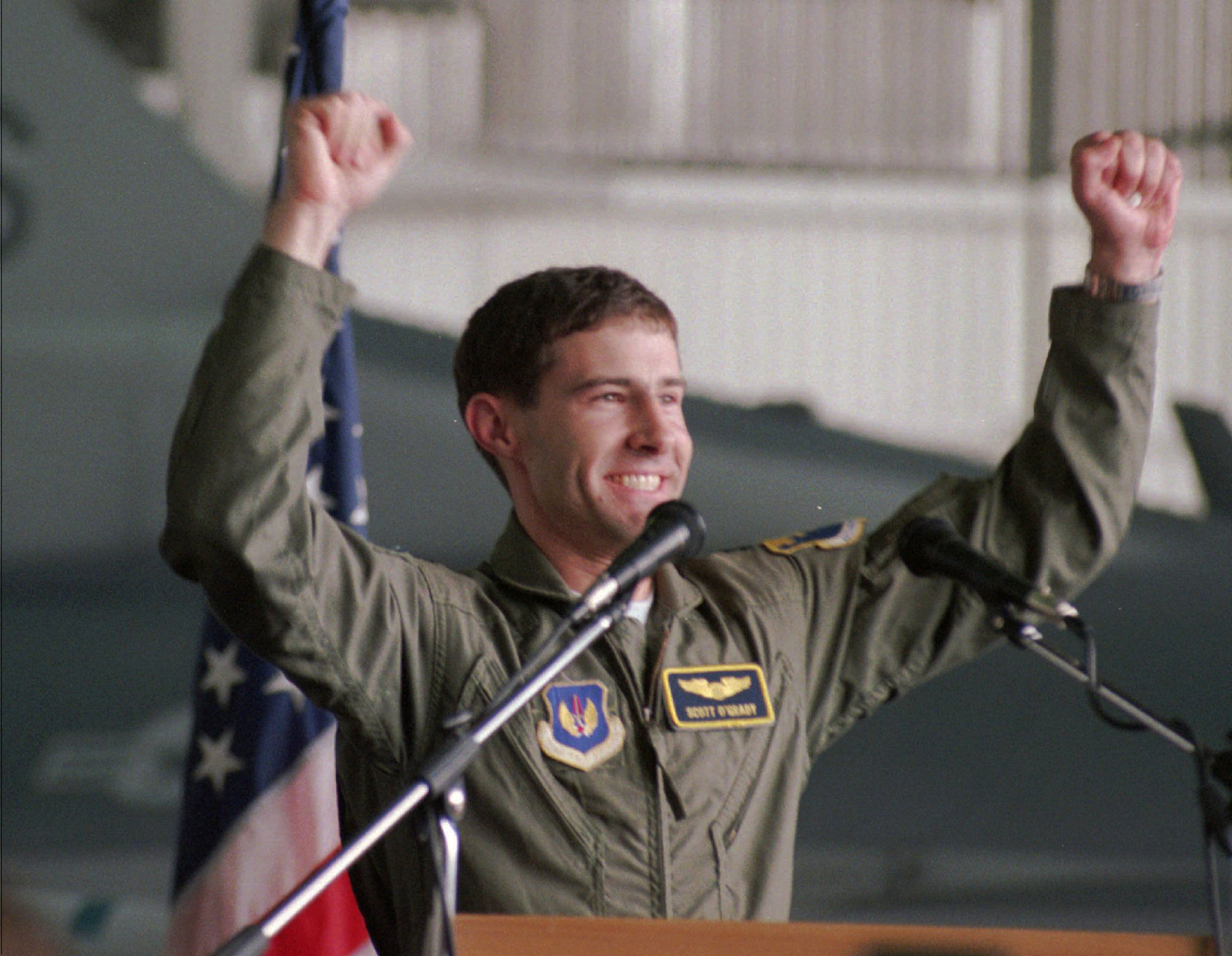
Aboard USS Kearsarge, O’Grady received medical treatment for burns, dehydration, and exhaustion. He was instantly a national sensation.
At the White House, President Bill Clinton awarded O’Grady a Bronze Star for Valor for successfully evading capture and a Purple Heart for his injuries.
Hanford, meanwhile, received an Aerial Achievement Medal—his second—for his singular role in finding and locating O’Grady. In 1996, he was inducted into the Aviation Week and Space Technology Laureate Hall of Fame at the Smithsonian Institution’s National Air and Space Museum in Washington, D.C., for his involvement in O’Grady’s rescue.
Eight years later, during the first three weeks of Operation Iraqi Freedom, Hanford earned two Distinguished Flying Crosses for valor, including one for saving the lives of 15
Special Forces Soldiers who were pinned down by enemy fire. He retired from the Air Force in 2006 after 20 years in uniform, and remains part of the F-16 community today, as an instructor for new F-16 pilots at Holloman Air Force Base, N.M.
What he learned that June night over Bosnia underpins the warrior philosophy he tries to pass on to the aspiring F-16 pilots he teaches.
“Preparation matters —initiative matters—loyalty knows no distance, and duty has no time limits,” Hanford says. “Despite risks, the mission is paramount. Sometimes the difference between failure and success comes down to one person refusing to give up, despite personal risks.”
When speaking to young Airmen, Hanford likes to paraphrase Winston Churchill: “Maybe once in your life, someone will tap you on the shoulder and ask you to do something great,” he says. “Wouldn’t it be a shame if you were not prepared?”
To this day, O’Grady credits Hanford’s singular determination with saving his life. The two remain close friends three decades later.