
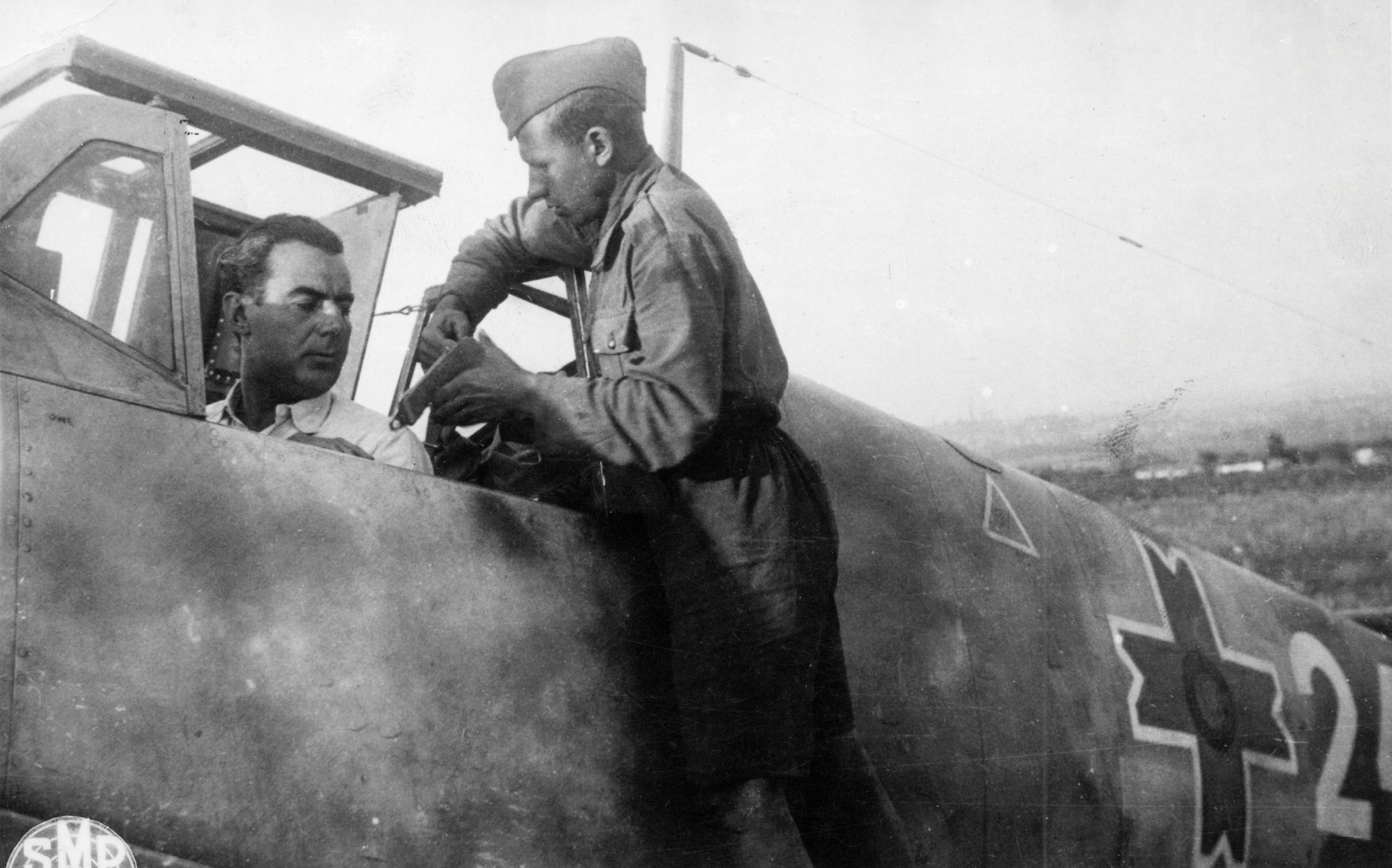
Having lost territory to Stalin in 1940, then sided with Hitler to win it back, Romania landed itself on the wrong side of World War II. For fighting men like Lt. Constantin “Bâzu” (“Buzz”) Cantacuzino, there was seemingly little choice but to serve to the bitter end.
An ace with thirty aerial victories, Buzz was no ordinary aviator. He was a prince, a descendant of one of Romania’s oldest aristocratic families.
Buzz seemed born for adventure.
Dashing, fearless, and larger than life, at 38 he was already a national hockey champion and an internationally renowned aerobatic pilot. Before the war, he had made headlines when he reported for duty in Romania’s reserves and became a fighter pilot.
By war’s end, he would be Romania’s top ace, his extraordinary journey having pitted him against not one enemy but three: the Soviets, the Americans, and the Germans.
Yet one of the most revealing moments of his career came high above Romania on June 6, 1944, when an American P-51 Mustang filled his gunsight…
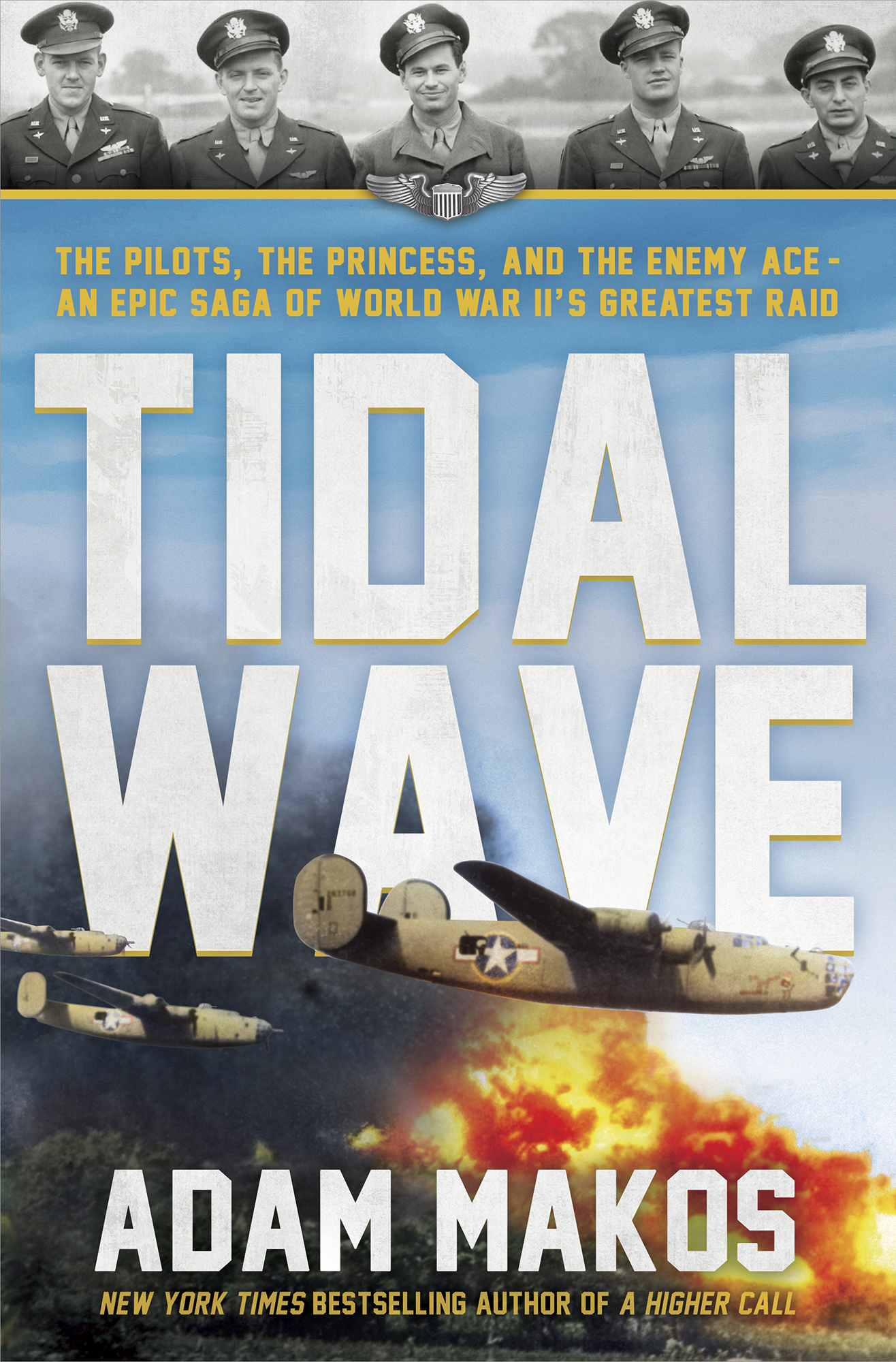
The following is excerpted from “Tidal Wave” by Adam Makos.
The Sportsmen
June 6, 1944
Eastern Romania
The skies were bright and cold at 19,000 feet as the squadron of Romanian fighter planes climbed toward the American bombers. It was about 10 a.m. Buzz peered through the bulletproof windscreen, his goggle-covered eyes locked on a distant target. His oxygen mask made his breath sound raspy. Crisp frost clung to the canopy glass, refracting the sunlight in a dazzling glare. He wore his black leather jacket and a fabric helmet against the bitter temperature.
Around Buzz and his wingman, a dozen Romanian Me-109s flew upward in tight formation. The prince was flying in the 9th Fighter Group now, an outfit formed from the best of the nation’s remaining pilots and known as “the spearhead” of the air force. Buzz and around 30 other aces had been drawn together into one group in a final attempt to stave off the
nation’s slow, inevitable defeat.
The silver bombers, about a hundred in all, were still 4,000 feet above, flying away from the Romanians. Their contrails raked a white path across the sky, leading the eye straight to them. They were B-17s, the Liberator’s more rugged cousin, streamlined, with a single tail and a reputation for taking punishment.
And this was only a fraction of the American fleet in the air. On the same day the Allies were storming the beaches of
Normandy, the 15th Air Force was unleashing its own invasion on Romania. Five bomber streams—B-17s and B-24s, nearly 500 planes in all—were making an all-out blitz, sending a message to Antonescu: Your days are numbered.
Buzz spotted something between him and the bombers. Tiny glimmers, a series of silver specks sparkling like tinsel, drifted in a downward slope in his direction.
Escort Fighters
“Motociclisti!” a Romanian pilot called. Motociclisti—motorcyclists—was their code word for American escort fighters.
The glimmers were larger now, and beginning to look like airplanes. Buzz estimated as many as 30 enemy escort fighters were roaring down toward him and his comrades. Bold and fearless, the unpainted, bare aluminum planes made no attempt at camouflage. If Buzz could have heard the American radio channel, he would have heard a voice coursing through the airwaves: “Burglar to Ripple 2, we’re engaging enemy aircraft.” The two formations were on a collision course.
Buzz’s breathing quickened and he nudged the power forward. His fighter’s Daimler-Benz motor surged. Buzz lowered his chin and held his climb. The lift was effortless—once again the ’109 climbed “like an elevator.” The Romanians’ only hope was to hold formation and stay the course. Maybe, just maybe, they could joust through the American escorts and reach the bombers before the fighters peeled back around for another go.
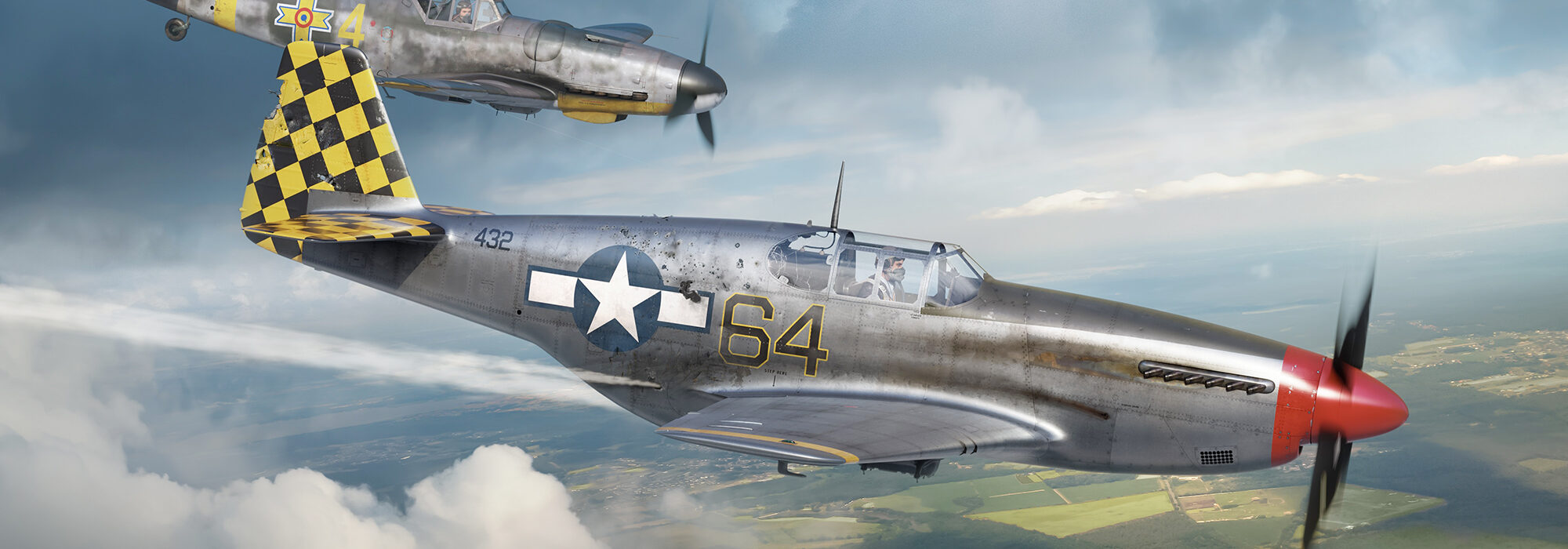
Four-plane flights of Americans came at him. Their combined closing speed topped 700 miles per hour. Guns blazed. Silver fighters ripped past Buzz, wave after wave, as Axis and Allied fighters clashed at more than 20 thousand feet above the Earth. Buzz tracked them over his shoulders as they went by, each a silver streak smeared in brash warpaint, red noses and black-and-yellow checkerboard tails. He’d never seen such colorful planes. Spotting their distinctive belly scoops, Buzz realized what kind of escorts these were: P-51 Mustangs. No wonder they weren’t camouflaged. This was the machine with nothing to hide from.
There’d be no pursuing the bombers now. Romanian ’109s peeled off in every direction, “forced to engage” the escorts. A massive dogfight began. Buzz broke from his climb to join the fight. Mustangs filled the sky wherever he looked, slicing this way and that, crisscrossing. Faster, more maneuverable, two Mustangs chased every Romanian fighter. Every gun on their wings fired. The Mustangs of the 325th Fighter Group, the “Checkertail Clan,” were out for blood and Buzz’s earphones were alive with calls from one Romanian to another, pilots urging, “Check your tail!”
Taking evasive action, Buzz racked his fighter one way, then another, always looking for a target while trying not to become one. His Messer groaned under heavy Gs. In the violent maneuvering, Buzz lost track of his wingman. His Revi gunsight flickered, then died—of all the times! Any unit cohesion was gone. The small Romanian force was outnumbered by more than 2-to-1, and this wasn’t even taking account of all the Mustangs in the dogfight. The Americans had so many planes that a dozen Mustangs remained over the bombers as top cover.
The Romanians couldn’t win. More than one pilot sensed it now. Buzz saw other Me-109s running for their lives. To stay was suicide. As one Romanian put it: “We were compelled to disengage.” It was every man for himself.
Buzz turned to the tactic he used whenever he was cornered. He racked the stick sidelong, threw the Messer on its back, and then dove. His plane plunged, its frame shuddering under the pressure. Buzz knifed through the sky at a ferocious speed. The altimeter needle spun backward: Nineteen thousand feet. Eighteen thousand. Seventeen thousand. His fighter groaned, the controls turned heavy. At 466 miles per hour, his airspeed indicator crossed the red line. But Buzz knew there was more to give. 480. 490. The aircraft screamed in protest. It was no comfort knowing that each wing was held on by large bolts, a Messerschmitt design feature. Somewhere around 530, the plane would come apart.
Reaching his limit, Buzz pulled back on the stick. The Messer trembled violently, then began to level out around 16 thousand feet, about 4,000 feet below the mêlée. He gave his gunsight a slap, hoping to bring it back to life. No luck. A roar of engines shattered Buzz’s respite. A quick glance around told him everything. Messerschmitts and Mustangs were cutting through the sky around him. The dogfight was spiraling downward. He broke hard, trying to latch on to a Mustang, anything to throw off their pursuit of a comrade. But before he could line up a shot, orange tracer bullets slanted down from above, slicing past his canopy. He glanced over his shoulder, above and behind. More Mustangs, guns blazing. They dove, targeting him with dogged persistence. Their pilots’ fearlessness and apparent bloodlust concerned him.
This was just not his day.
Buzz peeled over into another dive. He spotted a wide patch of cumulus clouds at 6,500 feet and steered toward them. Again, the altimeter needle spun backward as the Messer threatened to shake itself apart. He punched through the cloud layer and emerged into a hot, hazy summer morning. As he leveled off at 6,000 feet, the cockpit became thick with heat, steamy air from outside. Buzz tore off his oxygen mask. He saw fields stretching in every direction, plus some roads and villages. The clouds above his head hid his whereabouts for now.
It was discouraging to think how quickly his squadron had been overwhelmed. They hadn’t even been able to put up much of a fight.
Then he saw it: a lone Mustang, off to the side and a little ahead. A glint of bare metal gave it away. The pilot hadn’t seen him yet. He looked lost.
Buzz’s eyes locked on the threat. His instincts, carefully honed since 1941, kicked in, and he broke violently in the Mustang’s direction. There was only one rule that mattered: Shoot him before he shoots you.
Buzz went in for the kill.
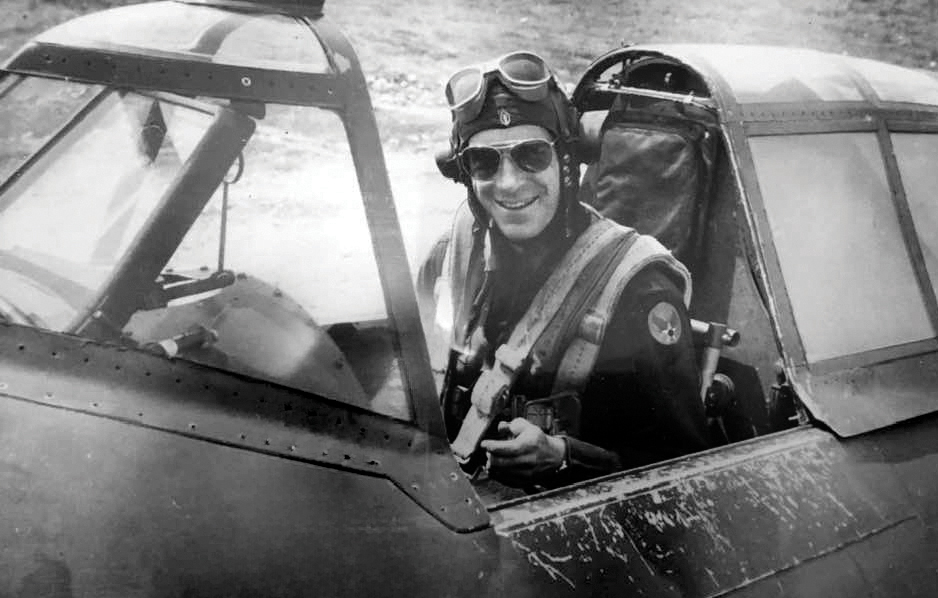
At the controls of the Mustang was a man Buzz would have had something in common with. First Lieutenant Donald “Mac” MacDonald, 24, was a sportsman too. His narrow face, brown hair, and blue eyes matched his lanky frame, all arms and legs, perfect for his life back home. In Wayzata, an upscale suburb of Minneapolis, MacDonald had been the tennis pro at Woodhill Country Club, teaching lessons to kids, seniors, and everyone in between. His picture hung on the wall there, his personality captured in a wide grin.
A veteran pilot with 45 missions under his belt, MacDonald wasn’t smiling now. He leaned side to side in his cockpit, scanning the skies above and below. He had been separated from his wingman, Second Lieutenant John Mumford, 22, of St. Petersburg, Fla. They had chased two Me-109s in a spiraling dogfight, and MacDonald had shot one down. But something had happened to Mumford. The last time MacDonald saw him, he was diving into the clouds at a steep angle. Maybe his radio had gone out, maybe his wounded plane was limping around somewhere, or maybe, God forbid, smoke was already rising from a crash site.
MacDonald was so focused on searching for his wingman that he didn’t notice the gray shadow slipping in behind him. Another sportsman, but this one played for the opposing team. MacDonald glanced over his shoulder. It was like seeing a ghost.
Buzz had the Mustang right where he wanted him. As he closed the gap, his Messer bucked in the wake of the enemy fighter, jolted by turbulence. He had him dead to rights.
Stalking from the tail like a predator, Buzz got a closer look at the P-51. He knew the shape by now, the long, streamlined nose, narrow tail, and muscular fuselage perched atop sharp, square wings built for speed. A machine of deceptive beauty, the Mustang was crafted for one purpose: to destroy other airplanes.
Buzz’s gunsight was dark, only a blank pane of glass where an illuminated aiming circle and cross hairs should be. He would need to fire by feel. He aimed the nose at the Mustang’s vitals, the belly scoop beneath the cockpit, where the radiator sucked in air to feed its powerful speed. With his thumb, Buzz pressed the trigger.
The cannon in the nose hammered and belched flame. Brass shell casings poured down in a rain of spent ammunition. Fragments of metal skin flew off the Mustang and flung themselves back in a slipstream. Buzz’s 20 mm shells found their mark. The belly scoop ruptured, and the Mustang’s coolant system vented a hissing white cloud. It was a mortal blow to a liquid-cooled engine. The engine would soon overheat, and the machine would seize up.
About this Book
Operation Tidal Wave—the daring Aug. 1, 1943, low-level strike against Hitler’s oil refineries at Ploesti is often seen as a disaster. Flying B-24s from Libya to Romania, the U.S. lost 53 bombers and some 500 Airmen on the mission, making it among the most costly operations of World War II in Europe.
Adam Makos’ vivid new history, “Tidal Wave: The Pilots, the Princess, and the Enemy Ace–A True Story of Courage and Survival in WWII,” tells the story of Lt. Ernie Poulson, a B-24 copilot shot down behind enemy lines; Princess Catherine Caradja, who risked her life to protect captured American fliers; King Michael I, the young monarch secretly plotting to free his nation from Nazi control; and Prince Constantin Cantacuzino, Romania’s leading fighter ace.
Drawing on years of research, diaries, letters, and family archives, Tidal Wave reveals a forgotten chapter of World War II.
The American was going down.
Inside the P-51, MacDonald shook off the shock of being hit, forcing himself to focus on survival. A 20 mm shell exploded behind his armored seatback. Fragments and the force of the blast punched forward, grazing his head and knee. He had been lightly wounded. His plane was not so lucky.
One glance at his instruments told him everything. Temperature was rising fast. His engine was melting into a solid block. He had to jump.
MacDonald pulled the emergency canopy release on the right side of the cockpit. Nothing. He yanked it again. Still nothing. Frantic, he tried the manual hand crank, hoping for the best, but the canopy was jammed shut by enemy shellfire.
He was trapped.
The Messerschmitt loomed behind him. There was nothing to do now but tuck into his shoulders, pray, and wait for the death blow.
Buzz held his thumb over the trigger of the 20 mm cannon. One pound of pressure, one more burst, and the Mustang would be finished. He could shear off a wing, send it tumbling in a helpless spiral, or walk the shells into the fuel tank for a fiery explosion.
But why?
This fight was over. His opponent was clearly defeated. Buzz lifted his finger from the trigger, letting the moment settle. Now that the other pilot could no longer hurt him, he saw the plane in a different light. Up close, it was beautiful. The red nose, the checkerboard tail—it looked more like a race car than a fighter plane. And it was fresh from the factory, barely worn in. The 325th had taken their Mustangs into combat just the week before. Buzz couldn’t help but admire it. The undisputed hot rod of the skies.
What Would It Be Like to Fly That Machine?
A realization hit him. They were about 60 miles behind the front lines. If the American pilot didn’t bail out, that Mustang was coming down in Romanian territory. Could this be true? He had a chance to capture the American wonder weapon. Not to study it—what would that accomplish at this stage in the war? Buzz wanted to fly it. His mind worked fast. They could fix it, like the B-24 they’d patched up, and bring it back to the air. If he could get behind the controls of a Mustang and take it up for a spin, just once, it would be a career-defining move for a man who loved airplanes more than almost anything else.
Buzz slipped out from behind the tail and edged forward, almost parallel with the Mustang. Staying behind the wing, he flew with it “as if providing cover” from anyone who’d think to harm it.
Don’t jump! he urged the Mustang pilot. That would ruin everything.
The American pilot lowered his nose toward the ground: He was bringing the plane in. Three thousand feet. Two thousand. One thousand. The two planes descended in tandem. The Mustang pilot steered for a freshly plowed field. Buzz was delighted. There was no softer place to land wheels-up.
But at 500 feet, the Mustang’s propeller suddenly came to a stop. The engine seized. All four blades froze. At any moment, the P-51 would lose speed, stop flying, and fall like a rock.
Put her down! Buzz urged.
The American had no choice. Quickly he forced the plane down. The Mustang was still doing more than 200 miles per hour when it hit the soil. The plane skipped and wobbled, flew again, launched over a line of small trees, then bellied in and skidded to a quick stop. A good crash landing. Pilot and plane were intact.
Buzz banked around for a closer look. His relief turned to alarm. Smoke was rising from the Mustang. No, no, no! His prize was catching fire, and worse, the canopy was still shut. Smoke poured from every seam. Buzz was horror-struck. The plane was on fire and the pilot was still inside. Get out!
In the smoke-filled cockpit, MacDonald groggily lifted his head. Blood seeped from his forehead where he’d smacked against the gunsight. He coughed, then looked around. The plane was on fire. Heat rose from the floor and behind his seat. He struggled to unlatch his seatbelt, but the clip wouldn’t give. He tried to wrestle his way out, but the seatbelt held fast. He pulled and tugged, but the clip would not release.
Burning to death was every pilot’s worst fear.
Desperately, MacDonald reached down with both hands to where the seatbelt was secured to the seat. He pulled with his arms, pushed with his legs, and stood with all his might, tearing the seatbelt from its mountings. The engineers at North American Aviation would have been amazed. It was “actually an inhuman feat.”
MacDonald pried at the canopy with both hands until it gave way, and then his boots hit the soil. He staggered away from his burning plane, half walking, half limping toward the nearest tree line. He had made it about 75 yards into a field when a sound from the sky stopped him in his tracks: the smooth purr of a Daimler-Benz engine. The Messerschmitt that shot him down was circling back around, most likely positioning for a strafing run.
And he was the target.
MacDonald saw no sense in running. He’d only die more exhausted than he already was. There was nowhere to hide, not in the middle of a field. Everything he’d overcome—the jammed canopy, the crash landing, the seatbelt—had it all led to this? MacDonald turned to face death head on.
At the far end of the field, the Me-109 leveled its wings in his direction. As the plane bore down on him, the flickering disc of its props looked like a buzzsaw. Over the engine roar came the scream of fast-moving air over intakes. MacDonald saw the dark gray aircraft had yellow markings on its wings. Romanian. He braced himself.
Then, much to his surprise, the flaps dropped from the 109’s wings. The enemy pilot slowed, and the fighter’s right wing dipped in his direction. It was as if the Romanian was making an air-show pass for an audience of one.
As the ’109 flew past him, MacDonald looked up. The Romanian pilot looked down and made the simplest of human gestures.
He waved.
MacDonald was dumbstruck. Should he wave back? They didn’t give instructions for this in the officer’s manual.
The fighter flew past without firing. The sounds faded, and the plane entered a graceful left turn. Whoever he was, the pilot wasn’t out to kill him.
Now that MacDonald had been shaken from his stupor, his thoughts turned again to his survival. He was still behind enemy lines. He resumed running toward the distant patch of woods. But as the downed American crossed the field, the ’109 made several protective orbits overhead before it departed and flew west. When MacDonald reached the woods, he looked back and questioned what he’d just lived through.
They would never believe this at the Woodhill Country Club.
A short time later, a Fieseler Storch observation plane landed in the field near the smoldering P-51. The German-built plane with its high-set wings and long, spindly landing gear looked more like an insect than a flying machine, but it made easy work of the bumpy terrain. Already the local police chief, some gendarmes, and a few curious locals had gathered at the wreckage. The Mustang had burned to the ground in its center.
Out from the observation plane stepped Buzz, followed by the pilot, and a Romanian public relations officer with a camera. The locals were surprised. Romania’s fighter pilot prince himself, here?
Buzz looked around. Where was the American pilot?
The police chief said the American had last been seen moving east toward the Dniester River on the Romanian border, trying to reach the Russians.
Buzz was crestfallen. Didn’t he know being a Romanian prisoner was far better than being a German prisoner? That was why Buzz had hitched a ride back to the wreckage. There was no salvaging the Mustang, but Buzz hoped to meet the pilot, if only to talk. He’d always had an affinity for Americans, dating to before the war, back when he’d faced them on the ice, as the captain of the Romanian national hockey team.
At the 1931 World Ice Hockey Championships in the mountain resort town of Krynica, Poland, Romania suffered a brutal thrashing, 15–0, at the hands of the Americans.
When the final whistle blew and the teams skated toward their locker rooms, Buzz did not follow his teammates. Instead, the prince glided to the bench where the coaches were packing up and asked for the score sheet. On the back, he wrote a short note in English, then skated it over to the referee.
Inside the American locker room, the celebration was loud, boisterous, unfiltered. The referee entered, brushing ice from his jodhpurs, and handed the note to the American captain.
He read it aloud.
The laughter ebbed. A strange silence settled over the room as the players absorbed the note’s deeper meaning. It offered neither surrender nor excuse for the defeat. Instead, it marked something higher, a gesture of true nobility.
“We thank you sincerely,” the prince had written, “for giving us the opportunity to learn something [from this game]—and to play with America.”
“Let’s get a photo!” The PR officer of the Military Propaganda Section had ridden along for this moment. Buzz approached the Mustang. He stood near the cowling and studied the melted cockpit. Smoke was still rising, and the metal was so hot he could only linger a moment.
Click.
Buzz stepped out of frame and stood alone, lamenting the loss of the Mustang and everything the war had come to stand for. The Romanian side had lost five planes that day, and destroyed two Mustangs. For what? They never even touched the bombers. To Buzz, all the violence felt foolish, immoral, and even criminal. Antonescu and his acolytes were intent on ushering Romania to its doom. They wanted to drag out the combat to the last day, hour, and man. And it was happening. The Royal Romanian Air Force was being ground down to nothing. When the Americans had first shown up over Bucharest on April 4, 1944, Romania had 115 fighters in service. By the end of the present month—June 1944—they would have fewer than 50, and this was not to mention the 33 pilots put in the ground. Romania was fighting to the bitter end, but for what? They soon wouldn’t have any pilots left. Buzz’s conscience couldn’t take it much longer.
Seeing the burned-out Mustang, Buzz wondered about the man who got away. The prince had always told himself he had no choice but to “fight who’s in front of me.” But being enemies was a choice. He’d never been a friend of the Axis powers, and he was certainly no friend of Antonescu and the fascists. They’d put his girlfriend, Nadia, and him through hell. Romania had joined forces with the Germans only as a survival tactic. At the time, it had seemed better than being flattened by the Soviets. But now, standing next to a smoldering P-51, fighting Americans, the unpleasant truth ate at him.
Romania was playing for the wrong team.
But what could one man possibly do about it?
Buzz’s encounter with MacDonald was only the beginning. Ahead lay a mission that would test the prince’s courage as never before, one in which the lives of more than 1,100 American Airmen would hang in the balance.
Discover the full story in the new book, “Tidal Wave,” available wherever books are sold.