
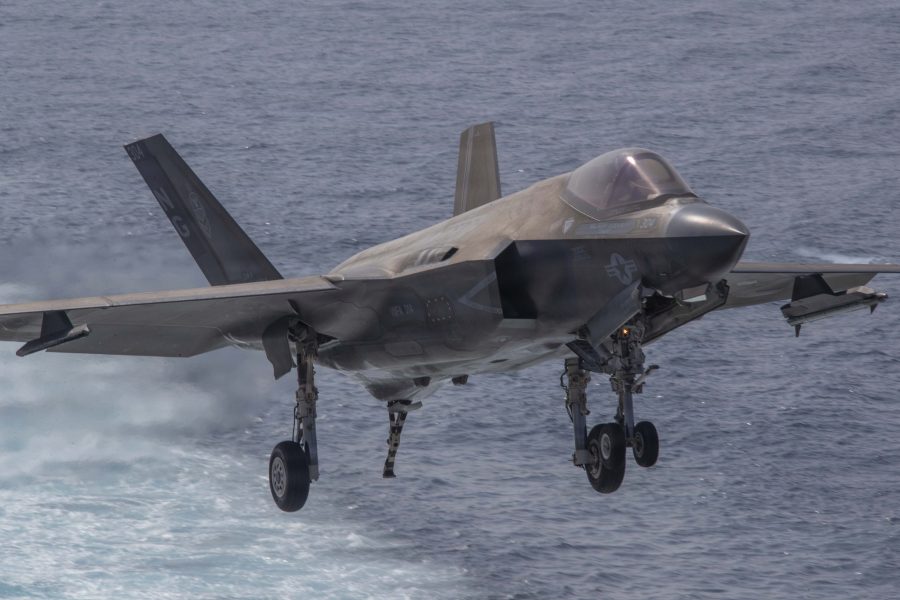
A U.S. F-35C shot down an Iranian drone operating near the USS Abraham Lincoln aircraft carrier Feb. 3 in a dramatic incident that American military officials cautioned could lead to conflict amid heightened tensions between Iran and the U.S.
The drone, a Shahed-139, “aggressively approached” the Lincoln with unclear intent,” U.S. Central Command spokesman Navy Capt. Tim Hawkins said.
The drone incident occurred just hours after a separate flare-up when a U.S.-flagged and -crewed tanker was threatened by Iranian forces in the Strait of Hormuz.
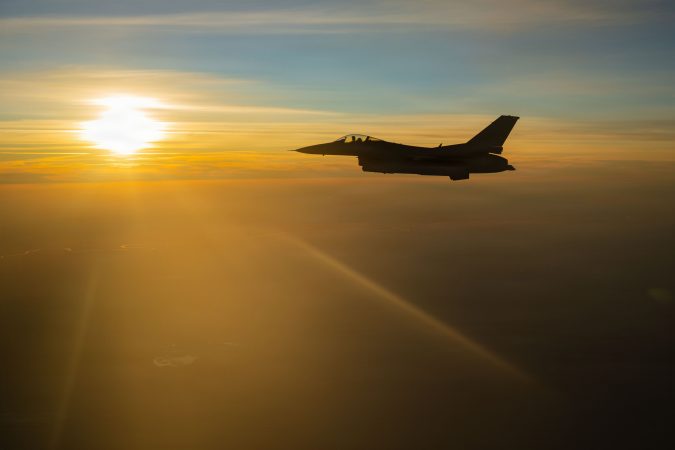
The Iranian threat to the tanker ceased when USS McFaul, a guided-missile destroyer operating in the area, responded to the scene and escorted the M/V Stena Imperative, assisted by air cover from two U.S. Air Force F-16s, a U.S. official told Air & Space Forces Magazine.
The Lincoln incident occurred later in the day; the carrier was transiting the Arabian Sea approximately 500 miles from Iran’s southern coast when an Iranian drone “unnecessarily maneuvered toward the ship,” Hawkins, the CENTCOM spokesman, said.
“The Iranian drone continued to fly toward the ship despite de-escalatory measures taken by U.S. forces operating in international waters,” Hawkins said.
An F-35C from the Lincoln then “shot down the Iranian drone in self-defense and to protect the aircraft carrier and personnel on board,” Hawkins added. The Lincoln is embarked with F-35Cs from Marine Fighter Attack Squadron (VMFA) 314, in addition to other warplanes.
A Shahed-139 is visually similar to an MQ-1 Predator and can be equipped with surveillance equipment. The drone involved in the Feb. 3 shootdown is believed to have been unarmed, and Iranian media reported that the aircraft was on a surveillance and reconnaissance mission. It is unclear whether the aircraft could have posed a threat to the Lincoln. CENTCOM cited the uncertainty of the drone’s mission as a reason for firing on the craft, as well as the failure of the aircraft to leave the area.
The drone incident was first reported by Reuters.
“Continued Iranian harassment and threats in international waters and airspace will not be tolerated,” Hawkins said. “Iran’s unnecessary aggression near U.S. forces, regional partners, and commercial vessels increases risks of collision, miscalculation, and regional destabilization.”
Tanker Incident
Two Iranian Revolutionary Guard Corps boats and an Iranian Mohajer drone approached M/V Stena Imperative at high speed and threatened to board and seize the tanker, U.S. officials said.
The U.S. account of events appeared to match a separate warning by UKMTO, a maritime warning organization affiliated with the U.K. Royal Navy.
On Feb. 3, a ship was hailed on the radio by “numerous small armed vessels,” UKMTO said in a statement, without identifying the nations involved. “The vessel has ignored the request to stop and has continued on its planned route.”
The moves come as the Trump administration is considering military action against Iran if a deal is not reached to end uranium enrichment and sharply curtail its nuclear program.
Trump considered striking Iran last month after weekslong anti-regime protests were met by a violent government crackdown. On Jan. 14, Trump assured protestors, “help is on the way,” but then opted to wait until more assets were assembled in the region. The U.S. sent an extra squadron of F-15E Strike Eagles to the Middle East. The Pentagon also dispatched the Lincoln to the region. The ship has an embarked carrier air wing and is accompanied by other warships in its carrier strike group.
More recently, Trump and other administration officials have focused less on the protesters, suggesting that the success or failure of potential talks to strictly limit Iran’s nuclear program will determine if U.S. force is used.
“Iran will not have nuclear weapons capability,” Secretary of Defense Pete Hegseth told reporters, including Air & Space Forces Magazine, during a visit to Florida on Feb. 2. “And so they can either negotiate on that front, or we have other options.”
“[Trump] doesn’t want to go that route, I don’t want to go that route, but our job is to be prepared, and so of course we are. We’re more than prepared,” Hegseth added, referring to military action. “President Trump’s committed to peace, committed to a deal if Iran’s serious about making a deal, and we’ll see. It’s up to Iran.”
The U.S. has not held formal talks with Iran since Operation Midnight Hammer in June, which consisted of strikes against three Iranian nuclear facilities carried out by B-2 bombers and submarine-launched cruise missiles. At that time, Trump said the U.S. had “obliterated” those facilities. Pentagon spokesman Sean Parnell provided a more qualified assessment in July, telling reporters that the U.S. strikes had “degraded their program by one to two years.”