
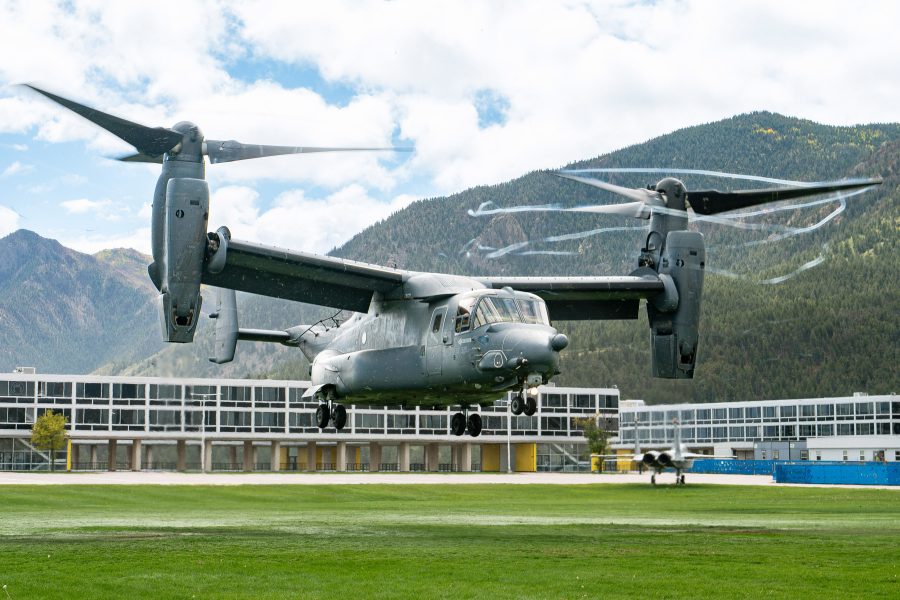
The Air Force’s CV-22 Osprey fleet started receiving new proprotor gearboxes last month—and officials say they’re planning a comprehensive midlife upgrade for the V-22 to address concerns over its safety and reliability.
Naval Air Systems Command’s Vice Admiral John E. Dougherty IV and Marine Corps Brig. Gen. David C. Walsh detailed the status of improvements to the Osprey during Feb. 10 testimony to the House Armed Services Committee. The committee is scrutinizing the V-22 after a series of mishaps and fatalities in recent years prompted comprehensive reviews by the Navy and the Government Accountability Office that detailed problems with the program.
The new proprotor gearboxes are required because impurities in some metal components are causing those parts to break up, depositing metal chips in the gearbox, some of which have led to failures. A gearbox failure in December 2023 caused an Air Force CV-22 crash off the coast of Japan, killing eight Airmen—the deadliest Air Force mishap in five years.
Gearbox defects have been cited for causing other mishaps too. The Osprey’s unique tilt-rotor design, which allows it to fly vertically like a helicopter or horizontally like a plane, depends on a highly complex transmission that has presented challenges since the aircraft debuted in the 1990s. Because the entire engine rotates, the gears and driveshaft undergo extreme stresses caused by weight and vibration.
The V-22 Joint Program Office, part of Naval Air Systems Command, announced plans for new gearboxes in February 2025. Dougherty and Walsh said Feb. 10 that the services have started fielding the new gearboxes, with the first installs taking place in January 2026 and 12 new gearboxes being delivered each month.
The new gearboxes employ steel alloys crafted with improved processes to enhance material purity. The plan, Walsh told Rep. Donald Norcross (D-N.J.), is to install new gearboxes in all V-22s by 2027.
A spokesperson for Air Force Special Operations Command, which operates the Air Force’s fleet of 51 CV-22s, did not immediately respond to questions about whether USAF aircraft are among those that have received new gearboxes so far.
The V-22 program office is also testing a new input quill assembly, part of the proprotor transmission that includes the gearbox and clutch. The assembly transmits power from the engine to the Osprey’s massive rotors.
The input quill assembly came under scrutiny as some Ospreys experienced slipping clutches, causing hard clutch engagements. The issue triggers a a fail-safe system designed to transfer power from one engine to the other, then re-engages, generating enormous spikes in torque. Hard clutch engagements have been cited in a deadly Marine Corps accident and in some Air Force mishaps, as well.
Plans to redesign or improve the input quill assembly have been ongoing since 2023, but Dougherty told lawmakers the plan is now to field the new assembly in “late 2027.”
Another improvement in the works is focused on the V-22’s nacelles, which house the aircraft’s power and propulsion components. The conversion area with each nacelle contains wiring bundles that feed power to other elements of the aircraft.
The Air Force started nacelle improvements in 2021, trying to ease access for maintainers, and early returns have been encouraging, Walsh and Dougherty said in written testimony: “Since first installation, the CV-22B has seen aircraft availability increase by over 20 percent, mean flight hours before failure increase by over 1,500 hours, and mean maintenance hours per flight hour decrease by over 2 hours.”
In September 2025, AFSOC commander Lt. Gen. Michael E. Conley told reporters that 31 of the Air Force’s 51 Ospreys had completed the nacelle improvements. Officials previously said the program would run through 2026, and a spokesperson did not immediately respond to a query about the current projected timeline to finish the updates to the fleet.
The Navy and Marine Corps will include the nacelle improvements as part of a broader midlife upgrade to the entire Osprey fleet, Dougherty and Walsh said. That upgrade will also include “drive system, airframe and avionics improvements,” they wrote.
Among the enhancements, Walsh said: a “cockpit technology replacement initiative to address obsolescence issues.”
The Navy first explored a midlife upgrade to the V-22 in 2015 but did not follow through. Officials say the improvements planned now will improve the V-22s’ flagging availability. The Air Force reported a mission capable rate of just over 30 percent for the CV-22 fleet in fiscal 2024.
Rep. Jack Bregman (R-Mich.) warned the aircraft are at risk of becoming “hangar queens.”
Dougherty and Walsh said they are also addressing communications shortfalls among the three services flying the V-22, problems highlighted in the reviews conducted by NAVAIR and the Government Accountability Office.
Air Force Special Operations Command hosted a joint V-22 Osprey program review in January in response to the NAVAIR and GAO reports and a new joint “leadership forum” has been established.
Dougherty and Walsh projected confidence that they could improve the Osprey’s readiness and keep the fleet healthy enough to continue flying into the 2050s, and several lawmakers lauded the CV-22’s unique capabilities.
But Rep. Joe Courtney (D-Conn.) hinted that Congress compared the problems with Osprey safety to a series of Navy ship collisions in 2017, which led lawmakers to initiate reforms through legislation.
“We should explore the possibility of legislative action to codify elements of these recommendations [from the GAO and NAVAIR reports],” Courtney said, just as “Sen. [John] McCain pushed for in the aftermath of the 2017 surface collisions. The possibility of legislative action … would send a powerful message to our service members and the public that real change is happening.”