
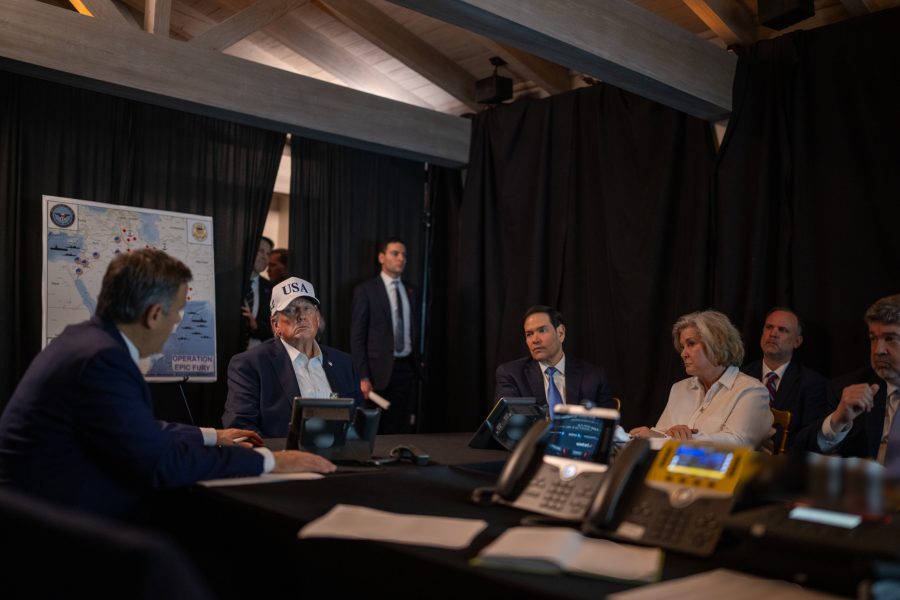
The U.S. and Israel attacked hundreds of targets in Iran on Feb. 28 with aircraft and Tomahawk cruise missiles, U.S. officials told Air & Space Forces Magazine.
President Donald Trump said the campaign was “massive and ongoing” in a late-night address posted on social media. Unlike recent actions like Operation Midnight Hammer in Iran or Operations Absolute Resolve in Venezuela, Trump suggested this would be an ongoing campaign lasting days or possibly weeks. The U.S. mission against Iran is called Operation Epic Fury.
In the most significant action, Israel killed Iranian Supreme Leader Ayatollah Ali Khamenei. His death was confirmed by Iranian state media after Israeli officials said earlier that the Israeli Air Force killed the supreme leader in an airstrike.
Trump said the U.S. offered intelligence support to the Israelis for the strike that killed Khamenei.
“Khamenei, one of the most evil people in History, is dead,” Trump wrote on Truth Social. “He was unable to avoid our Intelligence and Highly Sophisticated Tracking Systems and, working closely with Israel, there was not a thing he, or the other leaders that have been killed along with him, could do.”
The Israeli Defense Forces said they launched an “opening strike” against high-level officials that included Khamenei, and also killed Mohammad Pakpour, the commander of Iran’s Islamic Revolutionary Guard Corps (IRGC); Aziz Nasirzadeh, Iran’s defense minister; Ali Shamkhani, secretary of the Iranian Security Council; and other senior officials. “The operation began with a preemptive strike after the IDF identified several locations throughout Tehran in which senior officials of the Iranian defense establishment had gathered,” the Israeli Defense Forces said in a statement. Israel called its campaign Operation Roaring Lion.
“The people that make all the decisions, most of them are gone,” Trump told NBC.
A senior administration official said the U.S. believed the American and Israeli militaries needed to strike first to blunt Iran’s retaliation.
“We had analysis that basically told us, if we sat back and waited to get hit first, the amount of casualties and damage would be substantially higher than if we acted in a preemptive, defensive way to prevent those launches from occurring,” a senior administration official told reporters. “That is the focus of the campaign right now, and so far, it’s proven quite effective at treating their launcher capability, and hopefully that path will continue.”
The official said Iran’s refusal to discuss its ballistic missile program during recent indirect talks between the two sides also led the U.S. to attack. “The president, frankly, had no choice,” the senior administration official said. “We cannot continue to live in a world where these people not only possess missiles but the ability to make 100 of them a month in perpetuity to overwhelm any potential defenses. We are not going to be held hostage by them, and we are not going to let them hit us first.”
In remarks in the hours after the attack, Trump suggested destroying Iran’s ballistic missiles was a key reason he decided to embark on the operation.
“We are going to destroy their missiles and raze their missile industry to the ground,” Trump said.
Trump promised a thorough campaign. “We’re going to annihilate their Navy,” he said. “We are going to ensure that the region’s terrorist proxies can no longer destabilize the region or the world and attack our forces and no longer use their IEDs or roadside bombs, as they are sometimes called, to so gravely wound and kill thousands and thousands of people, including many Americans. And we will ensure that Iran does not obtain a nuclear weapon. It’s a very simple message.”
A second senior administration official said Iran and the U.S. could not agree on the future status of Iran’s nuclear program.
“It was very clear that the intent for them was to preserve their ability to do enrichment, so that over time, they could use it for a nuclear bomb,” the second official said. “We offered them many, many ways to do that, but instead, that was met with games, tricks, stall tactics, and that was really the conclusion that we came back with.”
Those two issues and a “lot of other reasons” led Trump to order the strikes, that senior administration official said.
The Trump administration has not provided any intelligence to substantiate its claims that Iran’s nuclear program was advancing. Secretary of State Marco Rubio has acknowledged that Iran was not enriching uranium and experts say there is no indication that Tehran’s was making major strides in its nuclear program following last June’s Operation Midnight Hammer attack. The Defense Intelligence Agency projected in May that Iran could have 60 intercontinental missiles by 2035 if Tehran opted to adapt its space launch vehicle.
U.S. officials confirmed to Air & Space Forces Magazine that the scope of the ongoing campaign is broad. The U.S. military is focusing on high-value targets, the officials said, including underground facilities that the U.S. believes are associated with Iran’s nuclear program, key Islamic Revolutionary Guard Corps targets, and naval facilities.
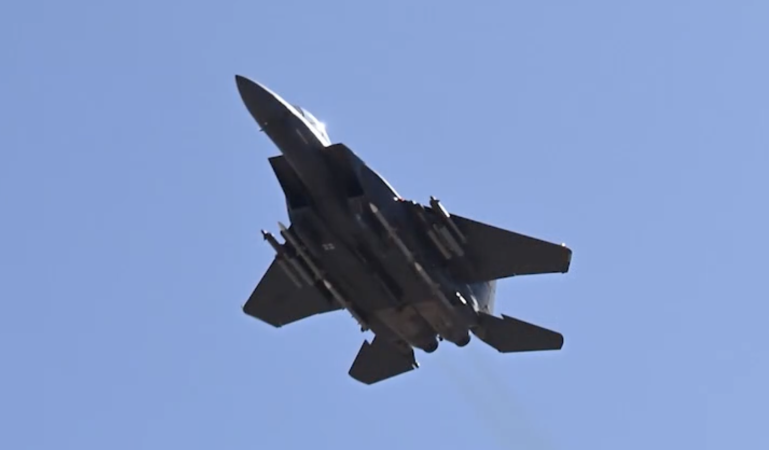
Air Force fighters participated in the operation and Navy aircraft launched from two U.S. aircraft carriers deployed nearby, according to CENTCOM. The command released photos of aircraft participating in Operation Epic Fury, including F-35 Lightning IIs, an F-15E Strike Eagle, F/A-18 Super Hornets, and other aircraft. Navy ships launched Tomahawk land attack cruise missiles in the first wave of attacks. The U.S. also used one-way attack drones in the operation, a U.S. official told Air & Space Forces Magazine. And Army HIMARS missile launchers were used.
U.S. Central Command said in a statement that the “first hours of the operation included precision munitions launched from air, land, and sea.” The command also later confirmed the use of “low-cost one-way attack drones.”
“The President ordered bold action, and our brave Soldiers, Sailors, Airmen, Marines, Guardians, and Coast Guardsmen are answering the call,” Adm. Brad Cooper, the commander of CENTCOM, said in a statement.
U.S. officials declined to comment on the exact nature of the Air Force’s involvement in the campaign, though CENTCOM posted a picture of an armed F-15E Strike Eagle it said participated in the operation.
“U.S. and partner forces began striking targets at 1:15 am ET to dismantle the Iranian regime’s security apparatus, prioritizing locations that posed an imminent threat,” CENTCOM added. “Targets included Islamic Revolutionary Guard Corps command and control facilities, Iranian air defense capabilities, missile and drone launch sites, and military airfields.”
The operation is expected to continue for multiple days, U.S. officials said.
Trump called on the Iranian people to rise up against the country’s authoritarian regime.
“It will be yours to take,” Trump said, addressing the Iranian public. “This will be probably your only chance for generations.”
A U.S. official said the U.S. has largely suppressed Iran’s air defenses, which were already weakened after last year’s strikes by Israel and the U.S. The Israeli Air Force said it had expanded its “aerial superiority” over Iran.
Secretary of Defense Pete Hegseth said in a statement that the operation was “the most lethal, most complex, and most-precision aerial operation in history.”
The Israeli Air Force said that 200 of its fighter jets participated in the initial wave strikes and hit 500 targets, the largest attack it has ever conducted. It also posted images of its F-35s, F-15s, and F-16s taking off to launch the attacks.
Iran retaliated by attacking U.S. military bases in the region, including Al Udeid Air Base, Qatar; Ali Al Salem Air Base in Kuwait; Al Dhafra Air Base in the United Arab Emirates; and Naval Support Activity Bahrain, Iran’s Islamic Revolution Guard Corps said. Muwaffaq Al Salti Air Base in Jordan was also attacked, according to Iranian state media. The governments of those countries said they successfully intercepted many of those missiles and condemned Iran’s response.
Naval Support Activity Bahrain was impacted by multiple missiles and an attack drone, multiple videos circulating on social media show.
“CENTCOM forces successfully defended against hundreds of Iranian missile and drone attacks,” the command said in a statement. “There have been no reports of U.S. casualties or combat-related injuries. Damage to U.S. installations was minimal and has not impacted operations.”
The Italian Air Force, which also uses Ali Al Salem Air Base, said that the Kuwaiti base was struck by missiles, and there was “significant damage to the runway” there, though Italian forces suffered no fatalities.
Trump acknowledged the risk to U.S. personnel. “My administration has taken every possible step to minimize the risk to U.S. personnel in the region,” Trump said. “The lives of courageous American heroes may be lost, and we may have casualties.”
A civilian in the UAE capital of Abu Dhabi was killed as a result of falling debris from missile interceptors. Qatar, which hosts the forward headquarters of U.S. Central Command and the regional Combined Air Operations Center, has already been subjected to multiple waves of Iranian missile attacks. Kata’ib Hezbollah, an Iranian-aligned militia in Iraq, said it would attack U.S. assets in response.
The U.S. buildup in the region includes dozens of Air Force fighters—F-35A multirole stealth planes, air superiority F-22 Raptors, and multirole F-15Es and F-16 Fighting Falcons, as well as A-10 Thunderbolt II attack planes. The U.S. Navy has two aircraft carriers in the region, the USS Gerald R. Ford and the USS Abraham Lincoln, which carry F-35C and F/A-18 fighters and EA-18 electronic attack planes.
The U.S. has amassed the largest concentration of airpower in the region since the 2003 invasion of Iraq.
Trump “monitored the situation overnight” at his Mar-a-Lago resort in Florida alongside “members of his national security team,” White House Press Secretary Karolina Leavitt said. Trump also spoke to Israeli Prime Minister Benjamin Netanyahu. Chairman of the Joint Chiefs of Staff Air Force Gen. Dan Caine, Hegseth, and Rubio were among those with Trump at Mar-a-Lago overnight, U.S. officials told Air & Space Forces Magazine, while Vice President JD Vance and other senior administration officials monitored the strikes from the White House Situation Room.
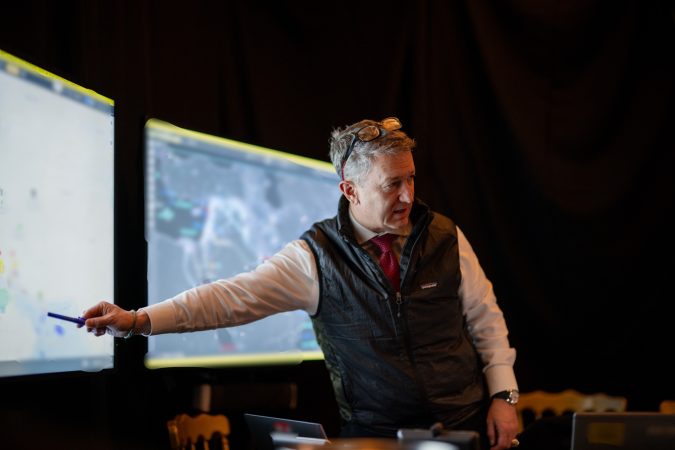
Rubio notified seven members of the so-called Gang of Eight, which comprises the Republican and Democratic leaders of the House and Senate and the chairmen and ranking members of the congressional intelligence committees. The Department of Defense notified the Senate and House Armed Services Committees after the strikes were underway, a U.S. official said.
Iran promised its own response. “We will teach Israel and America a lesson they have never experienced in their history,” the semi-official Fars news agency quoted an official as saying. But more than the U.S. and Israel, the official said that Iran’s response will be seen across the region. “Any base that helps America and Israel will be the target of the Iranian armed forces.”