
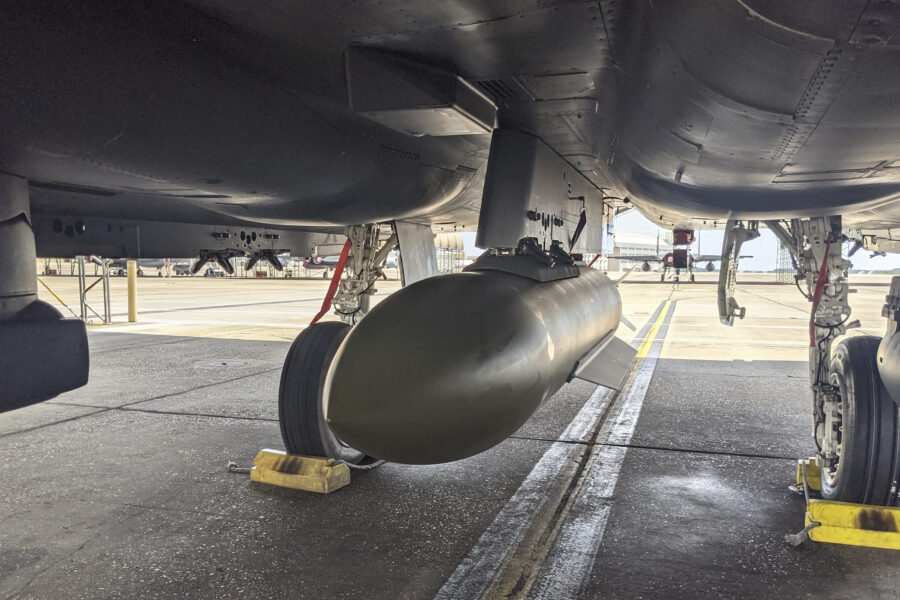
The Air Force is using some of its newest bombs and some of its oldest planes to strike very different targets in the Strait of Hormuz during Operation Epic Fury—a high-tech bunker-busting bomb and the famous A-10 Thunderbolt II attack plane.
Chairman of the Joint Chiefs of Staff Air Force Gen. Dan Caine referenced both weapons systems in a March 19 press conference at the Pentagon.
“The U.S. military dropped 5,000-pound penetrator weapons into the underground storage facilities storing coastal defense cruise missiles and other support equipment,” Caine said.
The weapons were GBU-72 Advanced 5K Penetrators, U.S. officials told Air & Space Forces Magazine.
As for the A-10s, the “Warthog is now in the fight across the southern flank and is hunting and killing fast attack watercraft in the Strait of Hormuz,” Caine said, referring to the plane by its nickname.
U.S. Central Command announced March 17 that it had “employed multiple 5,000-pound deep penetrator munitions” to hit hardened missile sites along Iran’s southern coastline near the Strait of Hormuz. Caine did not specify the type of weapon, nor the number used on the storage facilities.
Caine did not quantify how many fast-attack watercraft A-10s had struck. Overall, the U.S. military claims it has destroyed 120 Iranian naval vessels and 44 mine-laying watercraft so far in the campaign.
The strait is a key strategic chokepoint through which roughly 20 percent of the world’s oil supply passes every day. It has been almost entirely cut off to regular tanker traffic due to Iranian attacks and threats since the start of Operation Epic Fury, contributing to rising oil and fuel prices across the globe.
The GBU-72 was developed for both fighter and bomber aircraft to strike deeply buried, hardened targets, of which Iran has many protecting its munitions, drones, and nuclear manufacturing.
“These weapons are bespokely designed to get through concrete and or rocks and function after penetrating those barriers,” Caine said.
Officials said it is the first use of the GBU-72 in Operation Epic Fury. It was previously used against an underground Houthi site in Yemen in May 2024, CBS News reported at the time. Iranian-supported Houthi rebels have conducted ongoing attacks against maritime vessels in the Red Sea off the Yemen coast in recent years, sparking strikes by U.S. assets in the region.
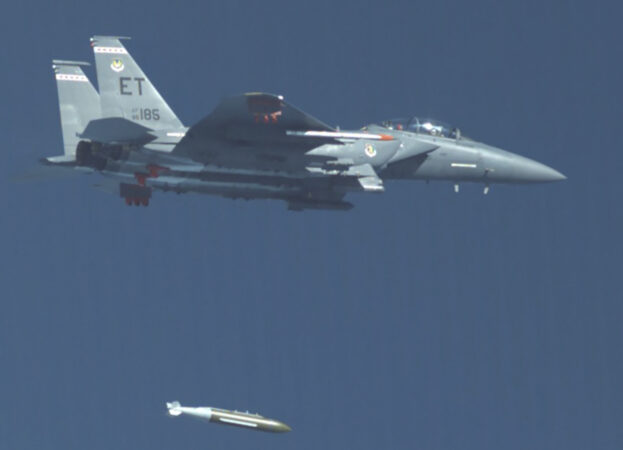
The GBU-72 saw its first test release at Eglin Air Force Base, Fla.,, in 2021 and moved to Joint Direct Attack Munition integration, developmental, and test flights in 2022, according to an Air Force release.
The munition was designed to outperform the legacy GBU-28, which has been in service since the 1991 Gulf War.
“Lethality is expected to be substantially higher compared to the similar legacy weapons like the GBU-28,” said then-GBU-72 Program Manager James Culliton in a release.
The GBU-28 is capable of penetrating 150 feet of soil or 15 feet of reinforced concrete.
Defeating such structures falls to “stand-in weapons” such as the GBU-72, which are more effective when enemy air defenses have been neutralized, a claim Secretary of Defense Pete Hegseth made regarding Iran.
U.S. officials have not specified what aircraft carried the penetrator bombs used in Iran. The 2021 bomb release at Eglin was conducted using a 96th Test Wing F-15E Strike Eagle. Aircraft photographer Ian Recchio captured an image of a B-1B Lancer bomber carrying a GBU-72 in June 2024.
The A-10’s strikes against fast-attack watercraft in the strait give the aging platform a role to play among its younger airframe brethren in the current operation. The Warthog has also been targeting Iranian-backed militia groups in Iraq, widely circulating videos on social media indicate.
The first production jet was delivered to Davis-Monthan Air Force Base, Ariz., in 1975.
The A-10 was specifically designed for close air support, flying at low altitudes and slow speeds to enable long loiter times. Those are advantages when spotting and stalking watercraft.
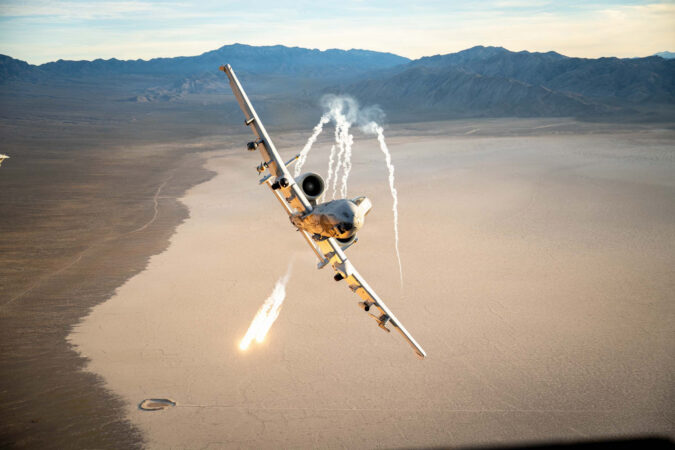
The aircraft can operate under 1,000-foot ceilings with a 1.5-mile visibility, according to Air Force data. It can take a beating, too. The Warthog can survive direct hits from armor-piercing and high-explosive projectiles.
Offensively, the A-10 carries a 30mm GAU-8/A Gatling gun capable of firing 3,900 rounds per minute. It can also carry an array of air-to-surface weapons such as the AGM-65 Maverick and AIM-9 Sidewinder missiles, according to Air Force data.
In early February, during the force-buildup prior to the launch of Operation Epic Fury, the Air Force and Navy issued a release that A-10s were training for a close air support mission for the littoral combat ship USS Santa Barbara in the Arabian Gulf.
CENTCOM also showcased images of the A-10 in refueling flights during the operation on March 15.
Though rare, this is far from the first time that the A-10 has been used in training or combat against a maritime target.
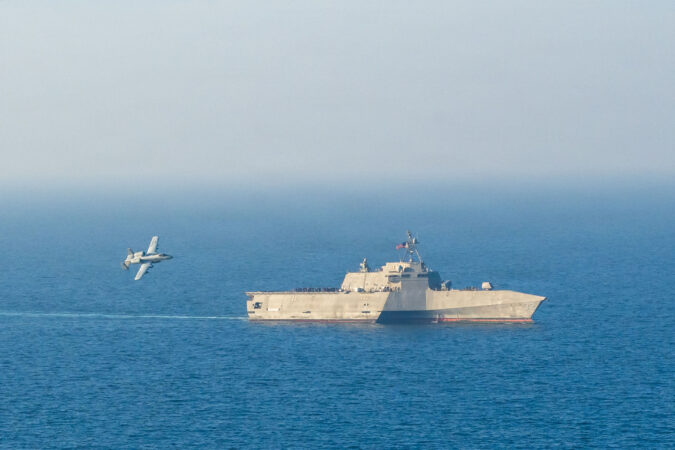
In September 2023, a pair of Thunderbolts from the 75th Fighter Squadron trained with the USS Stethem in the Gulf of Oman, according to a release.
The same release also noted earlier that year, the aircraft had teamed with naval assets USS Bataan and USS Thomas Hudner in the Gulf of Oman and accompanied a Navy patrol aircraft and three Coast Guard cutters in the Arabian Gulf.
On the combat side, an A-10 alongside a Navy P-3C Maritime Patrol aircraft and the guided-missile destroyer USS Barry struck a Libyan Coast Guard vessel, Vittoria, and two smaller watercraft when the Vittoria fired at merchant vessels off the Libyan coast on March 28, 2011, according to a release.
The A-10 hit the two smaller vessels, destroying one and forcing the other to be abandoned, according to the release.
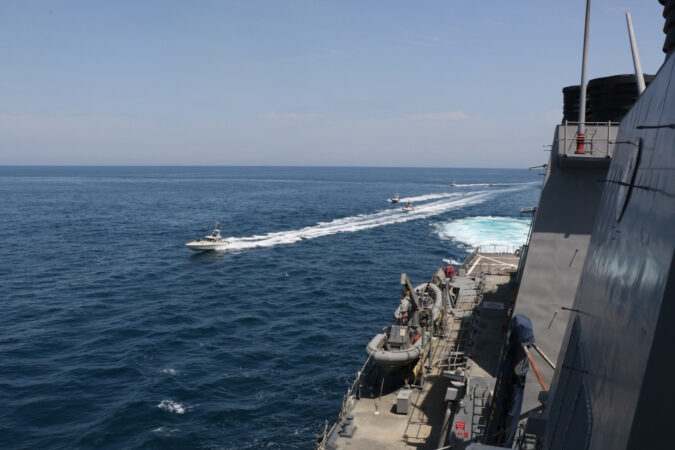
Fast-moving attack vessels have long been used by the Iranian Navy to harass shipping in the Arabian Gulf and especially in the Strait of Hormuz.
In 2020, the U.S. Navy released video and images of 11 Iranian fast-moving boats swarming various U.S. Navy ships in the Gulf at close range and high speeds, coming within 50 yards of one ship and 10 yards of another.
