
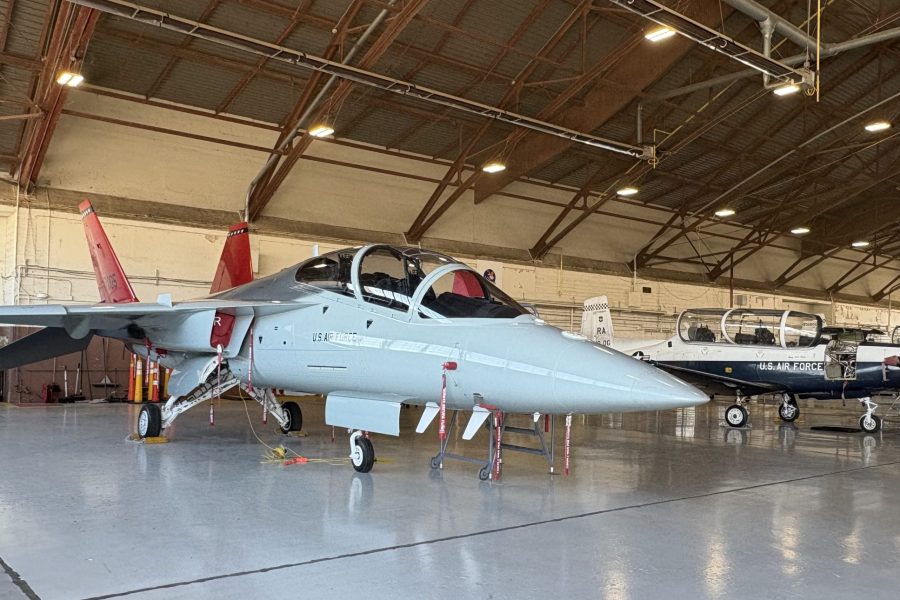
JOINT BASE SAN ANTONIO-RANDOLPH, Texas—The first T-7A trainer jet touched down here nearly two months ago to a welcome celebration filled with proclamations about the aircraft’s future. Now, for the next 20 months or so 14 pilots and two weapon systems officers with the 99th Flying Training Squadron are mastering the T-7s every idiosyncrasy.
At the top of a dizzying task list is earning the permissions to fly the T-7 locally, commander Lt. Col. Michael “Hyde” Trott told Air & Space Forces Magazine during a recent visit. Meanwhile, they’re working with Boeing contractors here to set up and test the first T-7 simulators, featuring panaramic screens, exact replica cockpits, and seats with haptic feedback—making them among the most technologically advanced simulators in the inventory.
The goal is to start live flying in March, at which point most of the squadron will still need to complete qualifications on the T-7. Even Trott, who delivered a Red Hawk here a few weeks ago, is still a sortie or two from being fully qualified.
Pilots from Boeing and the Air Force Test Center at Edwards Air Force Base, Calif., are helping with the transition, Trott said.
Once qualifications are done, a period of “familiarization” follows, during which the squadron will focus on aircraft behavior and procedures.
“We need to get in the aircraft to see how it flies and say, ‘Hey, is this really how we want to do things? Hey, we think this is better to do for overhead patterns. We think this is better to do for brake turn speed, for going to the merge in a tactical visual engagement, stuff like that,’” Trott said. “We need to get in the aircraft and put it through its paces.”
The 16 squadron members will then literally write the book on the T-7. They’re already developing what Trott called the “3-3,” which is “basically the how-to guide on how to fly a T-7 and how to employ it.”
Squadron members are reviewing flying guides and technical orders from Boeing, sharing feedback, and developing a training syllabus for future instructors to use to teach the T-7. They’re working from the Air Force’s existing Fighter Bomber Fundamentals course.
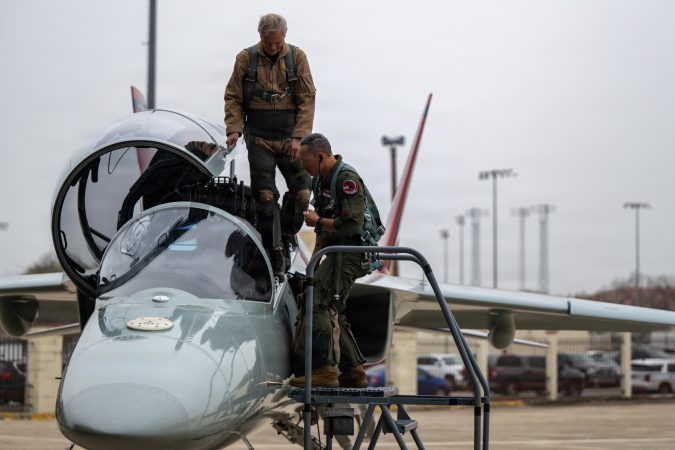
Following familiarization, the 99th must complete initial operational test and evaluation, where pilots and crew will execute a test plan approved by the Air Force Operational Test and Evaluation Center, ensuring the T-7 meets all necessary benchmarks.
Among the factors to be tested: Night flying with night-vision goggles, a new training requirement. But because of the large native bat population near Randolph, Trott said pilots will have to do the night vision tests from another base in the San Antonio area.
Scheduling such a small group with limited equipment is a challenge, Trott said. “Who’s doing what sim period for the testing we’re doing now? Who’s got all the tasks, who’s doing pubs, who’s doing [standardization and evaluation] check ride-type stuff, who’s doing training, who’s interfacing with Boeing and the program office?’ All those tasks are kind of divvied among all of our cadre. “
Yet once flights start up in earnest, everyone will be flying—frequently. “They all typically will fly once a day,” Trott said. “They’ve all got the bandwidth to do that.”
To start, they’ll fly T-6s or T-38s, because just one o the two T-7s now at Randolph will be dedicated to flight; the other is for training maintainers. But by summer, two more Red Hawks are expected, with a fifth due by the end of the year. And by fall 2027, he anticipates having 14 aircraft.
Meanwhile, the squadron probably won’t add personnel until summer 2027.
Flying the T-7 is the fun part, Trott said, showing off one of the planes to a visitor. “It flies like a fighter, maneuvers like a fighter,” he said. Boeing drew on existing designs, employing landing gear based on the F-16’s and the same engine as that powering the F/A-18. The control stick is on the side, just like in the F-35 and F-22.
The T-7’s shiny new-car paint and all-glass cockpit contrast with the heavy wear visible on nearby 20-year-old T-6’s and their time-worn seats and old-school small screens, switches and circuit breakers.
New pilots that grew up navigating iPhones and tablets will find those T-7s more familiar, even if they quickly catch up to the throwback cockpits of the T-6 and T-38, Trott said. “They are surprised,” he said. “They’re like, ‘Wow, I’m really surprised that this is the technology in the aircraft!’”
But that’s not for long, Trott knows: “That’s not going be the case when they hop in a T-7.”