

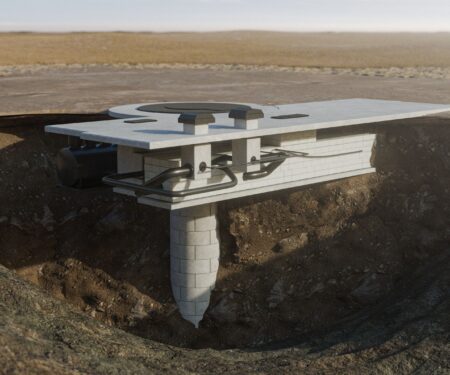
Air Force May Buy Land for 120 New Sentinel ICBM Silos
The Air Force may wind up buying land to build 120 new intercontinental ballistic missile silos as part of its revamped infrastructure approach for the new Sentinel ICBM.
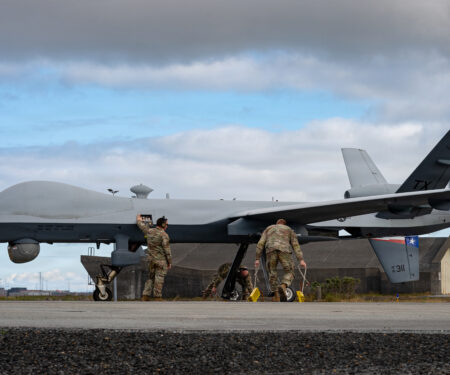
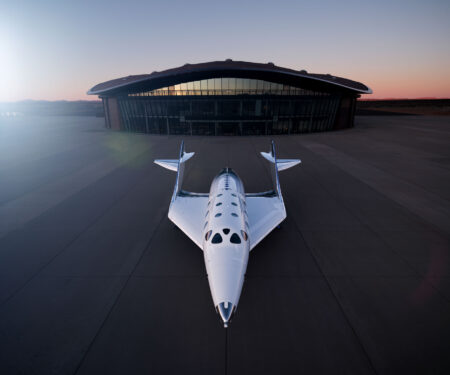
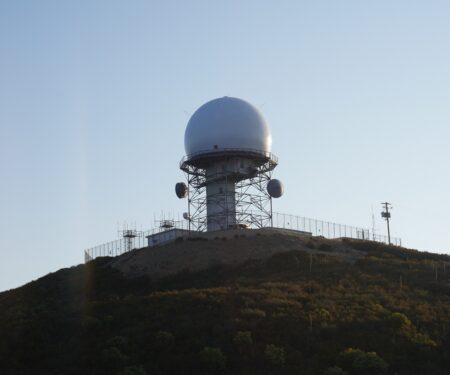
An array of U.S. Space Force electromagnetic-warfare systems is playing a key role in protecting American troops and degrading enemy satellites around the world.
Ukraine has accused Elon Musk’s SpaceX of undermining its ability to defend itself by limiting Starlink internet services as it reeled from intense Russian ballistic missile attacks that it said came without the usual warning from allies.
The head of the U.S. Army Space and Missile Defense Command was initially skeptical about the utility of high-altitude balloons, but now sees them as a “game-changing” capability.
Defense Secretary Pete Hegseth and service leaders took center stage at the Association of the U.S. Army’s annual conference on the morning of Oct. 14 discussing broad plans to scale autonomous weapons and stand up a new four-star command. “You have autonomy. You have robotics. You have SI [super intelligence]. You have space,” Hegseth told an audience full of service members and industry figures. “It’s that the folks who acquire it [defense platforms] need to be right there, up with the warfighter at the same time, who understand how to iterate it and change on and innovate on it.”
The Pentagon wants to build its stockpile of autonomous weapons from thousands of units to the millions. Defense Secretary Pete Hegseth addressed AUSA attendees at the Project Agincourt panel on Oct. 14, sharing that the Pentagon is requesting roughly $50 billion in reconciliation funding to support the push to scale autonomous and robotic systems.
The Pentagon recently established a new task force that’s charged with rapidly iterating and advancing weaponized drones and small uncrewed ground vehicles across the U.S. military. Col. Michael Penn, the Army official who is commanding the team—dubbed Task Force Easy—shed new light on its origin and Defense Department leaders’ overarching vision for it during the annual AUSA conference on Oct. 13.
U.S. Northern Command’s task force for coordinating Golden Dome homeland air and missile defense capabilities across the Joint Force has been newly charged with enabling related cyberwar capabilities, according to a senior official.
The military’s often-maligned relocation process could be centralized under a new agency by the end of the year, a senior Army official said this week. The Personal Property Activity, which manages about 300,000 military moves annually, is transitioning into a Defense Department agency, its commander, Army Maj. Gen. Lance Curtis, said Oct. 13.
Iran said Oct. 14 that a cargo ship has sunk after hitting a naval mine in the Strait of Hormuz. Meanwhile, a top Iranian official said Iran must be prepared for war even as it is negotiating with the U.S. And a hospital in Gaza said a woman was killed in an Israeli strike.
American drone-tech startups like HavocAI are swarming into Taiwan and—with the encouragement of U.S. government matchmakers—finding partners who can help them turn blueprints into reality. The emerging industry has the potential to serve the U.S. military’s demand for a secure drone supply chain that steers clear of China, while providing Taiwan with an arsenal that it sees as essential to its survival as a self-ruled democracy.
The U.S. Navy contracted Ursa Major to develop solid rocket motors for the sea service’s future Naval Modular Missile and Compact Air-to-Air Missile, the defense firm announced last week. The Colorado-based missile firm was awarded $137 million across two separate contracts covering the propulsion development of the fleet’s next-generation missiles. Ursa Major was contracted by the Navy in July to develop its design for the MK 104, a key dual-thrust rocket motor on Standard Missile-2 and 6 interceptors.
The U.S. Army now has at least five named programs seeking new anti-air interceptors of various tiers to collectively address everything from advanced hypersonic missiles to small weaponized drones. In the process, an important central theme is emerging: the service’s days of fielding air defense systems that can only use one type of interceptor look to be increasingly over.
At least 600,000 people were without power early on Oct. 14 in Ukraine, after Russia launched an aerial attack that struck energy infrastructure, Ukrainian President Volodymyr Zelenskyy said.
The Starship second stage of SpaceX’s Integrated Flight Test-13 is back at Starbase, Texas after surprisingly surviving splashdown in the Indian Ocean in July. To date, it is the only Starship not to explode after reaching the water and tipping over, with residual fuel usually causing an explosion. SpaceX was delighted to get post-recovery data especially about performance of the tiles, but returning it to Texas was no easy task.