
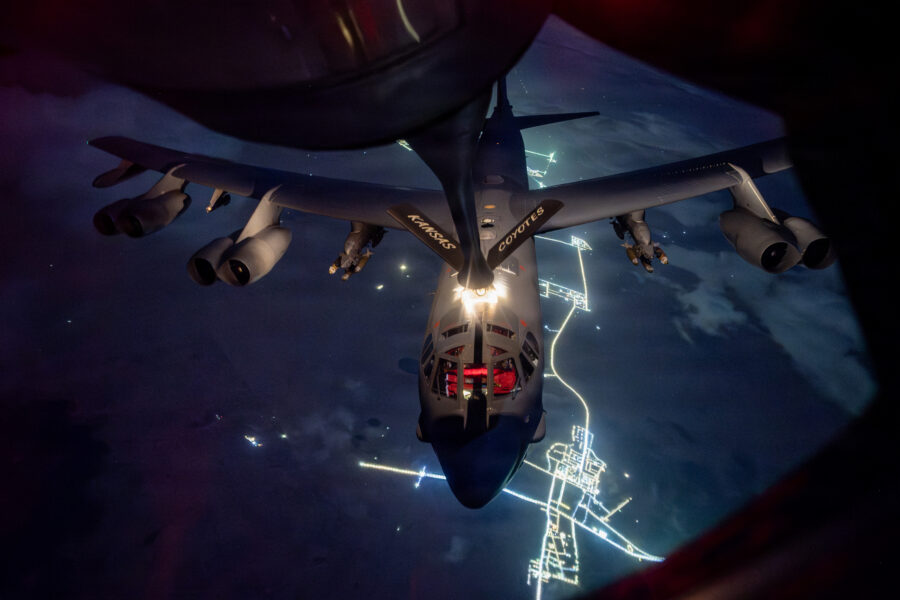
B-52 Stratofortress bombers marked a new first in Operation Epic Fury when some of the BUFFs flew over Iran carrying JDAM-guided gravity bombs, according to people familiar with the matter. The development signals a weakening of Iranian air defenses and a new use for the venerable bomber in the nearly five-week-old air campaign.
The entire U.S. bomber fleet remains in action against Iran—stealthy B-2 Spirits, which are based in the U.S. and have long been a subject of media fascination, have continued to carry out strikes, flight-tracking data and aircraft traffic control communications show.
But the bulk of the bombers involved in the operation are at RAF Fairford in the southwest of England, where the U.S. has amassed fifteen B-1s and eight B-52s, according to the Military Flight Tracking Alliance and flight tracking data, air traffic control communications, and local aircraft spotters.
The B-52s began the war by mounting attacks with stand-off munitions but have recently been seen by aircraft spotters and captured in official imagery carrying JDAMs as Iran’s air defense has weakened.
The U.S. is “switching towards more and more dynamic targets servicing mobile targets around the battle space,” Chairman of the Joint Chiefs of Staff Air Force Gen. Dan Caine said March 30. “We’ve continued to do the work against Iran’s missile, drone, and naval production facilities.”
“Given the increase in air superiority, we’ve successfully started to conduct the first overland B-52 missions,” added Caine, who did not discuss the specific munitions the bombers carried.
The armada of around two dozen bomber aircraft involved in the war is more varied than Operation Midnight Hammer, in which seven B-2s bombed nuclear facilities on a roundtrip, one-off mission. The bombers are supplementing well over 200 American fighter aircraft that are participating in Operation Epic Fury.
There are multiple reasons why bombers are playing such a prominent role in the campaign. A big one is the payload they can carry.
“What the bombers bring to the equation is that they have larger payloads of weapons and longer duration missions, which gives them the ability to maintain a presence in the weapons engagement zone for longer periods of time to respond to dynamic targets that have just been located, such as mobile missile launchers breaking concealment,” said Mark Gunzinger, a former B-52 pilot and Director of Future Concepts and Capability Assessments at AFA’s Mitchell Institute for Aerospace Studies.
Bombers can also carry more bunker-busting bombs than other aircraft, an important feature given Iran’s underground missile facilities.
Among the munitions the U.S. has used in the conflict are 500-pound, 1,000-pound, 2,000-pound, and 5,000-pound guided bombs. Those munitions include GBU-31 2,000-pound JDAMs and GBU-72 Advanced 5K Penetrator bombs. While capable of being carried on fighter aircraft, those weapons can be used in much greater numbers if employed by bombers. Aircraft have also used the Joint Air-to-Surface Standoff Missile, which has a warhead of around 1,000 pounds.
B-52s can carry 20 2,000-pound JDAMs, 30 1,000-pound JDAMs, or 20 JSSAMs between their external pylons and internal weapons bay. The B-1 and B-2 carry their weapons internally. The B-1 has the largest payload capacity of any U.S. bomber and can carry 24 2,000-pound JDAMS or 24 JASSMs. The B-2 can carry 16 2,000-pound JDAMs or 16 JASSMs.
“The payloads also give them the capacity to carry multiple weapons that are designed to penetrate hardened and deeply buried facilities and other targets—1,000 pounders, 5,000 pounders, and up, for that matter,” Gunzinger said. “Fighters can carry some penetrating weapons, but they’re limited by their payload capacity.”


B-1s and B-52s also carry advanced targeting pods, a modification that continues to make the even 1960s-era B-52s combat-effective, Gunzinger added.
A significant amount of the B-1 fleet is deployed to England, with 15 of 44 B-1s in the Air Force inventory there. Less than half of B-1s are mission-capable at any given time, according to the latest service figures. The Air Force has eight of its 76 B-52s deployed to Fairford. More than half of the BUFFs are mission-capable.
The U.S. military has declined to comment on its assets at RAF Fairford or discuss which munitions are being employed in individual strikes. But the bombers are visible to local enthusiasts, who capture bombers taking off and landing, sometimes with live munitions visible on the aircraft or seen during the loading process. B-52s have been captured taking off with JDAMs and JASSMs mounted on their wings before returning without weapons the next day. Local aircraft photographer Lee Hathaway has shared photos of bombers operating from RAF Fairford with Air & Space Forces Magazine.


“Once you have enough air control, you want to switch over to non-stealth bombers, because they can bring volume,” said Kelly Grieco, a defense policy expert and senior fellow at the Stimson Center. “Air control is a spectrum. Sometimes it seems like people think air superiority is like an on-off switch that the United States can flick. It’s not.”
Particularly earlier in the conflict, Iran showed some ability to target American aircraft, though the U.S. military says it has largely eliminated Iran’s air defenses. During the conflict, the U.S. has lost some 16 MQ-9 Reaper drones, many of which have been shot down, though some were damaged on the ground, according to people familiar with the matter. A U.S. Air Force F-35 Lightning II was also hit over Iran on March 19, and Iran targeted a U.S. Navy F/A-18 Super Hornet, as video circulating on social media shows. The Navy fighter appeared to narrowly avoid severe damage. But the U.S. now appears to have more confidence in its control of the skies.
After a month, the U.S. has “reached enough a degree of air superiority that they’re now comfortable sending the B-52s overland,” Grieco added. “It’s been quite methodical how they’re going about trying to gain these higher levels of air control.”


Bombers have played a significant role in previous U.S. wars in the region. B-52s launched strikes with cruise missiles and at low altitude at the start of Operation Desert Storm and then carried out stand-in strikes at higher altitudes.
President Donald Trump has threatened to escalate the fighting against Iran, which suggests that Fairford and the bombers based there will continue to be important for the campaign.
Fairford is “the preferred bomber forward operating location in Europe,” according to the 501st Combat Support Wing at the base, and nearby RAF Welford houses a large store of conventional weapons. The area houses prepositioned equipment and munitions, and it has a long and wide runway suitable for B-52s and B-1s, people familiar with the base said, making it an ideal location from which to launch bombers out of harm’s way.


