
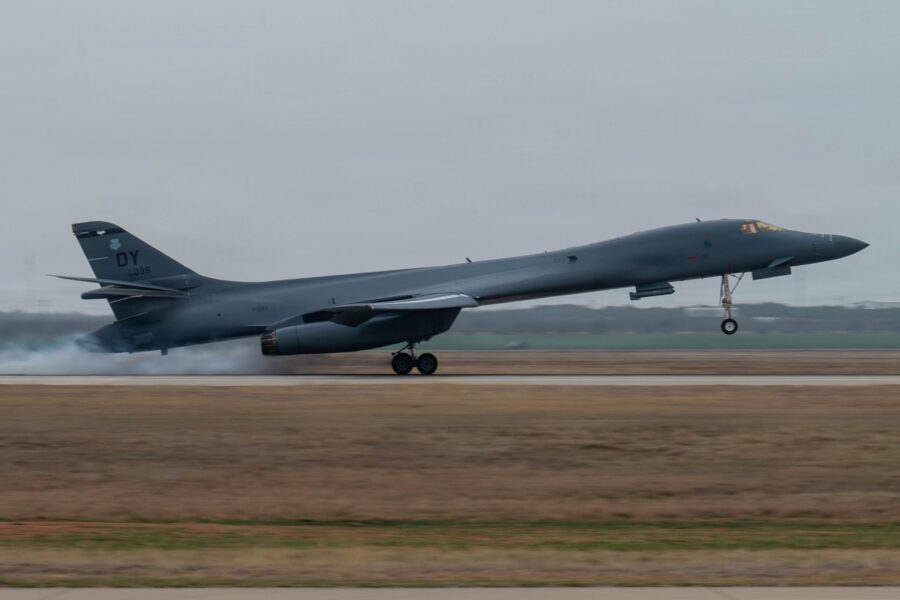
About a dozen B-1 bombers are now at RAF Fairford in the United Kingdom as a base from which to launch strikes on Iran, people familiar with the matter told Air & Space Forces Magazine—which could represent more than half of the U.S. Air Force’s mission-capable Lancer fleet.
The buildup at the air base in Gloucestershire, England, started March 6 when the U.K. Ministry of Defense started allowing the U.S. to use its bases for attacks on Iran and has continued apace in recent days, open-source data shows. All told, as many as 15 bombers are at the base, with three B-52 Stratofortresses in addition to the B-1s.
The press office for U.S. Central Command declined to comment. On March 7, the U.K. Ministry of Defense said in a statement that “United States has started using British bases for specific defensive operations to prevent Iran firing missiles into the region.” U.S. bombers are striking Iranian missile sites, the U.S. military says.
There are 44 B-1s in the Air Force inventory, but a portion of them are not available for operations at any given time, either for testing or for maintenance. As of late 2024, the service maintained a 47 percent mission-capable rate for the aircraft—suggesting around 20-22 jets are actually available.
While the U.S. has used both its B-52 and B-2 bombers to strike Iran, the B-1 is the most heavily deployed right now. It has the largest internal payload and is the service’s faster-flying bomber, making it ideal for reaching long distances and striking multiple targets over a wide area.
“I’m not surprised by it,” said retired Col. Mark Gunzinger, director of future concepts and capability assessments at AFA’s Mitchell Institute for Aerospace Studies and a former B-52 pilot. “I think the Air Force is using its bomber force quite effectively.”
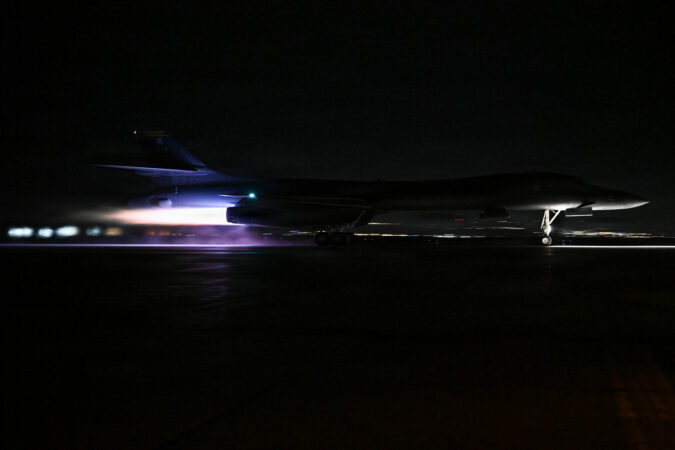
Gunzinger noted that the B-2 Spirit conducted early, long-range, stealthy strikes and the B-52 Stratofortress later strikes in Operation Epic Fury.
“For a fight of even this magnitude, relying on only one bomber variant could really put a lot of strain on that force and on their air crews,” Gunzinger said.
In the first few days of the operation, bombers were flying roughly 36-hour round-trip sorties from the continental United States to Iran and back. Those distances are doable but reduce the number of flights crews can make.
Initially, British leaders denied the United States use of its bases, such as Fairford and Diego Garcia, an island military base in the Indian Ocean. But officials relented following a March 5 Iranian drone attack on a U.K. base in Cyprus.
In a five-minute address on March 11, U.S. Central Command head Adm. Brad Cooper specifically referenced a bomber mission as part of the ongoing strikes.
“Just last night our bomber force hit a large ballistic missile factory,” Cooper said. He noted that such a strike was an example of targeting both current and future threats.
One B-1 arrived at Fairford on March 6, with four more arriving March 7. Those bombers were joined by three B-52s and three B-1s on March 9, and four B-1s on March 10, according to open source and flight tracker data.
Being able to fly out of Fairford significantly increases sortie rates.
“It certainly reduces strain on pilots, shorter sortie durations, less refueling, all translates to higher sortie rates,” Gunzinger said. “Greater rates mean more bombs on target.”
The B-1’s flexibility and munition carriage volume might also hint at why it’s in greater use at this stage.
Secretary of Defense Pete Hegseth told reporters on March 4 that the U.S. used more “exquisite standoff munitions” at the start of the operations, but as Iran’s air defenses degraded, those were no longer needed.
“And now with complete control of the skies, we will be using 500-pound, 1,000-pound, and 2,000-pound GPS and laser-guided precision gravity bombs of which we have a nearly unlimited stockpile,” Hegseth said.
Open-source photographs posted to social media this week showed crews offloading cruise missiles from a B-1 and replacing them with Joint Direct Attack Munitions, or JDAMs.
The aircraft can carry the following bomb quantities and types:
- 84 Mk 82 (500-pound)
- 24 Mk 84 (2,000-pound) general-purpose bombs
- 84 Mk 62 (500-pound)
- 8 Mk 65 (2,000-pound) Quickstrike naval mines
- 30 CBU-87/89 cluster bombs
- 30 CBU-103/104/105 WCMDs
- 24 GBU-31 JDAMs
- 15 GBU-38 JDAMs
- 24 AGM-158A JASSM, JASSM-ER, or LRASM
With that munition flexibility and volume, the B-1 gives commanders options and quantities to strike a variety of targets, Gunzinger said.
“You have to start at the targeting level,” he said. “The types of targets to attack, the types of weapons, what kind of aircraft, kinds of loiter time, dwell time to strike emerging targets.”
Another feature of the bomber fleet and the B-1 in particular, he said, is the ability to loiter and dwell longer on target than the fighter fleet.
“They operate from air bases outside the range of Iran’s threats. Long range equates to quite a bit of dwell time in the battlespace,” Gunzinger said. “It allows a bomber crew to loiter, react to targets of opportunity, and quick taskings to strike emerging targets.”
The aircraft may be versatile and in high demand, but it isn’t immune to maintenance needs. It has the lowest mission-capable rate among the bomber fleet at 47 percent, according to 2024 data. The B-2 led the pack with 56 percent while the B-52 clocked in at 54 percent.
There have been 44 B-1s in the inventory since 2021, when Congress allowed the Air Force to retire 17 of the bombers. Prior to that, the Air Force retired 33 in 2003 to reinvest in fleet modernization.
In 2024, the Air Force was in the process of resurrecting two B-1s following a 2022 engine fire on one aircraft and a January 2024 crash at Ellsworth Air Force Base, S.D. Their replacements were pulled from the “Boneyard,” officially known as 309th Aerospace Maintenance and Regeneration Group at Davis-Monthan Air Force Base, Ariz.
Congress mandated in its 2021 National Defense Authorization Act that the service maintain at least 92 bombers in the Primary Mission Aircraft Inventory and prevented the Air Force from reducing capability or personnel in any B-1 squadron. The B-1 is expected to keep flying until enough of its replacement, the developing B-21 Raider, are operational. Those aircraft are expected to arrive in quantity between 2030 and 2036.