
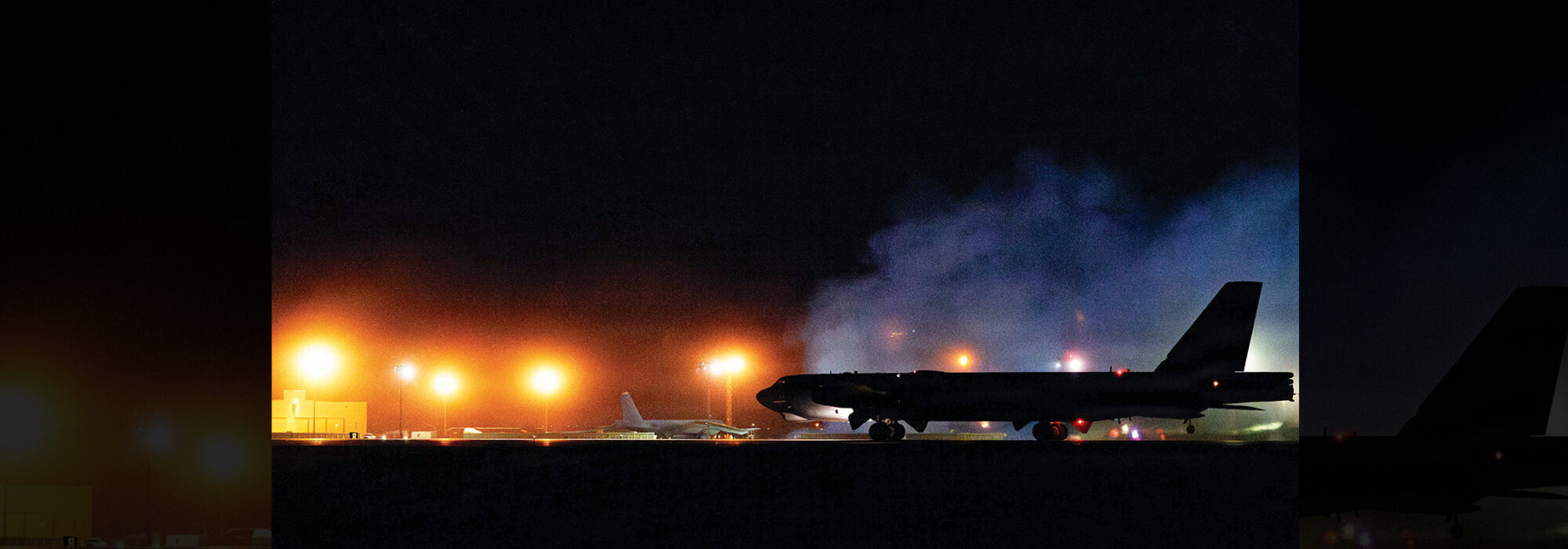
Early Lessons of Epic Fury
USAF, USSF Lead in Biggest Air Campaign Since 2003.
By Greg Hadley and Chris Gordon with Courtney Albon, Matt Cox, Steve Losey, and Todd South
W
hen the U.S. and Israel launched strikes against hundreds of targets in Iran Feb. 28, they kicked off the most intense American air campaign in a generation.
The exact end state of Operation Epic Fury remains unknown at this writing. But like other large-scale air campaigns of the past 40 years—Operation Desert Storm vs. Iraq in 1991, Operation Allied Force against Serbia in 1999, and Operation Iraqi Freedom in 2003—the results and lessons will have a profound impact on the future of airpower.
“If we’re just looking at pure airpower and the military competence with which the Air Force works, I think that we’re once again showing the Air Force at its best, with the precision munitions, demonstrating that we can penetrate sophisticated air defense and be successful,” said former Air Force Chief of Staff Gen. John Jumper in an interview with Air & Space Forces Magazine.
“So the lesson that we take forward, then becomes, we’re doing this over large distances—but when you pay attention to the Pacific looking forward, the tyranny of distance is even more egregious,” Jumper said. “I think we will learn a lot from what we’re going through now, and that will project into the future.”
The Air Force’s and Space Force’s performance over 10,000 combat flights as of March 23 included strikes against more than 10,000 Iranian targets, according to U.S. Central Command. Since the start of Epic Fury, the U.S. has employed every type of operational fighter, bomber and aerial tanker in the inventory, along with cargo, ISR, electronic warfare, and battle management aircraft. While CENTCOM did not detail how many aircraft have deployed to support the operation or how many munitions have been expended, based on open-source flight tracking data, posts from local aircraft spotters and satellite imagery, Air & Space Forces Magazine estimates that close to 300 Air Force, Navy and Marine Corps fighters and at least 20 bombers took part in operations.
A collective of open-source flight trackers that call themselves the Military Air Tracking Alliance counted about 75 refueling aircraft in the CENTCOM area of operations, and more than 700 mobility flights apparently related to the operation.
The Buildup
Beginning in mid-January and throughout February, Air Force and Navy assets flowed into the region as negotiations over Iran’s nuclear ambitions continued between President Donald Trump’s administration and the Iranian regime ground to a stalemate.
While the U.S. typically keeps a squadron each of F-16s, F-15s, and A-10s in the CENTCOM AOR, along with KC-46 and KC-135 refueling units, additional combat units flowed into the region with stops at Lajes Field in the Azores or RAF Lakenheath in England. F-22s from Joint Base Langley-Eustis, Va., headed to Ovda Air Base in southern Israel, while KC-46 Pegasus and KC-135 Stratotanker aerial refueling aircraft flew to Ben Gurion International Airport, Israel’s main commercial airport, according to flight tracking data and photos posted on social media.
F-35s from the 158th Fighter Wing of the Vermont Air National Guard arrived on the heels of having taken part in Operation Absolute Resolve, the U.S. mission to capture Venezuela’s former president Nicolás Maduro in early January.
And U.S. Air Forces in Europe employed KC-135 tankers from RAF Mildenhall, F-35 and F-15E fighters from Lakenheath, and F-16 Fighting Falcons from Spangdahlem Air Base, Germany, among others.
Extra E-3 Sentry AWACS airborne command and control aircraft and E-11 BACN airborne communications relay aircraft deployed to the Middle East and to Europe as well.
Operations
The initial strikes of Epic Fury—and Israel’s parallel operation, Roaring Lion—decapitated the regime and attacked more than 1,000 targets including air defenses, the Islamic Revolutionary Guard Corps, Iran’s ballistic missile enterprise, launchers and manufacturing facilities, and its navy, most of which was sunk.
The timing appeared based on U.S. intelligence that placed Iran’s Supreme Leader, Ayatollah Ali Khamenei in a specific place at a specific time; Israel killed him and a number of others as they met in his compound.
Iran retaliated with missiles and one-way attack drones targeting U.S. military bases in the region and civilian infrastructure belonging to countries allied with the U.S. Among the bases attacked were Al Udeid Air Base, Qatar; Ali Al Salem Air Base in Kuwait; Al Dhafra Air Base in the United Arab Emirates; Muwaffaq Al Salti Air Base in Jordan, and Naval Support Activity Bahrain.
At the start, U.S. forces employed a combination of space and cyber capabilities, along with penetrating aircraft and long-range standoff munitions to destroy Iran’s air defenses and other targets. The Space force efforts began before the first bombs were dropped, Chairman of the Joint Chiefs of Staff Gen. Dan Caine said. Those actions included “layering nonkinetic effects, disrupting and degrading Iran’s ability to see, communicate, and respond.”
Space Force Guardians deployed overseas and in the U.S. are supporting Operation Epic Fury, people familiar with the matter said, including members of Space Forces Central (SPACECENT), the USSF component to CENTCOM.
Guardians are tasked with conducting electronic warfare operations, missile warning and tracking, and providing key position, timing, and navigation to U.S. forces, likely missions that are being conducted in Epic Fury.
“Our Space superiority has been a critical enabler to this fight unseen by the world,” CENTCOM Commander Adm. Brad Cooper said March 11. “The Space Force is doing two things: First, they’re degrading Iranian capability, and second, they’re helping to protect American forces.”
Four stealthy B-2 bombers hit “hardened ballistic missile facilities” on Feb. 28, CENTCOM said, flying to and from the U.S. nonstop. F-35s and F-16s specializing in suppression of enemy air defenses joined them. There was even speculation that the ultra-secret, never-acknowledged RQ-180 drone was used for stealthy intelligence, surveillance, and reconnaissance after a mysterious aircraft appeared over an air base in Greece, though that remains unconfirmed.
The operation took a human toll on U.S. forces. Six Soldiers died March 1 when an Iranian attack drone hit a “tactical operation center” in Kuwait. The next day, three F-15E Strike Eagles were shot down over Kuwait in an apparent friendly fire incident—by a Kuwaiti F/A-18. That incident remains under investigation. All aircrew ejected safely.
In another tragic accident, two KC-135s touched in Iraqi airspace, crashing one and damaging the other, resulting in six Airmen dying in the deadliest USAF accident since 2023.
Within a few days, though, the U.S. had degraded Iran’s air defenses to the point that Caine said the U.S. had “air superiority” in the southern part of the country, and U.S. forces shifted from primarily using standoff weapons such as missiles to more “stand-in” weapons like satellite- and laser-guided bombs.
The United Kingdom, after initially refusing to allow the U.S. to use its bases for strikes, reversed course March 5, after an Iranian drone struck a U.K. base in Cyprus. Knowing that Iran could hit a European base raised concern throughout NATO.
The Cyprus attack set the stage for RAF Fairford in England to become the U.S. bomber force’s main hub of operations. Over the course of 10 days or so, 12 Lancers and six Stratofortresses landed at the base, representing 15 percent of those fleets combined, and an even larger portion of the operational fleet. These bombers, along with fighters, employed bunker-busting bombs like Joint Direct Attack Munitions and GBU-72 Advanced 5K Penetrators.
In briefings and videos, Defense Secretary Pete Hegseth, CENTCOM Commander Adm. Brad Cooper, and Caine said the pace of Iran’s ballistic missile and one-way attack drone launches slowed dramatically after the conflict’s first days. And in social media posts, CENTCOM showed off videos and images of Iranian missile and drone facilities, factories, and more being destroyed in strikes.
Many of those images appear to be feeds from MQ-9 Reaper drones, which played a key role in the operation, flying numerous orbits over Iran while gathering intelligence and taking out targets. Reapers enabled persistent intel over Iran and kept manned U.S. fighters farther from risky airspace, but Iran proved able to counter the unmanned airplanes, shooting down about a dozen MQ-9s in the first few weeks of the conflict, according to people familiar with the operations who asked not to be identified.
Leaders touted the campaign’s overall effectiveness at degrading Iran’s navy, its missile launchers and production facilities, and its nuclear program.
“It’s not just that Iran doesn’t have a functioning air force or that their entire navy is at the bottom of the Persian Gulf or their missile force is shrinking daily,” Hegseth said March 13. “Even more importantly, they also don’t have the ability to build more.”
Iran’s dwindling defenses damaged an Air Force F-35A March 19, wounding the pilot during a combat mission and forcing them to make an emergency landing, people familiar with the matter told Air & Space Forces Magazine. The aircraft was most likely damaged by a surface-to-air missile. Like the F-15E friendly fire incident and the KC-135 crash, U.S. Central Command said it is investigating the incident.
“The key takeaway is not that modern air warfare is risk-free” noted retired Air Force Lt. Gen. David A. Deptula in a commentary. “There is always a risk when you fly into a war zone … the United States and its allies have fundamentally changed the cost calculus. Where previous generations accepted high attrition as the price of access, today’s force is engineered to minimize losses while maximizing operational effect.”
As Epic Fury stretched past three weeks, Iran tightened its noose on the Strait of Hormuz, a key strategic choke point through which roughly 20 percent of the world’s oil supply passes, pushing up global fuel prices.
The Lessons
In 1991, the U.S. and its allies flew more than 116,000 combat air sorties and dropped 88,500 tons of bombs over six weeks—resulting in a lightning fast 100-hour ground campaign. In 2003, the U.S. and allies flew more than 40,000 sorties, including nearly 21,000 strike sorties, over four weeks, and ground forces toppled Saddam Hussein’s regime in less than a month.
Yet Operation Allied Force stands as a different historical example. That 78-day campaign was waged entirely through the air, with U.S. and NATO forces flying 38,004 sorties, 10,484 of which were strike sorties.
Jumper led U.S. Air Forces in Europe at the time and while the political objectives of that campaign were “a bit confusing” at first, but President Bill Clinton eventually narrowed the scope into two core goals: force President Slobodan Milosevic to withdraw from Kosovo and end his attempt to kill or drive out all ethnic Albanians from Kosovo, then a part of Serbia.
U.S. military objectives in Iran have focused on ending its nuclear program, disrupting its missile enterprise, and destroying its navy. Jumper argued that airpower is working.
“We are continuing to demonstrate that which the Air Force does the best, and that is to penetrate and put heavy kinetics on target,” he said.
While Desert Storm and Allied Force demonstrated the value of airpower, Jumper said they also helped the Air Force refine how it applies that airpower.
“In Desert Storm, I think we only had about 10 percent or maybe a little bit more than that of precision munitions,” Jumper said. “By the time you get to 1999 and Allied Force, I think we’re getting upward to 60 or 70 percent. … So there was an increasing use of precision munitions, and certainly more sophisticated use of UAVs along the way.”
More lessons from Iran will emerge over time, but Jumper identified one that already stands out to him.
“I think we’re all aware of the fact that our readiness rates have been far below what they’ve been in previous confrontations, and we’re having to pour, I believe from what I know, pretty much everything we have into the current effort,” Jumper said. “I think in the previous engagements we were in, if you look at Allied Force, Iraqi Freedom, and Desert Storm, I think we probably maxed out at about 70 percent of our force employed with enough left back to continue with training at some level and to keep some proficiency. I think that we’re probably not quite able to do that [now], especially with our fifth-generation assets during this conflict.”
Indeed, while the total number of aircraft used in Epic Fury is lower than the numbers for Desert Storm, Allied Force, and Iraqi Freedom, the overall size of the Air Force fleet has shrunk during that time. Shortages of parts, pilots, and training time are not reflected in what the Air Force pushed forward, but probably are in what had to be held back.
Air Force Chief of Staff Gen. Kenneth S. Wilsbach has made improving readiness the defining theme of his tenure, and continued on that note in a March 6 letter to the entire force, telling Airmen that “we need you ready” and “physical, mental, spiritual, and unit readiness are imperative.”
Jumper predicted Wilsbach will maintain that focus. “Are we properly configured to be able to regenerate aircraft sorties, to generate sorties the way we need to, especially with our fifth-generation aircraft?” Jumper asked. “Do we have the parts? Do we have the sustainability to be able to do that?” Those are the key questions Wilsbach must work through. Next, he must “translate that into some sort of a Pacific scenario and ask the same question,” Jumper said. “These are lessons that we need to learn,” he said.
Remembering 6 Airmen Killed in KC-135 Crash in March
By Matthew Cox
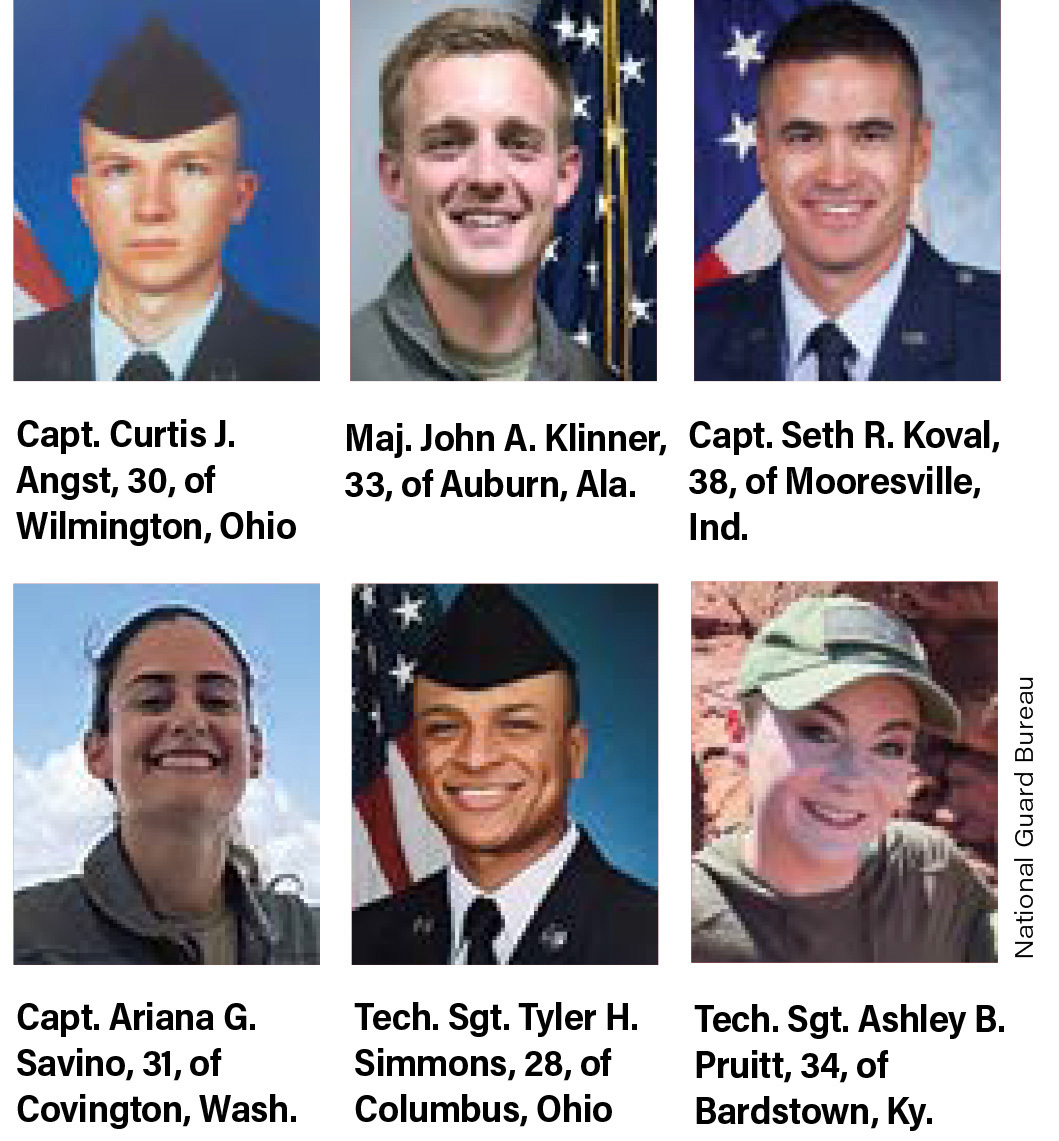
The six crew members killed March 12 in a tragic KC-135 Stratotanker crash in Iraq were the first Airmen to die while supporting Operation Epic Fury against Iran. The plane was flying without communications and apparently collided with another KC-135, which landed safely, but damaged, in Israel. The Pentagon is investigating the accident.
The six Airmen killed in the crash are:
Klinner, Savino, and Pruitt were assigned to the 6th Air Refueling Wing at MacDill Air Force Base, Fla., but were part of the 99th Refueling Squadron stationed at Sumpter Smith Joint National Guard Base, Ala. Koval, Angst, and Simmons were assigned to the 121st Air Refueling Wing at Rickenbacker Air National Guard Base, Columbus, Ohio.
The crew of the KC-135, call sign ZEUS 95, included husbands, fathers, wives, mothers, sons, daughters, and siblings. ”Simmons entered the Air Force in 2017 and first became a security forces specialist before transitioning to become an in-flight refueling specialist, or boom operator, in 2022. Simmons deployed during Operation Freedom’s Sentinel in 2018.
His mother, Cheryl Simmons, reflected on him as a “man of purpose,” who knew the risks of service, recalling him saying, “I know I could lose my life, but this is what I want to do. I was born for this.”
Koval’s wife, Heather Koval, said in a statement that her husband “always put others before himself—until the very end.” Koval enlisted into the Air Force in 2006 and became a machinist with the Indiana National Guard’s 122nd Fighter Wing. He was commissioned in 2018 with the 121st Air Refueling Wing, completed pilot training in January 2020, and then went on to complete instructor pilot training in 2024, according to his Air Force bio. He served multiple deployments.
“He grew up dreaming about becoming a pilot and to stand beside him as he made his dreams come true was an honor,” his wife wrote in a Facebook post.
Angst initially enlisted in the Ohio Air National Guard in May 6, 2015, then commissioned in 2021 and attended undergraduate pilot training in 2022, followed by the KC-135R Pilot Initial Qualification in 2024. “He was dedicated to serving his country; he deeply valued the people he had the privilege to serve alongside,” a family statement read.
Savino’s family described her as “fierce, brave, passionate.” “We take comfort in knowing that Ariana died doing the one thing she loved the most—flying.” Savino, who was chief of current operations for the 99th Air Refueling Squadron, received her commission in 2017 through the Air Force Reserve Officer Training Corps from Central Washington University, Wash., graduated from training as a Combat Systems Officer in 2020, and then served at Robins Air Force Base, Ga., as a standardization and evaluation officer, assistant flight commander, and flight commander. She became a KC-135 pilot in 2025.
Klinner served as chief of squadron standardizations and evaluations at the 99th. He entered the Air Force in 2017 through Air Force Reserve Officer Training Corps from Auburn University. After completing pilot training in November 2018, he was assigned to the 92nd Air Refueling Squadron at Fairchild Air Force Base, Wash. He completed advanced instrument training and instructor pilot training in 2022, followed by evaluator pilot upgrade in 2024 while assigned to the 99th.
Pruitt was an assistant flight chief of operations and a KC-135 boom operator instructor for the 99th, according to the 6th Air Refueling Wing release. She entered the Air Force in May 2017 and completed Career Enlisted Aviator training in February 2018 and then the Initial Boom Operator course in July 2021. Pruitt had multiple deployments.
Survived by her husband Gregory, the father of their two children, he described his wife to the Associated Press: “In a word, radiant,” he said. “If there was a light in the room, she was it.”