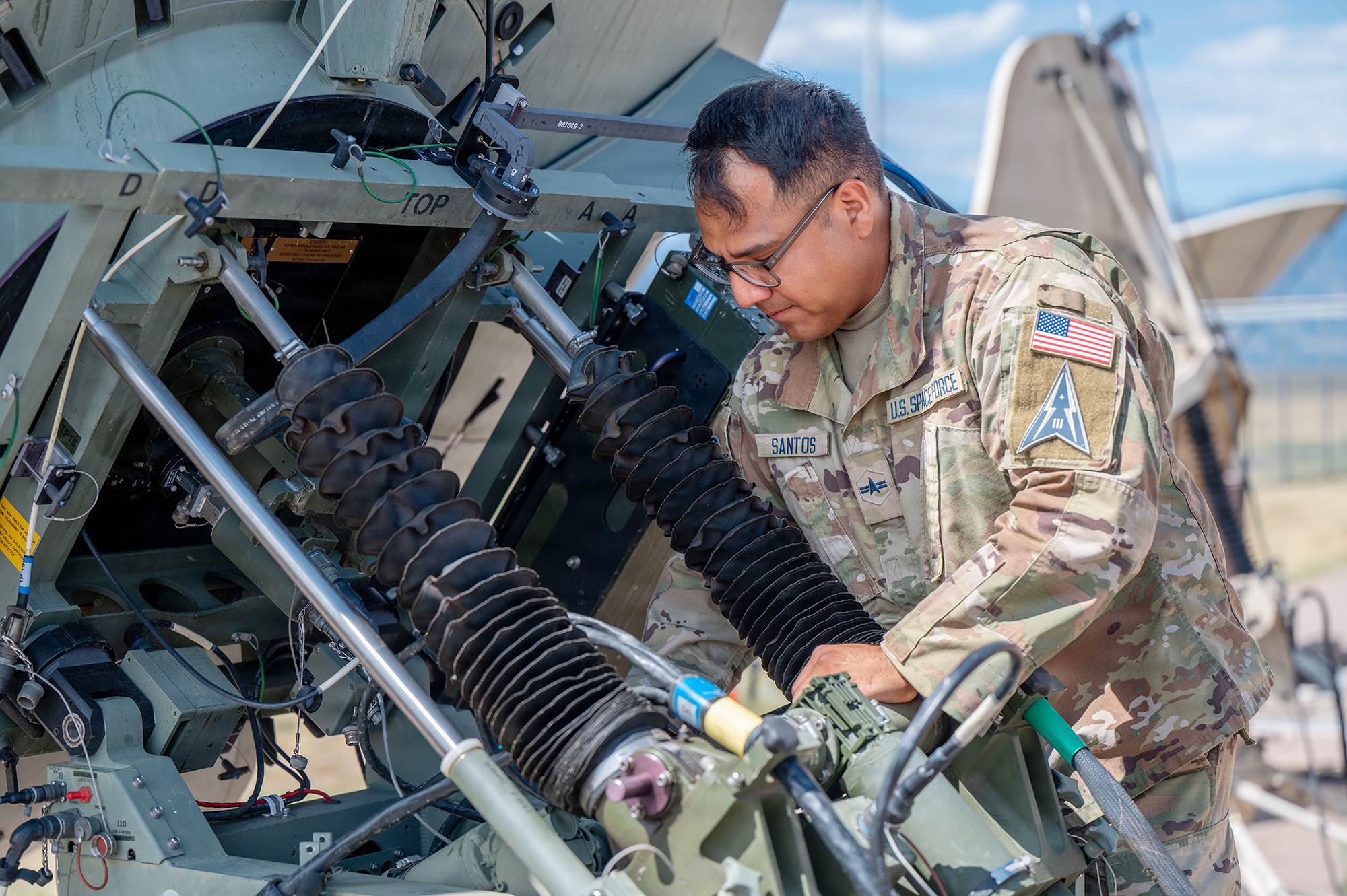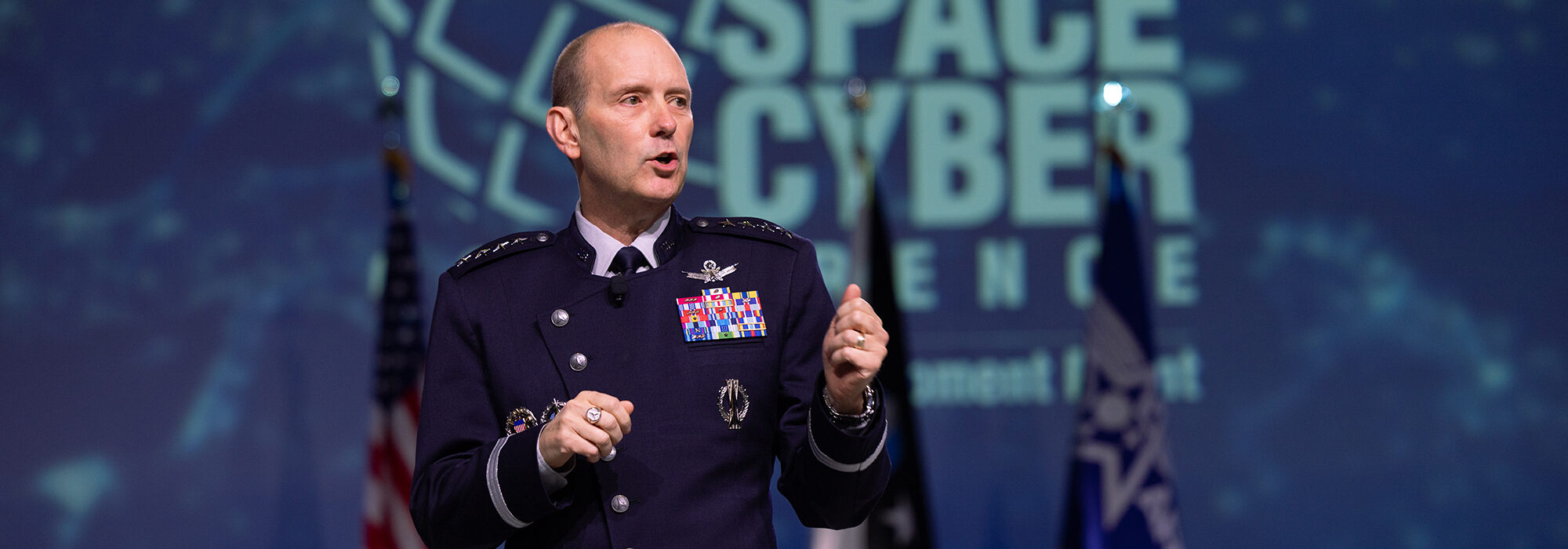
Thousands more Guardians. Hundreds of new satellites. Newly disclosed on-orbit weapons.
At AFA’s Air, Space & Cyber Conference in September, Space Force leaders laid out how the service is in the process of transforming from a small, secretive pocket of the Pentagon into a swaggering, muscular warfighting organization, ready for battle.
It started with Air Force Secretary Troy E. Meink’s revelation during his keynote that the Space Force has “on-orbit space control weapons capable of defending the joint force against hostile adversary action.” While not completely shocking to those who closely follow the service—officials have hinted at “counter-space” capabilities and “space fires” in recent years—the plainspoken declaration was a first and generated headlines around the globe, from People magazine to Chinese state media.
A day later, Chief of Space Operations Gen. Douglas A. Schiess made the case that after years of Space Force officials warning about “dogfighting” satellites and novel space weapons from China and Russia, the U.S. disclosing it has its own weapons will help deterrence.
“At this point, we are trying to say that we also need capabilities to not only defend the joint force from space-enabled attack, but defend our assets,” he said. “And so, I think it was time that within the Department of War we talked about it, and it’s time to talk about that we have the capabilities to make sure that we can do what the joint force needs.”
Both Meink and Schiess declined to discuss more specifics about what these on-orbit weapons are. But they indicated more are on the way, driven by the threat.
“We face determined and credible adversaries who are building and fielding counter-space systems at incredible speeds to target directly the United States space advantage,” Schiess said. “We will make disciplined and responsible choices about how we build and sustain our combat advantage, which means scaling our ability to respond to threats.”
Space Force leaders group these capabilities under the new mission of “space control.” Lt. Gen. Gregory Gagnon, head of Combat Forces Command (CFC), told reporters on the sidelines of the conference that the Space Force will need to expand its existing units for missions it expects will grow in the coming years, including space control.
Adding Satellites
The need to control the space domain is driven by how much the entire U.S. military now relies on space to operate—and that reliance is picking up pace, officials said. There is both added demand for missions the Space Force already performs like satellite communications and missile warning and the shift of new missions to space like interceptors via the Golden Dome missile defense shield and target tracking. This demand is fueling an explosion in the number of satellites on orbit.
As recently as 2021, the Space Force had about 70 satellites in orbit that it publicly disclosed. By 2025, it was past 140—though the true number is certainly higher with classified systems.
Gagnon, noted in a discussion at the conference that the scale of growth is only accelerating.
“In the next three years, with our budget funding, we will command and control over 500 percent more,” he added. “That’s a fivefold increase in the amount of kit that will be in outer space.”
That increase is driven mostly by the new proliferated satellite constellations the Space Force is deploying in low-Earth orbit. The Space Development Agency’s Proliferated Warfighter Space Architecture will provide both data transport and missile warning, while the Space-Based Air and Ground Moving Target Indication programs will track targets of all kinds.
Meink revealed during the conference the first of those AMTI satellites were set to launch in September. Gagnon said a new GMTI capability called Resilient Radar System-Ground will follow in the next year or so, building on the initial capability fielded by the National Reconnaissance Office.
Amid the rush to field all these new satellites, the Space Force is looking for assurance from the space industrial base that they can meet the moment. In April, the head of Space Systems Command Lt. Gen. Philip Garrant said a significant portion of the Space Force’s historic $19 billion procurement budget for fiscal 2027 would go toward contracts for new satellite lines and an expansion of existing constellations.
“If a company is nominally making 10, we want you to be prepared to make 40,” he said at the time. “We want industry to make the investments in capitalization and facilitization, and in return you’re going to get these large production contracts.”
Garrant and others, including Meink, have said the service is weighing multiyear procurement deals for satellites as well as production framework agreements, similar to the deals signed with companies like Lockheed Martin and RTX for munitions. The munitions agreements, which weren’t initially backed by funding, are meant to send a demand signal to industry so they can confidently spend their own capital to increase production capacity and be ready to deliver when the contract awards come.
That push comes amid a broad increase in private investment in the space industry; according to a new report from British investment firm Seraphim and Relm Insurance, global investment has doubled in the last year, hitting $23 billion in June. However, that funding hasn’t necessarily been directed at manufacturing capacity. A March 2026 report from the Aerospace Industries Association and Pricewaterhouse-Coopers noted hesitance among manufacturers to fund new facilities, workforce, and tooling without guarantees of long-term demand.
The Space Force’s new space acquisition executive, Erich Hernandez-Baquero, told reporters Sept. 16 the service is also considering ways to solidify the space industrial base for components and subsystems that have proven difficult to produce at scale.
“What we’re seeing is we need to scale our production capability around satellites in general,” Hernandez-Baquero told reporters. “There are lower, subtier elements of that supply chain that crosscut different mission areas that we may want to look at because those are bottlenecks.”
Adding People
The planned fivefold increase in the number of Space Force satellites is driving another need: more personnel to operate them.
Early this year, Space Force leaders started talking about doubling the size of the force in the next five years. At AFA, officials detailed just how they’re planning to grow so much so quickly—and it goes beyond doubling.
As things stand, the Space Force has less than 11,000 uniformed Guardians and around 5,000 civilian employees. Senior leaders said their goal is to reach 25,000 uniformed and 12,500 civilian Guardians—a combined increase of about 134 percent. A service spokesperson confirmed the plan is to reach those numbers by fiscal 2031.
Brig. Gen. Christopher Fernengel, former director of plans and programs on the Space Staff, had laid out those numbers earlier this year, but talk of doubling the force led many to assume the service was aiming for 20,000 uniformed Guardians by 2030.
Lt. Gen. David N. Miller Jr., the service’s top planner, reaffirmed the higher numbers during a panel discussion at the conference—and suggested those still might not be high enough.
“As much as I know we need 25,000 Guardians in the next five years, as much as I know we need about 12,500 civilians in the Space Force in the next five years, the actual requirement, I could argue, is more,” said Miller, who serves as deputy chief of space operations for strategy, plans, programs, and requirements.
Gagnon said his command, which presents forces to combatant commanders around the globe, is already seeing “exponentially” more demand for space capabilities.
“Of the six geographic combatant commands, all of them are asking me for help,” he said. To meet that demand, he added, two-thirds of the Space Force’s planned growth will reside within CFC and will go toward generating “more combat crews and more force elements” for commanders.
That includes new units to support new missions, like AMTI and GMTI. In late July, Combat Forces Command activated the 77th Surveillance Squadron within Space Delta 7, tasking it with delivering air and ground tracking intelligence and delivering it to decision-makers.
In discussions about growing, officials have no concern about attracting enough people—after all, the service has easily met its recruiting goals every year of its existence and has even had to turn away thousands of interested recruits and transfers. The service has so much interest, Chief Master Sergeant of the Space Force John F. Bentivegna and others have taken to saying the Space Force doesn’t recruit new members—it “scouts” them.
In order to meet its growth goals in a “sustainable” way, the service needs to be strategic, said Deputy Chief of Space Operations for personnel Katharine Kelley.
“It is arguably easier to just say, ‘I need this many new Guardians,’” said Kelley. “It is much harder to say, ‘I need to seed all of that talent inside the service that already exists and not create an imbalance in an up-or-out promotion system.’”
Too many new Guardians with little experience entering at the lowest ranks could wreak havoc on the service’s grade structure, she noted.
“We’re trying to balance not having all of our accessions be brand-new in terms of experience,” she said. “We’re looking for ways to make sure that we can kind of balance this as a sourcing model and a sustainment model for people.”
One way is direct commissioning, allowing civilians with relevant space experience to join the service at a higher rank and grade, Kelley said. Another way is interservice transfers—the Space Force just opened its application window for such transfers from the Army, Navy, Air Force, and Marine Corps in fiscal 2027.
Inevitably, though, the makeup of the force will likely change, said Bentivegna—the Space Force has always been unique among the services given its high proportion of officers to enlisted, and while it’s unlikely to approach the ratio of the Air Force or Marine Corps, the coming growth is expected to favor the enlisted side.
“We’re going to grow more enlisted than we are going to grow officer,” Bentivegna said. “I think just a couple years ago it was almost a flat 50/50. Now we’re 53 percent enlisted, and I think that will continue to grow.”
Growing the Pipeline
No matter what, every new Guardian that the Space Force accepts will have to go through training of some sort. That means a huge influx for Space Training and Readiness Command.
In 2027 alone, STARCOM boss Maj. Gen. James E. Smith said, his command will have to train up:
- Three times as many total Guardians as 2026: 1,000 to 3,000
- Twice as many enlisted: 700 to 1,400
- Four times as many officers: 400 to 1,600
Smith called that growth “a huge, huge scaling problem.” In response, STARCOM has raced to add around 75 new instructors at its various schools and courses.
The Space Force has always relied on the Air Force for support functions, and it will do so even more with the increased training workload, Smith said. But at the same time, the service has to continue to carve out its own identity of “Guardianship” and ensure the training is Space Force-centric.
“It’s not just enough to create a pipeline to create more Guardians,” Smith said. “We’ve got to have Guardians have the right skill sets to execute these new missions.”
Part of that, Smith said, is continuing an effort that was a top priority under former Chief of Space Operations Gen. B. Chance Saltzman: improving the service’s test and training equipment.
“There are some pieces still missing in our recipe. One of them is a fully constructed live, virtual, and constructive environment in order to do both tests, but also to do training,” Smith said.
This March, the Space Force issued a request for proposals for a physical test and training range that will feature a mix of ground and space-based systems. Officials have said they are looking to identify near-term gaps in test and training ranges and quickly field capabilities to address them.
Adding Infrastructure
Test and training ranges are just some of the infrastructure needs the Space Force must address with its coming expansion.
Kathryn Kolbe, assistant deputy chief of space operations for installations and logistics, said the service still faces “significant infrastructure shortfalls” and is trying to address them through expanded military construction.
“For the [fiscal 2027] budget, we submitted the largest investment in MILCON in Space Force history,” Kolbe said. “If appropriated, we would receive $2.2 billion.”
Almost half of that, $1 billion, would go toward building four new space operations centers at bases around the country. The service is also seeking an undisclosed classified total for five new tactical electronic warfare centers to be based in the U.S. and abroad.
Officials have said they want those hubs to support resilient operations for missions like space control, space-based sensing and targeting, and data transport. While geographical distribution through resilience is one way to meet that requirement, Chief of Space Operations Gen. Douglas Schiess said Iran’s targeting of U.S. space and missile defense systems in Operation Epic Fury has highlighted the need to better protect personnel and the systems they operate. The service and the broader joint force are also looking at ways to make them more mobile, and is even eyeing underground facilities for forward-deployed operations, he told reporters Sept. 15.
Leaders have also been investing billions of dollars in infrastructure to support more launches at its ranges on Cape Canaveral Space Force Station, Fla., and Vandenberg Space Force Base, Calif. That work is expected to ramp up over the next few years as the ranges make room for more launch complexes and support infrastructure, and the Space Force plans to request funding for the effort in its fiscal 2028 budget request.
All this construction will take time, though, and the personnel growth is coming fast.
“In the meantime, we’re building temporary facilities for our operational units, for our training units, and for other requirements as they arise, as we plan, program, design, and construct our long-term facilities and infrastructure,” Kolbe said.