
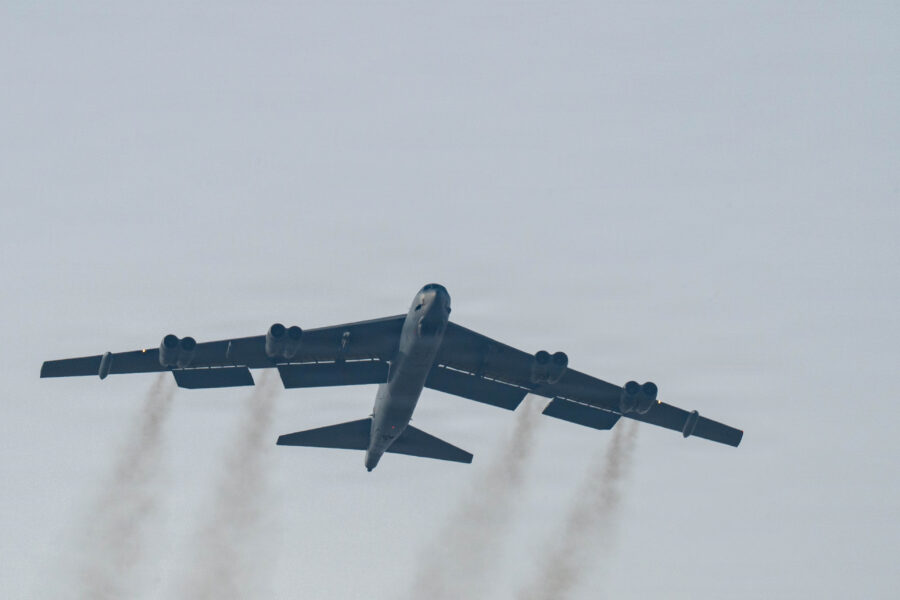
U.S. personnel and bases in Europe are playing a major role in enabling the war against Iran, Operation Epic Fury, the head of American forces on the continent said March 12.
“Our forces, bases, and infrastructure take advantage of the continent’s strategic geography and allow the United States to rapidly move forces, sustain operations, and provide the president with diverse military options across multiple theaters,” Air Force Gen. Alexus G. Grynkewich, the head of U.S. European Command, told the Senate Armed Services Committee. “This mission continues today with support to Operation Epic Fury in Iran.”
One European base in particular, RAF Fairford in the United Kingdom, has been at the heart of bomber operations against Iran.
As of March 13, some 18 bombers are operating from the base in Gloucestershire, England—12 B-1B Lancers and six B-52 Stratofortresses, according to open source flight tracking data, air traffic control communications, and aircraft spotters. The British government has acknowledged that the U.S. is using the base to strike Iranian missile facilities, the main target of the U.S. bomber force.
Dozens of tankers operating from bases in Europe have also helped enable bombing missions from the continental United States.
“Having capability in Europe ultimately provides options for this administration or any administration in the event of a conflict,” said Grynkewich, who is also NATO’s top military commander. “One of the missions of U.S. European Command is to serve as a power projection platform. And so it is. Having capabilities in Europe, munitions in Europe allow us to help U.S. Africa Command to target terrorists in Africa or to help U.S. Central Command as they execute Operation Epic Fury. The distances are shorter, it’s less expensive, and it’s much easier to project power with our network of bases and allies.”
Installations haven’t been the only way the U.S. has leveraged Europe for the fight. The Pentagon has also drawn on much of the Air Force’s combat power assigned to Europe for Epic Fury.
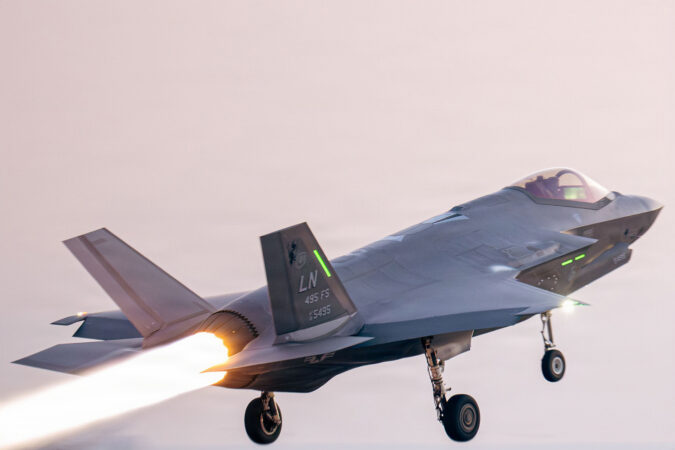
Dozens of F-35 Lightning II and F-15E Strike Eagle based at RAF Lakenheath, U.K., which carry “LN” tail codes, have participated in the air campaign, according to official images released by the U.S. military and U.S. officials. So have the “Wild Weasel” F-16 Fighting Falcons from Spangdahlem Air Base, Germany, whose role is to attack adversary air defenses, distinguished by their “SP” tails.
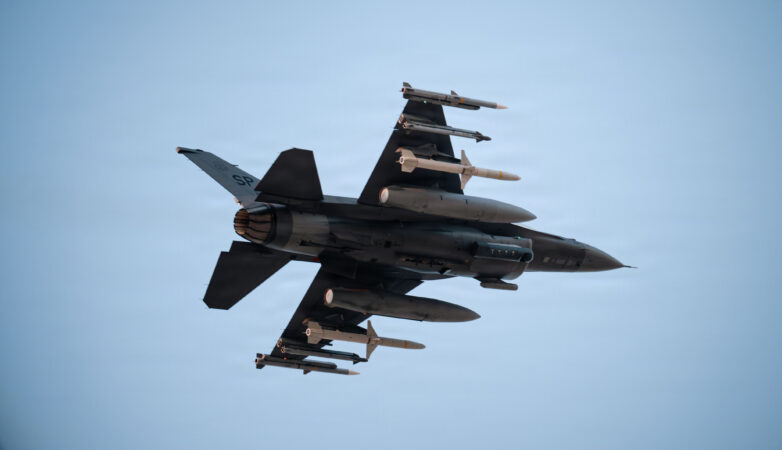
Those European-based fighters are permanently assigned to U.S. Air Forces in Europe, the air component to EUCOM. In contrast, Air Forces Central, the Air Force component in the Middle East, has no fighters that are permanently based in the region.
U.S. fighters heading to the Middle East have also used bases in Europe as stopovers before continuing eastward in the U.S. buildup to the war.
Iran’s actions have drawn Europe itself into the conflict too. British forces were attacked with apparent Iranian-designed drones in Cyprus when Iran retaliated after America and Israel began the war on Feb. 28. Iranian ballistic missiles were fired at Incirlik Air Base in Turkey, which is also part of European Command and has been a longtime base for U.S. forces. Turkey is also one of the 32 members of NATO. Grynkewich said Iran fired those missiles, which were shot down by air defenses.
“Our Soldiers, Sailors, Airmen, Marines, and Guardians have been operating at a high tempo in the Eastern Med and elsewhere defending Alliance territory and defending our forces and projecting power into U.S. Central Command,” Grynkewich said.
Conflict in Europe is also linked to tensions in the region, too. Iran has retaliated against countries across the Middle East and bases that host U.S. forces with the same type of one-way attack drones that it has supplied to Russia. Russia has reportedly provided targeting data to Iran, which Grynkewich declined to confirm. Six Soldiers were killed in an Iranian drone attack against U.S. forces in Kuwait, one Solider was killed in an attack at Prince Sultan Air Base, Saudi Arabia, and six Airmen were killed March 12 when a KC-135 Stratotanker crashed in western Iraq.
“Our competitors around the globe will work with each other when they share interests,” Grynkewich said. “And we’ve certainly seen that with the North Koreans and the Iranians and the Russians.