
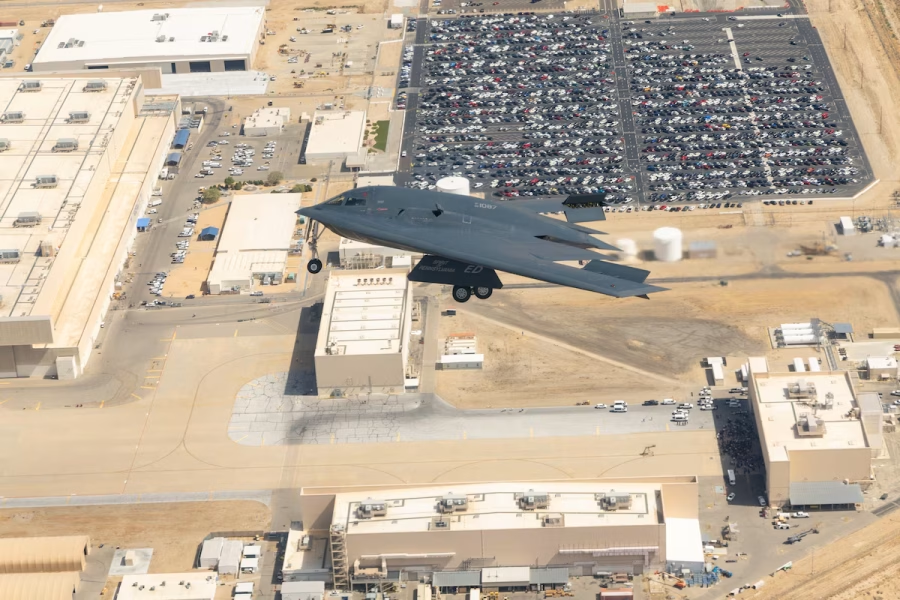
A B-2 bomber badly damaged in a crash more than four years ago is back in service after a painstaking restoration process that cost just under $24 million, the Air Force revealed in a Dec. 3 release that included an unusual level of detail about repairing the iconic stealthy aircraft.
The aircraft, dubbed the “Spirit of Georgia,” returned to service Nov. 6, bringing the B-2 fleet back up to 19 airworthy aircraft. Two B-2s have been lost in accidents so severe that repair was not economical. Given there are so few airframes and the demand for the B-2’s unique stealth and range capabilities, keeping each one airworthy is “essential for maintaining the B-2 fleet’s readiness,” the release noted.
What’s more, the repair was a relative bargain; a B-2 that crashed on Guam in 2010 cost an estimated $105 million to repair. Losing an aircraft entirely is even pricier—an accident report on a crash that destroyed a B-2 in 2008 valued the cost of the aircraft at $1.4 billion.
The “Spirit of Georgia” ran off the runway while landing at Whiteman Air Force Base, Mo. on Sept. 14, 2021. The accident occurred when the left main landing gear collapsed due to the failure of a critical mechanical lock. When the gear collapsed, the left wing of the stealth bomber scraped along the runway and grass, severely damaging its exquisitely shaped, low-observable structures and coatings.
Another B-2, the “Spirit of Hawaii,” suffered a similar accident in December 2022, but that aircraft was not repairable because the fuel tanks caught fire and destroyed most of the wing structure.
The “Spirit of Georgia” crash was considered so serious it led to an 18-month grounding of the entire B-2 fleet, and the bomber was potentially considered a write-off, service officials said at the time.
Recovery crews used inflatable airbags to lift the bomber high enough that the left main gear could be locked into position; the whole aircraft was then towed to a hangar for evaluation.
“The immediate response by the 509th Maintenance and B-2 System Program Office Engineering team was critical,” said Col. Jason Shirley, senior materiel leader at the Air Force Life Cycle Management Center’s B-2 System Program Office, which led the overall repair effort. The damage was “primarily concentrated around the left main landing gear bay and lower wing area,” he said.
Over the next year, after the accident investigations concluded, the recovery team performed “laser dimensional inspections,” the Air Force said, “which confirmed that critical areas, such as flight control attachment fittings and landing gear bay fittings, remained within acceptable tolerances.” An analysis was then conducted to determine how much load the primary structure could stand. Non-destructive testing techniques were also used to assess the outboard wing spars, which revealed no internal spar damage.
Almost exactly a year after the accident, the bomber was quite literally patched and taped to make it airworthy. The “Spirit of Georgia” then made a ferry flight to Northrop Grumman’s Plant 42 location in Palmdale, Calif., arriving Sept. 22, 2022, wearing speed tape along some damaged areas and lacking some of the low-observable treatments it usually carries.
“The temporary repairs saved the U.S. government an estimated $52 million, shaved nine months off the schedule, and allowed the ferry flight to proceed,” the Air Force release stated. Once at Palmdale, the bomber underwent repairs to all the crash-damaged areas, followed by a routine Programmed Depot Maintenance cycle.
The repair was done in four phases:
- In Phase 1, the repair was designed and needed long-lead materials were ordered.
- In Phase 2, test panels were constructed to test the repair concept
- In Phase 3, the repairs were executed
- In Phase 4, airworthiness tests were developed to certify the repairs were sound, and brought the aircraft back to specifications.
“One of the most innovative solutions was the decision to use an existing 8×4 foot composite skin section from [B-2] Test Article 0998 as a donor part,” the Air Force said. “This significantly reduced cost and schedule compared to fabricating a new composite skin.”
The fix “restored functionality” to the Spirit of Georgia’s “lower wing skin carrying wing loads, airstream, and internal fuel tank pressures.” Other milestones included replacing the left wingtip, the outboard wing major mate skin panel, and the left main landing gear door hinges. Other fixes included “repairing composite skin disbonds and rigging the [gear] door.”
The B-2 is a unique aircraft, the stealthy composite structures and coatings of which require precise management of temperature during the curing process.
Heat needed to be applied to specific areas which were immediately adjacent to “critical joints and structure” that should not be heated, the Air Force release noted; that was especially challenging when the repairs had to be done in “enclosed, confined spaces,” structure engineer Matt Powers of the B-2 program office said.
“This was overcome by utilizing advanced custom-built heating equipment, performing thermal surveys, and adjusting insulation and cooling air throughout the final cure,” he said.
Hard knocks on the B-2’s composite wing fuel tanks also posed a challenge in controlling contamination.
“The team managed to return these composite bonding surfaces to a near lab-grade cleanliness level prior to applying the repair plies,” the service reported. The repairs were completed on May 12, 2025.
The restoration also allowed the Air Force to try out some new technologies and techniques. Because the structures were too large to be put in an autoclave—a heat chamber used to bond, shape, and cure composites—“a new composite resin from another platform was used for the first time on the B-2.”
This new resin was already proven for large composite repairs outside of an autoclave. This saved months and lowered the risk of costly rework, the Air Force said.
The experiment could even benefit the Air Force down the line, as “the new materials and equipment will significantly improve sustainment and modernization work for the fleet, allowing for faster and more cost-effective repairs of composite structures in the future, reducing downtime and extending the lifespan of the fleet,” the release asserted.
The materials and processes used in the fix were “leveraged from other Northrop Grumman programs,” the Air Force said, likely referencing the new B-21 bomber. The Air Force has previously said it is updating the B-2 with some lessons learned from B-21 production.
One of the techniques used in the restoration was a “scarf” or “taper” repair, which preserves the shape and load-bearing abilities of repaired composite surfaces without a protruding patch or bump; critical in a low-observable aircraft. It must match the shifting direction of grain in the composite material layers and work without creating a scab that could fail under flight loads.
The Life Cycle Management Center release credited Air Force Global Strike Command’s logistics and plans shops for collaboration with speeding the restoration.
Global Strike Command “provided critical response and concurrence on temporary repairs to facilitate the initial ferry flight and programmed and approved an unfunded request for in-depth scarf repairs during depot maintenance,” said Cindy Connor, deputy branch chief for the B-2 office’s air vehicle and systems management branch.