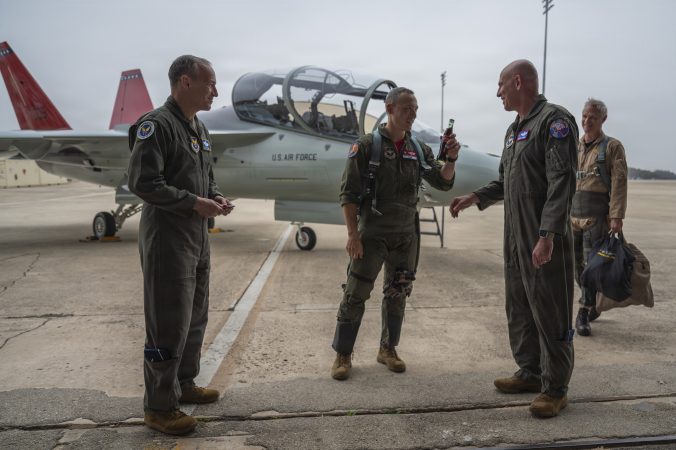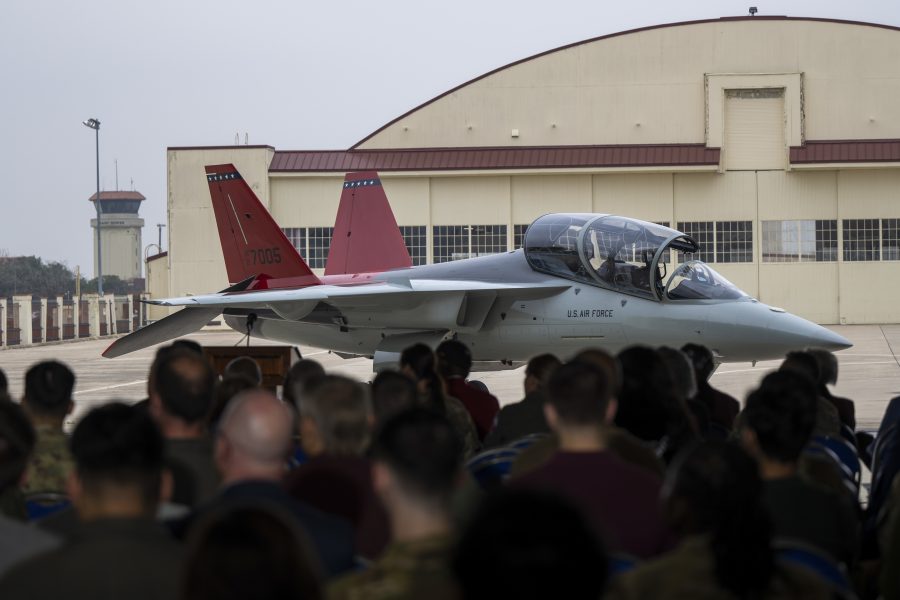
With the first operational T-7A trainer jet in hand, Air Force leaders are already looking ahead to how the Red Hawk will fit with the service’s plans for sixth-generation aircraft.
During a Jan. 9 ceremony celebrating the jet’s arrival at Joint Base San Antonio-Randolph in Texas, three general officers all noted that the T-7 will be in service for decades and is therefore crucial to preparing Airmen to fly the next-generation fighters and bombers.
And that new generation is coming soon, added Brig. Gen. Matthew A. Leard, director of plans, programs, requirements, and international affairs at Air Education & Training Command. Asked during a livestream of the ceremony how the T-7 will incorporate sixth-gen technology “10 years from now,” Leard quickly noted that the need isn’t that far off.
Indeed, the new B-21 stealthy bomber is slated for initial operational capability in the mid- to late-2020s, and the in-development F-47 air dominance fighter is expected to fly in 2028.
“Future-proof is kind of a loaded term, but [the T-7A] is a lot more future-proof than our current enterprise for sure,” Leard said. “And as we start to explore what those sixth-generation capabilities look like, I think they’re a lot closer than what you reference. We’re definitely getting there with F-47 and B-21. That’s when we will, as a training enterprise, begin to understand what exactly we need to bring into this airplane to better prepare our pilots to fly those aircraft into the future.”
Officials have frequently touted the technology going into the T-7, from its digital design to its modern avionics. Perhaps most important for staying relevant to sixth-generation aircraft, though, is the Red Hawk’s open software architecture, Leard said.
“I think of it a lot as sort of the latest iPhone. It’s going to be good for a long time. It’s going to get software patches. It’s going to increase in capability as we go,” he said. “What we’re getting today is an aircraft with plenty of power, with plenty of maneuverability, an all-glass cockpit, that really is a blank slate for us to add capability over time, and really does prepare all of our pilots—it still prepares them for fourth-gen, but really prepares them for the fifth-gen follow on, and then eventually for sixth-gen aircraft as we still explore exactly what that looks like.”
The need for a trainer that can prepare aviators for sixth-generation aircraft is all the more acute because the Air Force’s existing advanced trainer, the T-38C Talon, is nearing an average of 60 years old. Leaders have noted challenges in training new pilots on aircraft such as the F-35, given the aircraft’s advanced age, and AETC Commander Lt. Gen. Clark Quinn said there has been a shift in air warfare systems that the coming sixth-generation aircraft will only push further.
“For too long have we been using a second- and third-generation aircraft to produce fourth-, fifth- and soon sixth-generation pilots,” he said. “In the 1960s, aircraft were difficult to fly and their weapons were relatively simple to employ, and the T-38 was designed with that in mind. Today, the opposite is true: aircraft are easier to fly, but mastering the complex information and weapon systems is the key skill our pilots must possess. And the T-7 is designed to do just that.”
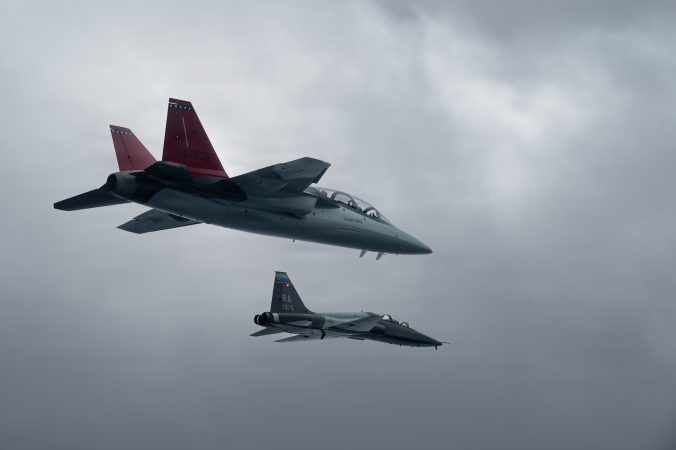
Acting Air Force Vice Chief Lt. Gen. Scott Pleus emphasized that point, arguing that the T-7 is fundamentally different from both the T-38 and the T-6 Texan II, the Air Force’s primary training aircraft for new student pilots.
“Our fifth- and sixth-generation assets have different training needs, and the T-7 is the right training aircraft to get us there,” Pleus said. “This airplane can do it all. We can pull more Gs. We can go at higher angles of attack. It will allow our brand-new student pilots to learn task management the way a fifth- and sixth-generation fighter pilot is being trained in the F-35, the F-22, and eventually the F-47.”
Leard previously told Air & Space Forces Magazine that AETC leaders have begun exploring whether to shift some undergraduate pilot training duties from the T-6 to the T-7, in addition to taking on the higher-end training done with the T-38. And Quinn hinted at that too, saying during the ceremony that the Red Hawk will both teach pilots to fly and to manage advanced systems.
“The T-7 represents our commitment to staying ahead of the curve and ensuring our Air Force remains the most dominant air power in the world,” he said.
That effort is still in its early days but starting to progress, Leard noted. The first T-7 arrived in Texas on Dec. 3—the welcome ceremony was postponed due to inclement weather—and a second jet is expected in the coming weeks. These initial aircraft will be used by the 99th Flying Training Squadron for initial operational test and evaluation. Then, in 2027, the squadron will shift to training instructor pilots, who will, in turn, train new pilots. Eventually, the Air Force wants to have 351 T-7s spread across five bases.