
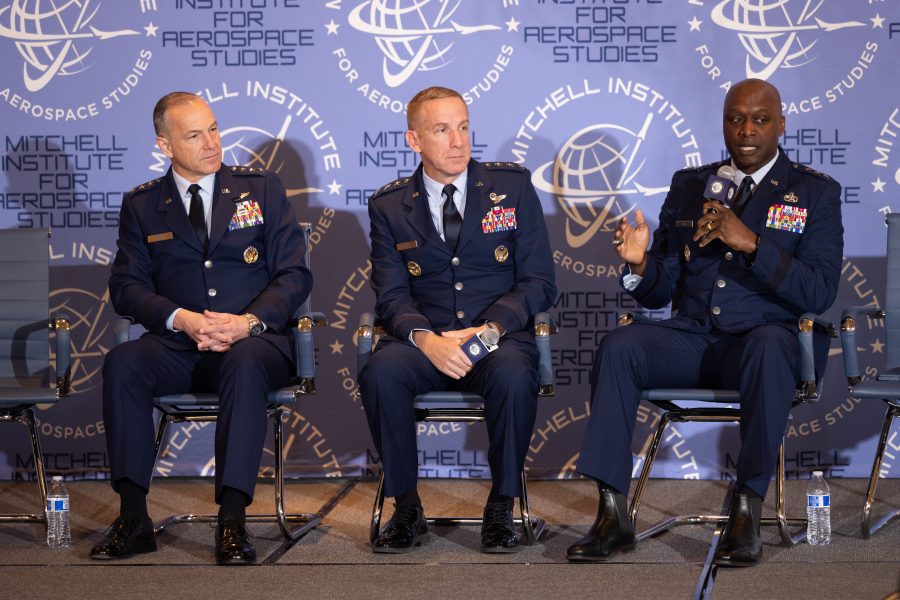
If the Air Force is in line for a big budget bump from President Donald Trump’s proposed $1.5 trillion defense budget in 2027, the head of Air Combat Command said he would make aircraft spare parts his top spending priority—but cautioned that more money to buy parts won’t equal a quick fix to the service’s aircraft readiness challenges.
“The first dollar I would spend would be on spare parts and the sustainment enterprise—spares, your deployed spares packages, your support equipment—those things that enable readiness at home and on the road have to be shored up,” Gen. Adrian L. Spain said Jan. 29 at the Airpower Forum, hosted by AFA’s Mitchell Institute for Aerospace Studies.
Aircraft maintenance is a key focus of both Chief of Staff Gen. Kenneth S. Wilsbach and Air Force Secretary Troy E. Meink.
“Secretary Meink and Chief Wilsbach are explicitly clear: readiness is our focus right now,” Air Force Director of Staff Lt. Gen. Scott L. Pleus said during the event. “So, what we are doing right now is we are now saying we’ve got to buy parts. We’ve got to have the parts available so that … maintenance folks that are out there wrenching on the flight every day, in the cold, in the rain, in the heat, have the parts they need so they can fix those airplanes.”
Parts shortages are nothing new for the Air Force, even for the service’s top aviation programs.
In late 2018, for example, the Government Accountability Office reported that the F-35 fleet—across the Air Force, Navy, and Marine Corps—was suffering from low mission-capability rates due to inadequate parts availability. A Pentagon Inspector General report from 2023 found that the Air Force hadn’t adequately accounted for “diminishing manufacturing sources” for the B-52, which contributed to spare parts shortages
Indeed, documents from the Air Force’s 2026 budget request note “diminishing manufacturing sources issues”—also called “vanishing vendor syndrome” because companies that used to build certain parts go out of business or stop making them—for the F-35, B-21, B-2, F-22, KC-46, E-7, and more.
Spain said the problem started when “we corporately bought into kind of the Walmart model in the 1990s and 2000s” and said “Hey, I’m going to buy X amount, and when I use one, I’m going to put one back on the shelf and I’m not going to have any extra.”
That model carried risk, the general noted: “There’s delays in delivery, there’s perturbations in the production of said equipment, and if the supplier goes bad, and you only have one, you run into problems and delays. We’ve realized a lot of those risks at different times, but that’s what we’re seeing now.”
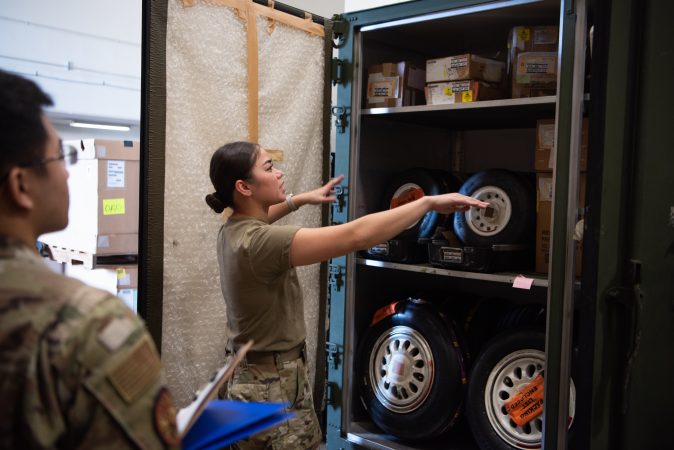
The Air Force is attacking the problem in the 2026 budget with nearly $2 billion dedicated for initial spares and repairs. Lawmakers then added $220 million specifically for F-35 spare parts in their defense appropriations bill—$140 million for the F135 engine and $80 million more for the airframe.
Looking ahead to 2027, the service could have even more money to address the issue thanks to Trump’s proposed $500 billion plus-up. Given the Air Force typically garners about 20 percent of the military’s budget, it could be looking at $100 billion in growth next fiscal year.
But even if the Air Forced received the entire plus-up, “it takes a while for money to turn into capability and in the flying business that take a while, that amount of time is measured in years,” Spain said. “If I buy $500 billion worth of parts today … those parts don’t start showing up for a year or two, in some cases, depending on which parts we’re talking about.”
Maintainers
On top of that production timeline, aircraft readiness isn’t likely to increase until the Air Force trains the right number of maintainers to keep the current fleet flying, argued retired Col. John Venable, a fellow at the Mitchell Institute and a former F-16 pilot and Thunderbirds commander.
Divesting hundreds of legacy aircraft in recent years has had the side effect of significant cuts in the Air Force maintainer field, Venable said during a discussion on readiness at the event. Dating back to fiscal 2023, the service has sought to retire 250 or more aircraft in each budget—though some are repeats after Congress blocked certain moves. Those aircraft come with associated billets.
“Even with a great number of ready, available spare parts, I can’t see us being able to fix the airplanes unless we have the number of crew members on the flight line that can actually be qualified and be available to fix them,” Venable said.
Lt. Gen. Kenyon K. Bell, deputy chief of staff for logistics, engineering, and force protection, acknowledged the maintainer challenges and said service has developed a new framework, dubbed Aircraft Readiness Machine, or ARM, that will enable leaders to “look across the competing areas that we all know about: its operations, its modernization and its sustainment.”
“Each fleet is going to establish their own north star—what their aircraft availability needs to be, where it needs to be, and then we’ll be able to see where those critical shortfalls are and then assign someone responsible to go after those critical shortfalls, whether it’s in people, it’s in equipment, it’s on the flight line, or it’s at the depot,” Bell said.
Bell also asserted that the service’s new career field strategy will help strengthen the maintenance force by reforming how future maintainers are trained and used throughout the force.
The Air Force unveiled its plan to condense its list of more than 50 aircraft maintenance job specialties down to seven in a January 2025 memo.
Under the new strategy, set to start in 2027, junior enlisted Airmen will start out in a generalist track, a single Air Force Specialty Code where they will be trained “on the most common maintenance competencies and be charged with applying them across multiple airframes,” according to the memo.
Once Airmen reach the rank of Senior Airman and are preparing to become noncommissioned officers, they will become a specialist in one of six areas:
- Avionics and Electrical, which combines avionics with the electrical side of the Environmental and Electrical (E&E) specialty
- Aerospace Ground Equipment, which will look the same as it does now
- Advanced Mechanical, which combines crew chiefs, fuels, hydraulics, and the flight line side of engine maintenance
- Crew Support Systems, which combines ejection seat systems with the environmental side of E&E
- Fabrication, which combines aircraft structural maintenance, aircraft metals technology, and nondestructive inspection.
- Intermediate-level engines, for maintainers dedicated to intermediate-level engine maintenance.
“We want to make sure that the maintainers are as trained and capable as possible, so we’re reposturing how we train those maintainers initially,” Bell said.
“Our initial thought is that we bring maintainers in, and we keep them at the generalist area for a bit, and then we start to move forward into more specialized maintainers, that’s going to help us with that a skill imbalance that’s going to improve the quality of the maintainer and also their alignment with their skill sets.”
The new strategy sparked concerns among current and former Air Force maintainers that the new design could dilute expertise across the career field and reduce local leaders’ ability to solve complex maintenance problems. Critics also question how the Air Force would switch to the new scheme amid a shortage in maintenance manning.
Then-Chief Master Sergeant of the Air Force David Flosi said at that time that the new force design is not an attempt to do more with less personnel.
“We’re not trying to, like, squeeze 10 people’s worth of work into five people,” Flosi said. “We want to have the capability for an Airman to do as much as they have capacity for.”
To Bell, the new strategy is going to help the Air Force when it has to deploy a new generation of skilled maintainers into austere environments on the future battlefield.
“Because make no mistake about it, it’s likely to be a contested environment, if there is another conflict,” Bell said. “We have challenges, and we’re going to get after them.”