
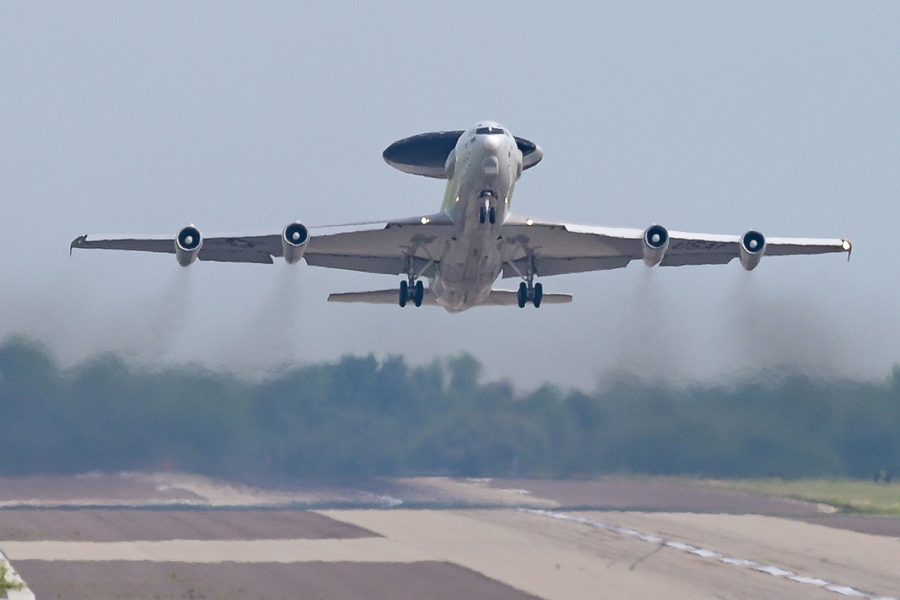
When an E-3 Sentry battle management aircraft was severely damaged in an Iranian attack on Prince Sultan Air Base, Saudi Arabia, it sparked a host of questions about one of the Air Force’s oldest, smallest, but most critical fleets. Experts say the service doesn’t have many options to answer those questions.
The Air Force has yet to officially confirm the March 27 drone and missile attack damaged an E-3, but Air & Space Forces Magazine previously confirmed the damage with people familiar with the matter and reviewed an image that shows significant damage to an E-3 at the base; essentially its entire rear section is destroyed.
Since then, other images have circulated on social media showing the damage. Should the Air Force declare the aircraft a total loss, it would shrink an AWACS fleet already stretched thin when divestments sent half the jets to the Boneyard a few years ago. But attempting to restore the damaged plane with parts from those retired jets—or even returning a retired aircraft to service—is no small feat.
In the near term, other capabilities like the Navy’s E-2D Hawkeye could fill some gaps, but that aircraft’s mission and capabilities are slightly different from the AWACS.
Air Force fighters and other combat aircraft flying sorties in Operation Epic Fury depend on the E-3 to provide command and control and intelligence, surveillance, and reconnaissance capabilities, acting as the “quarterback” in the sky deconflicting and directing actions. But the Boeing-made aircraft is based on the “jet age” Boeing 707 first launched in the 1950s and has been in service in the late 1970s—meaning the airframes are worn and many spare parts are no longer in production. The E-3’s mission capable rate—the rate at which aircraft are able to perform at least one of their assigned missions—was 55.7 percent in 2024. The Air Force stopped publicly releasing MC rates after 2024.
“Based on the latest data that we have, this was a 16-aircraft fleet, about half of which was mission capable, which puts me at a number of eight to nine,” Philip Sheers, an associate fellow at the Center for a New American Security’s defense program, told Air & Space Forces Magazine.
“You’ve allocated six to the Middle East, and then you also have some undisclosed number of E-3s that are in Alaska doing homeland defense missions. And between those two apportionments, you’re pretty much at capacity with the fleet, and so it’s not clear to me what kind of flexibility there is at all to reallocate forces without seriously sacrificing or compromising other strategic or operational priorities.”
Most of the extra capacity for the AWACS fleet was cut in 2023 and 2024, when the Air Force retired 15 of its 31 jets. Officials said at the time that the retirements would allow maintainers to focus their efforts on improving the availability of the remaining jets and inject more needed spare parts back into the system. The plan was to replace the AWACS with the newer E-7 Wedgetail, an aircraft based on the Boeing 737.
Congress agreed to the cuts, but put language in the fiscal 2024 National Defense Authorization Act that prohibits the Air Force from retiring any E-3 that would put the fleet size below 16 airframes until the service started procuring the E-7.
The Air Force formally awarded a contract to Boeing for prototype E-7s in 2024. But since then, Pentagon leadership tried to shut the program down in the 2026 budget and voiced support for relying more on space-based systems—a capability that is not yet fielded.
To the Boneyard?
There are currently 18 E-3s “in storage” with the 309th Aerospace Maintenance and Regeneration Group, at Davis-Monthan Air Force Base, Ariz., an Air Force official confirmed. The AMARG, or the “Boneyard” as it is often called, hosts hundreds of aircraft in varying states—some are maintained so that they could be returned to service if needed, some are steadily cannibalized for spare parts, while others are simply left in storage.
The state of the E-3s there is not confirmed. The Air Force official told Air & Space Forces Magazine that the service does “not release additional information on the status of those aircraft.”
The AMARG does periodically release public inventory counts, though, and its latest from March 2025 states that the 18 E-3s are located in areas 23, 25 and 26. An unofficial website, the AMARC Experience, that closely tracks information about the Boneyard describes these areas as places where aircraft are usually in “various states of completeness,” as they undergo a reclamation process to salvage critical spare parts.
Some of those parts and structures could theoretically be combined with what is salvaged from the E-damaged in the Saudi attack.
“While it was destroyed, there’s a lot of that equipment that’s still usable,” an Active Air Force air battle manager who served on an E-3 crew told Air & Space Forces Magazine. “If you look at the photos of it, the full front half of the aircraft appears to be good. The most important thing that we would want to use are the engines, if any of them survived.”
The air battle manager added that it would be “logical for the service to pull spare components from some of the E-3s stored at the Boneyard and combine them with the portions of the E-3 that survived the attack, if doing so is cost-effective.”
Sheers, however, cautioned that doing so will be a challenge, since the E-3 damaged at Prince Sultan appears to have been hit near its distinctive radar, which are difficult to replace.
“I have no idea what’s feasible in the Boneyard, but those radars are extremely fragile, he said. “That’s a very tall order.”
It would also likely be a lengthy process—and even if it works, the juice might not be worth the squeeze, Sheers argued.
“I’m not sure of what the utility of going and fishing out an old radar is and repurposing it, even if you could, because one of the operational problems that the ABM fleet is contending with right now is being able to identify and declutter these low-flying objects from background surface terrain and other background objects, and that’s something that older radars are not as effectively equipped to do,” Sheers said.
Other Options
One ABM aircraft considered more suited for detecting low-flying objects is the E-7. The Royal Australian Air Force is the only service in the world with an operational Wedgetail, and it deployed one of the jets to the Gulf region in early March at the request of allies there.
But the Australian government said March 12 that the deployment was only for an initial period of four weeks, and its mission there is focused on defending against Iranian attacks, not helping coordinate the U.S.-Israeli campaign.
The British have ordered E-7s, but they have yet to officially accept any aircraft. Boeing is still modifying the prototype aircraft intended for the U.S. Air Force.
In the short term, the Navy’s E-2D Hawkeye airborne early warning aircraft could repurposed for more joint missions to fill some of the operational gap of the lost E-3, Sheers said.
During Operation Rough Rider, the campaign to thwart Houthi rebels out of Yemen from attacking commercial shipping in the Red Sea, the “E-2 played a central role in identifying incoming threats and de conflicting and orchestrating responses,” Sheers said.
Yet the E-2 does not offer all of the capabilities of an E-3. The turboprop aircraft has five crew members, compared to the jet-powered E-3’s is usually 17 or more, and its range without refueling is significantly shorter.
“I think the challenge for how to manage the E-2 fleet going forward is, this is a platform and a crew that has … had its primary mission be dedicated to the defense of the of the carrier strike group,” Sheers said. “So how are we going to adapt that if we are going to see the E-2 as the platform that’s going to become more multimission, multipurpose—what is that going to look like?”
Absorbing Losses
Since Epic Fury began, more than 300 service members have been wounded, according to U.S. officials. Thirteen service members have been killed, including a Soldier at Prince Sultan Air Base during a previous attack on the base in early March. The U.S. has also had roughly 20 aircraft damaged during the air war.
Three F-15E Strike Eagles were shot down by a Kuwaiti fighter in a friendly fire incident March 2, Air & Space Forces Magazine previously reported. All crew members were recovered safely. On March 12, a KC-135 Stratotanker crashed in western Iraq, killing all six Airmen aboard. Another KC-135 had its tail severely damaged in the same incident but landed safely. In a March 14 social media post, President Donald Trump appeared to confirm that at least one KC-135 was damaged on the ground by an Iranian strike on Saudi Arabia. At least a dozen MQ-9 Reaper drones have been lost in the conflict, and some of the losses occurred while the aircraft were on the ground during Iranian missile attacks. A USAF F-35 Lightning II was damaged over Iran on March 19.
The aircraft losses are a sobering reminder that the U.S. is behind on its ability to absorb even minor losses without having them affect operational effectiveness, Sheers said.
“From a loss and reconstitution standpoint for our air fleet, I don’t think we’re anywhere near yet where we want to be,” Sheers said.