
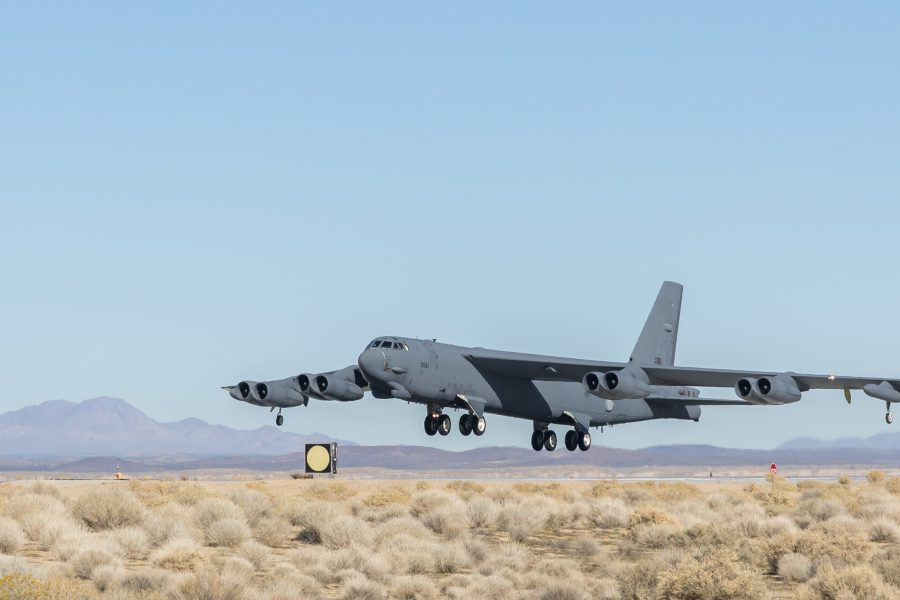
A B-52 equipped with the new Stratofortress radar flew Dec. 8, a key first step in modernizing the Cold War bomber.
The flight, from Boeing’s San Antonio, Texas, facility to Edwards Air Force Base, Calif., where the system will be put through the paces in testing, was a major step toward realizing the goal of a massively updated B-52J configuration, Air Force officials said in a Dec. 10 release.
The upgrade has not always been smooth flying. The program suffered a “Nunn-McCurdy breach” in May, requiring the Air Force to inform Congress of a “significant” increase in a program’s cost or schedule, defined as at least 15 percent. Now things appear on track.
“This milestone ensures our future Airmen inherit a modernized, ready Air Force,” Air Force Chief of Staff Gen. Kenneth S. Wilsbach said in the release. “The B-52 Radar Modernization Program is about more than technology, it’s about readiness, deterrence and the ability to fight and win. The B-52 remains a powerful example of how we fly, fix, and fight to sustain global strike capability.”
The B-52 modernization seeks to keep the BUFF flying until 2050 or later; the first B-52H models first flew in 1960. The bombers’ range, payload capacity, and stand-off launch capabilities are a complement to the B-21 Raider‘s stealth, survivability and penetrating capability, service officials say. Along with the radar, 76 B-52s will ultimately get new Rolls-Royce engines, new crew compartments, new conventional and nuclear communication systems, and an all-new glass cockpit.
A crew from the 49th Test Evaluation Squadron at Barksdale Air Force Base, La., and the 419th Flight Test Squadron at Edwards Air Force Base, Calif., will conduct ground and flight test activities on the aircraft throughout 2026 to meet requirements for a “production decision later in the year,” the release states.
The radar modernization effort is slated to replace the B-52’s long-obsolete, analog AN/APQ-166 radar with the Raytheon AN/APQ-188 radar. Lt. Gen. Andrew J. Gebara, deputy chief of staff for strategic deterrence and nuclear integration, said Aug. 27 that the service chose a radar that is “largely an F/A-18 Hornet radar” instead of paying more to design a new radar.
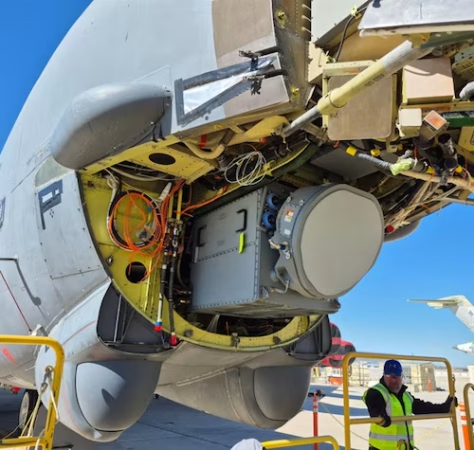
The Active Electronically Scanned Array (AESA) radar system was developed by Raytheon Technologies and integrated into the B-52 by Boeing. It features an upgraded, all-weather navigation and targeting capability for the workhorse bomber.
“This radar modernization ensures that the B-52 will continue to serve as a cornerstone of American airpower well into the future,” Secretary of the Air Force Troy Meink said in the release. “We are committed to extending the life of this vital platform, allowing it to operate alongside next-generation fighter and bomber aircraft.”
Meanwhile, the Air Force’s second B-21 completed its first flight on Sept. 11 from Northrop Grumman’s facility in Palmdale, Calif., to Edwards AFB, nearly two years after the first aircraft flew on Nov. 10, 2023. Air Force Officials have said they want to start fielding the B-21 by the “mid-2020s,” but it’s still unclear when the first bombers will become operational.
Vice Adm. Richard Correll, the new head of U.S. Strategic Command, has voiced support for producing more than the Air Force’s original plan to buy 100 B-21 bombers.
Congress has funded an expansion of the B-21’s production capacity, indicating that an increase is coming in the bomber’s production rate and eventual production numbers.