
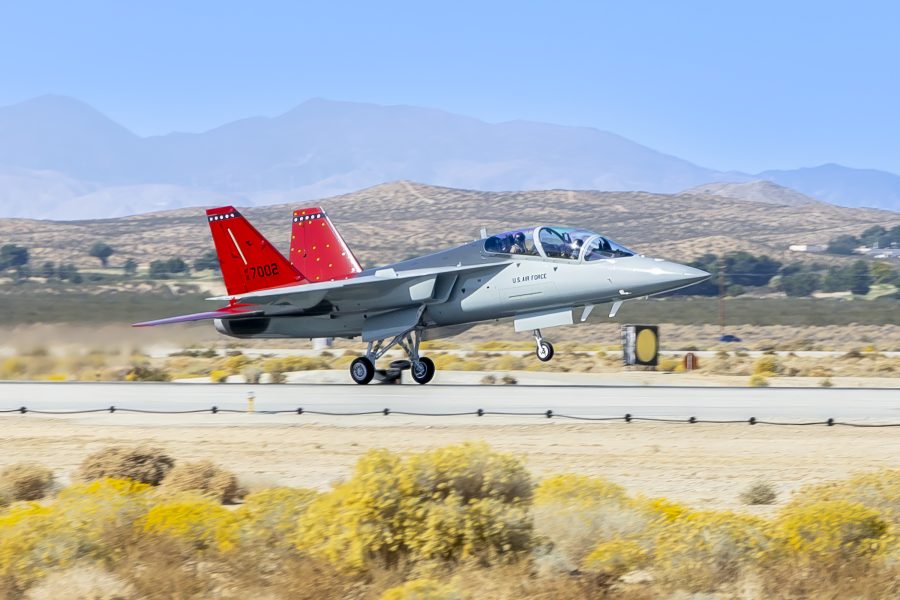
Air Education & Training Command received its first T-7A Red Hawk when the long-awaited next-generation jet trainer landed at Joint Base San Antonio-Randolph on Dec. 5.
The plane’s arrival from Boeing’s St. Louis manufacturing plant was relatively subdued after a ceremony to celebrate the occasion was scrapped due to weather. But the milestone is still a big one for the T-7 program.
More than two years after the Air Force accepted its first T-7 at Edwards Air Force Base, Calif., in 2023, which was used for developmental testing, the first operational aircraft is assigned to the 99th Flying Training Squadron, which is responsible for training instructor pilots. But first the pilots who teach the instructors need to get their hands on the plane.
“The initial flying will be done to get the initial cadre qualified, and then we are going to be putting the aircraft through its Initial Operational Test and Evaluation, or IOT&E, phase to make sure it performs the way we intend it to perform in the missionized setting we want to use it in,” said Lt. Col. Michael “Hyde” Trott, commander of the 99th Flying Training Squadron, briefing reporters. “We will be working through that hand in hand with our IOT&E partners.
“Our first students … [are] projected in the fall of 2027, when we will be asked to start producing Pilot Instructor Training students to be instructors in the T-7,” he said.
The 99th’s heritage dates back to World War II, when it was the 99th Pursuit Squadron, manned by the famed Tuskegee Airmen. The T-7 was named “Red Hawk” to honor the Tuskegee Airmen’s “Red Tails” nickname.
“We are prepared to hit the ground running and make sure we create the best foundation possible for the next 30 to 40 years of pilot training and to write another storied chapter in the legacy of the Tuskegee Airmen and the 99th,” Trott said.
While the first pilots train in flight, maintainers will get acquainted with the care and sustainment of the aircraft through the IOT&E process, and will later teach others.
“What we typically do for an aircraft is it will have its acceptance inspection at its first duty station, and that’s where we really spend time getting to know the jet, the ins and outs, making sure all the paperwork is in order, that we have a safe and reliable platform to fly,” said Jillian T. Watson, AETC’s director of logistics, engineering, and force protection. “So that’s the first thing that we do from a maintenance perspective. After that, we’re going to be hitting the ground running on maintenance familiarization, training for our first team of professionals who will shepherd this jet through its initial squadron stand-up here at Randolph.”
A second jet is expected by spring 2026, with the 99th eventually operating 14 aircraft. Eventually, the Air Force plans to have 351 T-7s spread across five AETC bases. The Red Hawks are intended to replace the aging T-38 Talon, the workhorse jet trainer for advanced pilot training since the 1960s. Today, however, the T-38 is increasingly hard to maintain and outdated, requiring student pilots often need to “relearn” techniques when they move on to more advanced operational jets like the F-35.
In a Dec. 3 release, AETC said it has plans for the T-7 to also “eventually” replace the T-6 Texan II, used for undergraduate pilot training. A spokesperson said those plans have not been finalized.
The Red Hawk promises major advances, from stadium-style seating, where instructors can look over the shoulders of their students, to advanced technology allowing for “live, virtual, and constructive training,” enabling pilots to fly missions in tandem with students in simulators.
“Let’s say we only want to produce four aircraft to fly in the air. I can have four sims tied into the same scenario and get the same learning,” Trott said. “A sim sortie will never fully replace a flight sortie, but they can get the same learning and training in the same scenario with their brothers and sisters in the aircraft at a much cheaper cost.”
The new trainer jet is much more representative of the fourth- and fifth-generation fighters pilots will fly once they reach the operational fleet. But it’s been a long road to delivery. Air Force and Boeing officials initially touted the Red Hawk as a pioneer of digital design, boasting how quickly the jet moved from concept to prototype, and anticipating rapid delivery and production. But testing exposed problems, such as wing rock at high angles of attack, issues with the flight control software, and questions about testing data for its escape system. Funding issues also contributed to delays.
The service approved a new acquisition strategy in January 2025, however, insisting that they needed to start fielding the T-7 quickly and learn as they go, because the T-38 was running out of time.
That starts with the first delivery to Randolph.
“The aircraft delivery is the first physical representation of progress within the program,” said Brig. Gen. Matthew Leard, AETC’s director of plans, programs, requirements, and international affairs, in a statement.