
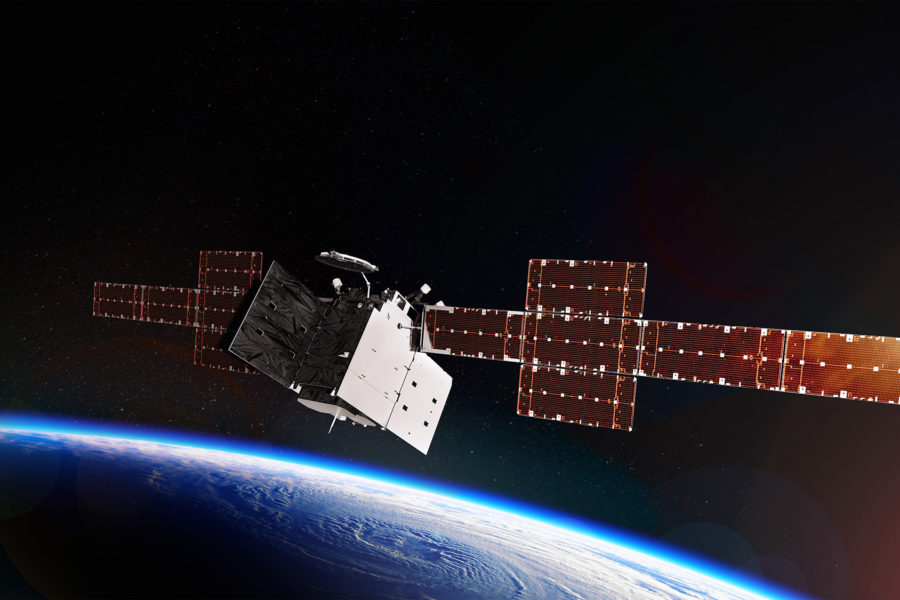
WGS provides worldwide, high-capacity communications for deployed air, land, and sea forces. The system is designed to augment and then replace DSCS X-band frequency service. It also augments the one-way Global Broadcast Service Joint Program Ka-band frequency capabilities and provides a new high-capacity, two-way Ka-band frequency service. Block I includes: SV-1 (Pacific region), SV-2 (Middle East), and SV-3 (Europe and Africa). Block II satellites are modified to better support the airborne ISR mission and include: SV-4 (Indian Ocean), and SV-5 and SV-6, purchased by Australia in 2013. The U.S. is partnering with Canada, Denmark, Luxembourg, the Netherlands, and New Zealand on Block II follow-on satellites SV-7 to SV-10.
The Space and Missile Systems Center conducted tests to field anti-jamming capability for SV-1 through SV-10 starting in 2022. Congress added funds to procure the 11th and 12th satellites, but USSF opted for the single, modernized WGS-11+ platform. Congress added FY23 funds to again procure WGS-12 to ensure depth of coverage, augmenting the future Protected Tactical SATCOM (PTS), which will provide battlefield coverage in contested spectrum environments. USSF demonstrated PTS and is working to field an IOC capability using a WGS satellite for the Indo-Asia Pacific theater. The capability could be extended to the full constellation, permitting an advanced anti-jam/low probability of interception bridge to PTS, augmenting the future constellation.
The Boeing-designed WGS-11+ will offer roughly twice the capability, in addition to stronger, more reliable coverage, and was initially slated for launch in 2025, but is now scheduled for later this year. It will host a dedicated PTS payload in addition to being the first WGS satellite carried into orbit by a ULA Vulcan Centaur. Poland and Japan signed agreements to join WGS in 2024 primarily utilizing the two latest satellites.
Wideband Global SATCOM Technical Data
Contractor: Boeing.
Operator/Location: USSF CFC, Mission Delta 8, 4th Space Operations Squadron (4 SOPS), Schriever SFB, Colo.
First Launch: October 2007.
IOC: April 16, 2008.
Design Life: 14 yr.
Launch Vehicle: Atlas V, Delta IV; planned: Vulcan Centaur (WGS-11).
Constellation: 10 satellites.
Active Satellites: •SV-1. Block I, launched in 2007; active. •SV-2. Block I, launched in 2009; active. •SV-3. Block I, launched in 2009; active. •SV-4. Block II, launched in 2009; active. •SV-5. Block II, launched in 2013; active. •SV-6. Block II, launched in 2013; active. •SV-7. Block II follow-on, launched in 2015; active. •SV-8. Block II follow-on, launched in 2016; active. •SV-9. Block II follow-on, launched in 2017; active. •SV-10. Block II follow-on, launched in 2019; active.
Dimensions: Based on Boeing 702 Bus.
Weight: 13,000 lb at launch.
Performance: Approx. 10 times the capability of a DSCS satellite.
Orbit Altitude: Geosynchronous.
Power: Solar arrays generating 9,934 watts.