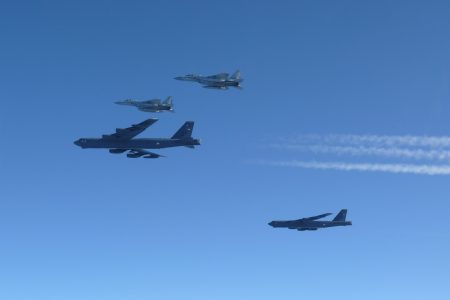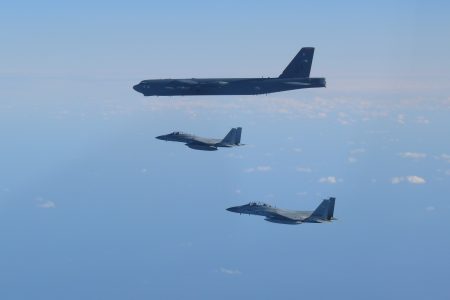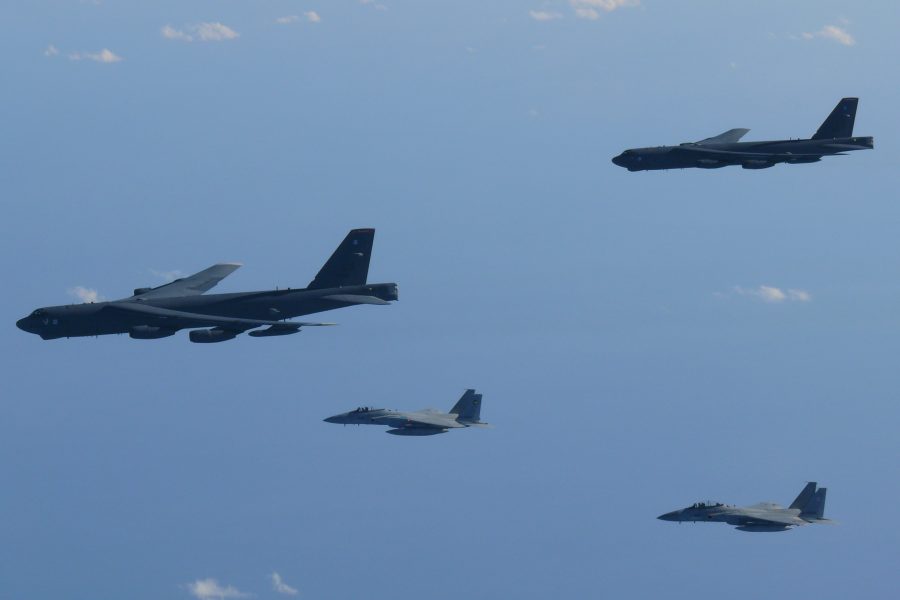
Two U.S. Air Force B-52 Stratofortress bombers flew with Japanese fighters over the Sea of Japan after a string of Chinese provocations toward Japan—including a joint bomber patrol with Russia—in response to Japanese Prime Minister Sanae Takaichi’s comments about Taiwan.
The B-52s were joined by three stealthy F-35s and three multirole F-15Js, Japan’s version of the Eagle, flown by the Japan Air Self-Defense Force.
“The JSDF & the U.S. Armed Forces conducted a bilateral exercise over the Sea of Japan, demonstrating our readiness and response capabilities,” Pacific Air Forces wrote in a social media post. “Training together reaffirms our commitment to the U.S.-Japan Alliance & strengthens deterrence.”
Tensions between China and Japan grew after Takaichi told the Japanese parliament on Nov. 7 that a Chinese attack on Taiwan would endanger Japan’s security and might prompt a military response. China’s foreign minister responded by accusing Japan of “grossly interfering with China’s internal affairs.”
Then two Chinese H-6 and two Russian Tu-95 bombers conducted a joint patrol earlier this week near Japan, a mission that Japanese Defence Minister Shinjiro Koizumi said in a post on X was “clearly intended as a show of force against our nation.”
Prior to that, on Dec. 6, Chinese fighters from the aircraft carrier Liaoning locked their radars onto Japanese planes that were intercepting them near Japanese airspace.
The B-52s that flew with the Japanese were assigned to the 2nd Bomb Wing at Barksdale Air Force Base, La., and featured the wing’s “LA” tail flash.
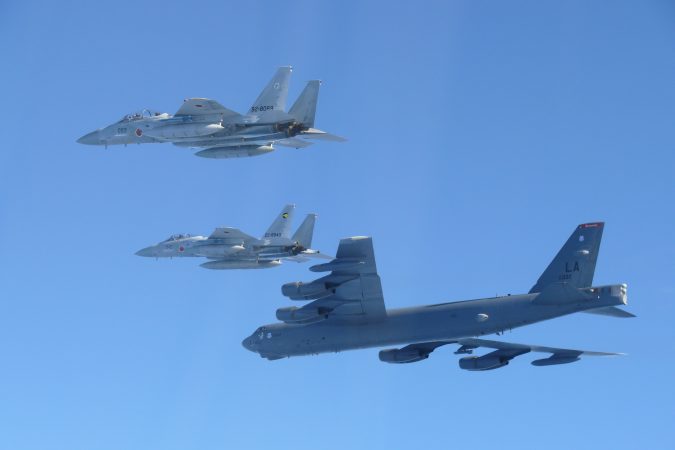
Japan’s Joint Staff said in a statement that the mission occurred “amid an increasingly severe security environment surrounding Japan” and “reaffirms the strong will between Japan and the U.S. not to tolerate unilateral changes to the status quo by force.”
China considers Taiwan, a self-ruled democracy, to be part of its territory and has increased its military pressure on Taipei in recent years, conducting mock military exercises that have mimicked an invasion or blockade. The White House’s new National Security Strategy says that deterring a Chinese attack on Taiwan remains a priority and that the United States and its allies must develop the capability to thwart “any attempt to seize Taiwan.”
Koizumi also spoke via video conference with NATO Secretary General Mark Rutte on Dec. 10. The two officials discussed the joint Chinese and Russian bomber flight on Dec. 9 and the targeting of Japanese aircraft by the Chinese fighters’ radars.
The B-52 flight with Japan is not the only high-profile bomber mission the U.S. has conducted recently. In the late hours of Dec. 10, at least one B-52, assigned to Minot Air Force Base, N.D., was operating off the coast of Venezuela, open-source flight tracking data shows. The bomber was visible for just under 30 minutes with its transponder on. U.S Southern Command and Air Forces Southern, which oversee forces in the region, did not immediately respond to a request for comment.