
U.S. military and law enforcement officials captured Venezuelan President Nicolás Maduro in a high-stakes military operation on Jan. 3, a mission carried out by the Army’s Delta Force and supported by extensive American airpower.
More than 150 aircraft—including bombers, fighters, intelligence, reconnaissance, surveillance, and rotary wing aircraft—supported “Operation Absolute Resolve,” as the mission was dubbed, according to Air Force Gen. Dan Caine, Chairman of the Joint Chiefs of Staff.
Participating aircraft included B-1B Lancer bombers; F-22 Raptor, F-35 Lighting II, and F/A-18 Super Hornet fighters; EA-18 Growler electronic attack planes; E-2 Hawkeye early warning aircraft; various intelligence, surveillance, and reconnaissance aircraft; and numerous drones. Helicopters from the Army’s elite 160th Special Operations Aviation Regiment descended on Maduro’s location.
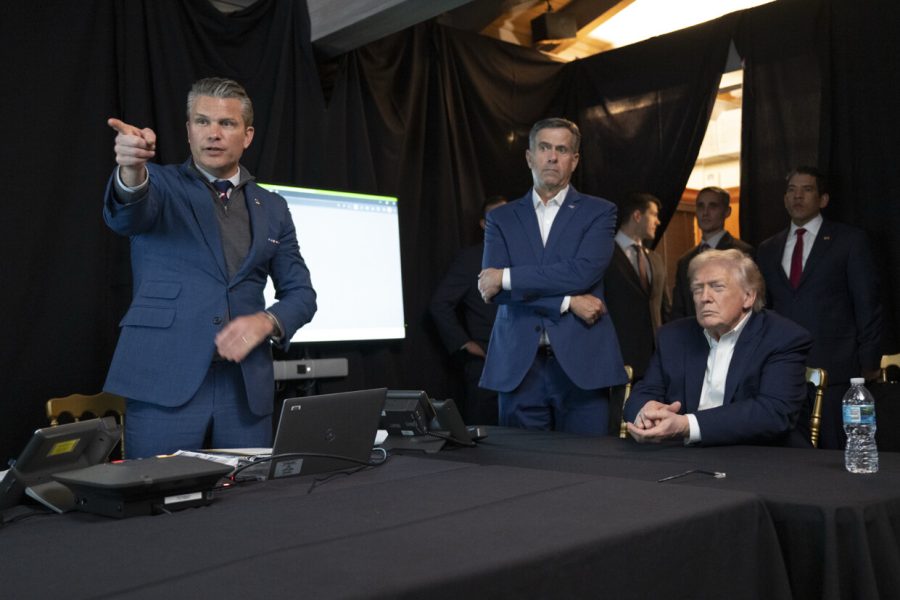
“As the force began to approach Caracas, the Joint Air Component began dismantling and disabling the air defense systems in Venezuela, employing weapons to ensure the safe passage of the helicopters into the target area,” Caine told reporters in a joint press conference with President Trump, Secretary of State Marco Rubio, and Defense Secretary Pete Hegseth at the president’s Mar-a-Lago residence in Florida.
“The goal of our air component is, was, and always will be, to protect the helicopters and the ground force and get them to the target and get them home,” Caine added.
U.S. Space Command, U.S. Cyber Command, and intelligence agencies, including the CIA, NSA, and the National Geospatial-Intelligence Agency, participated in the effort, Caine said. The mission included knocking out electricity in the capital.
Caine said the helicopter insertion force, which included law enforcement personnel, flew into Venezuela at an altitude of just 100 feet over the water, reaching Maduro’s compound at 1:01 a.m. Eastern time.
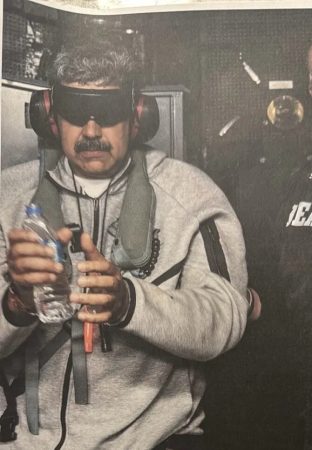
The U.S. force came under fire and returned fire. One U.S. helicopter was struck, but remained flyable, and completed the mission. Some U.S. personnel were injured, Trump said. None were killed.
By 3:29 a.m. Eastern time, Maduro and his wife were embarked aboard the USS Iwo Jima amphibious assault ship, from which they were taken to the U.S. for trial, U.S. officials said.
Poor weather delayed the operation over a period of days, but “last night, the weather broke just enough, clearing a path that only the most skilled aviators in the world could maneuver through—ocean, mountain, low cloud ceilings,” Caine said.
The role of airpower was critical to the operation’s success. Mark Montgomery, a retired Navy rear admiral and senior fellow at the Foundation for Defense of Democracies, said the “airstrikes on military targets serve two purposes: to create the space for Special Forces to conduct their capture operation, and to signal to the Venezuelan military that ‘this is not a fight you want to take up.’”
The capture of Maduro on a moonlit night created a power vacuum in Venezuela, which Trump said the U.S. would fill until there is a “proper transition” to a new Venezuelan leadership.
Trump said the U.S. operation involved great risk. “This is an attack that could have gone very, very badly,” Trump said. “We could have lost a lot of people last night. We could have lost a lot of dignity. We could have lost a lot of equipment.”
But he said a “second wave” of U.S. forces was standing by, ready to intervene if necessary. “We’re ready to go again if we have to,” he added.
The U.S. forces deployed for the operation included 12 F-22s from Joint Base Langley-Eustis, Va. Publicly available imagery shows Air Force F-22s are on site at Roosevelt Roads Naval Station, Puerto Rico, alongside the Vermont Air National Guard F-35As—a unit that specializes in suppression of enemy air defenses—U.S. Marine Corps F-35Bs, and other U.S. military aircraft.
During the Trump administration’s buildup of military might in Latin America, the U.S. has also been using air bases elsewhere in Puerto Rico, the U.S. Virgin Islands, the Dominican Republic, El Salvador, and other locations in the region, including the USS Gerald R. Ford aircraft carrier and the USS Iwo Jima, as well as bases in the continental U.S.
The B-1 bombers appear to have originated from Dyess Air Force Base, Texas, according to open-source analysts. Both F-22s and B-1s have flown south from their home bases in the U.S. in recent days, civilian flight trackers have observed. Those operations could have been a rehearsal mission, decoys, or even the start of operations that were later called off. What appears to be a secretive RQ-170 Sentinel, a stealthy, flying-wing surveillance drone, was also spotted over Venezuela in videos posted on social media. Caine said U.S. aircraft deployed from 20 different locations in the Western Hemisphere on land and at sea during the operation to capture Maduro.
U.S. Southern Command, which oversees forces in the region, referred questions about the operation to the Pentagon, which did not immediately respond to a request for comment.
The operation occurred on a notable day in history: the 36th anniversary of the U.S. capture of Panamanian strongman Manuel Noriega during Operation Just Cause, in which U.S. forces invaded Panama to topple its drug-running dictator.