
Trading 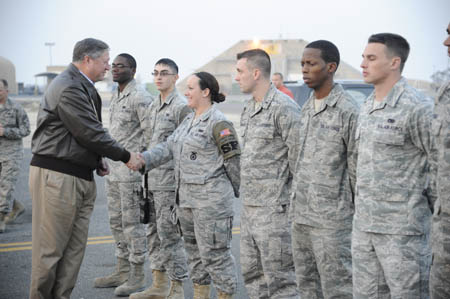 size to maintain a quality force and staying focused on readiness and modernization likely remains the best combination of choices available to sustaining the Air Force—and the US military overall—as the world’s finest in fiscally challenging times, said Air Force Secretary Michael Donley. Admittedly, that “will be politically difficult and challenging to implement,” wrote Donley in an opinion piece posted on Jan. 8 at the AOL Defense website. While there is “little disagreement” that the Air Force must maintain readiness and modernize, there is “real resistance” to the Air Force divesting aircraft and downsizing installations, he stated. “It is understandably difficult to accept reductions that affect individual communities,” wrote Donley. “But it is not possible to avoid real impacts” without such changes given the $487 billion in defense reductions required by the Budget Control Act, he said. (That figure doesn’t include the additional $500 billion that budget sequestration would take from the defense budget.) “We will adjust and compromise as necessary, but we’ll need broad consensus with Congress on the way forward to avoid a hollow force,” wrote Donley.
General Atomics, the maker of one of the Air Force’s first Collaborative Combat Aircraft, has ambitious plans for its family of semi-autonomous drones beyond the FQ-42, including a flying-wing aircraft capable of carrying out both reconnaissance and strike missions. Meanwhile, the Air Force Research Laboratory announced a new program to…