
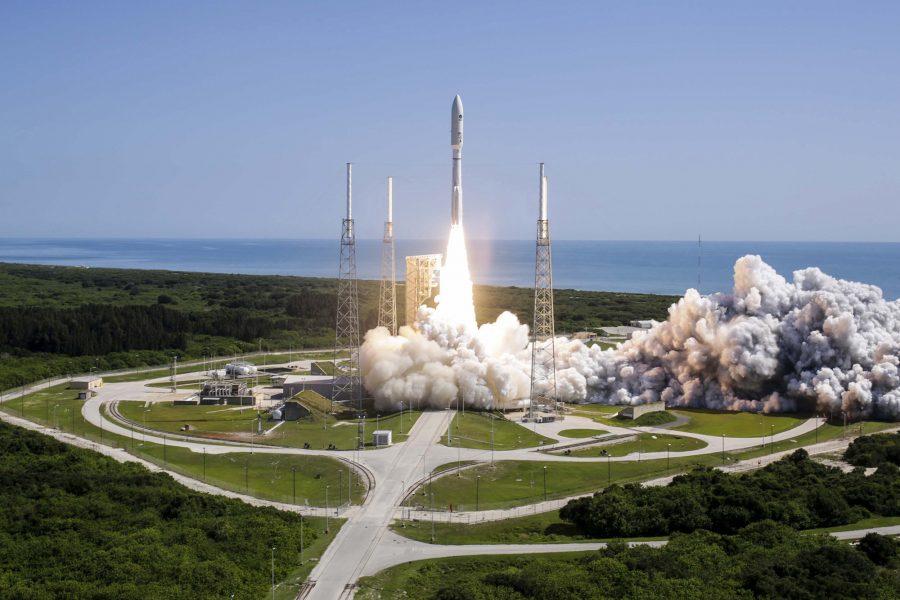
The Space Force is planning improvements at its launch ranges to better accommodate the logistics and infrastructure demands that come with the launch industry’s shift toward reusable rockets, according to the commanders of the service’s two launch deltas.
SpaceX’s Falcon 9 rocket has long been the only launch vehicle with a reusable first-stage booster, but that’s changing. Last month, Blue Origin recovered the first stage of its New Glenn rocket following the vehicle’s second flight. And longtime military space lift provider United Launch Alliance has a plan to eventually recover the engine of its Vulcan rocket through a system called Sensible Modular Autonomous Return Technology, which it expects to start flight testing next year.
Rocket reusability means companies can fly missions more frequently and at lower costs, but it also puts strain on the infrastructure at the Space Force’s ranges at Cape Canaveral Space Force Station, Fla., and Vandenberg Space Force Base, Calif. Speaking Dec. 2 at a Special Competitive Studies conference, the commanders of those ranges said they’re working with industry and Congress to reduce the strain on launch infrastructure.
“What we have to do here … is upgrade our infrastructure to be able to handle that throughput and enable them to leverage that technology to the fullest extent, decrease the number of days it takes to go to the next operation, and just get more efficient overall with how we operate,” said Col. James Horne, commander of Space Launch Delta 30 at Vandenberg.
When a company recovers a booster, they typically transport it via barge back to the range’s wharf. The booster is then loaded on a truck and driven to a facility for refurbishment. Horne and Col. Brian Chatman, who leads Space Launch Delta 45 at Cape Canaveral, said their ranges weren’t designed to handle that much traffic.
At the Cape, which last month logged its 100th launch for the year, the road used to move recovered boosters is the single line of transportation on and off the range, Chatman said. That wasn’t an issue 10 years ago when it was supporting 10 to 20 missions annually, but at a range that’s already running out of room due to surging demand, it’s on the verge of presenting a significant challenge.
That challenge will only grow over the next decade—by 2035, SLD 45 expects to be supporting 300 launches annually. The Space Force also announced Dec. 1 that it approved SpaceX’s Starship rocket to launch from the range. The massive rocket, still in its flight test phase, will require significant infrastructure and support.
As the Space Force weighs its options for addressing its infrastructure needs, Chatman said SLD 45 will host industry later this month to discuss the challenge and hear potential solutions, which could include widening roads, new processing facilities, or a booster-specific transport line.
At Vandenberg, SLD 30 is planning a “massive” overhaul of its wharf, which all launch providers must use to transport their rockets to the range. Horne said the goal is to enable more simultaneous activity through the entry port and to increase the wharf’s usability, which is often impacted by weather.
“Right now, we’re hovering around 50 percent usable days a year at our harbor just based on the sea walls and some of the logistics behind it,” Horne said. “We’re trying to get that up to the 89 percent range.”

Chatman and Horne said their teams are also working closely with Congress to ensure they have the funding and authorities they need. In recent years, lawmakers have approved policy changes that make it easier for the Space Force to share utilities and other costs with commercial providers. Congress has also approved $1.3 billion in funding through 2028 for the service’s “Spaceport of the Future” modernization effort.
The legislation and resources have been helpful, the range commanders said, but they’d like to see looser restrictions on the Space Force’s use of private funding for infrastructure upgrades. Today, when companies lease a launch complex, they pay to maintain and build out those facilities but don’t contribute to the broader range modernization projects, even though they will ultimately benefit from those improvements.
“We’re actively engaged with Congress and with the launch service providers on how we can facilitate the launch service providers being able to leverage their funds to get after additional upgrades that are outside the fence line of the launch complexes that they have,” Chatman said.