
AURORA, Colo.—The Space Force is moving to bolster its contributions to the long-range kill chains that industry and government officials agree the U.S. will need in a large-scale conflict, leaders said Feb. 24 at AFA’s Warfare Symposium.
Long-range kill chains, or kill webs, are the ways in which various sensors and shooters across the joint force share target data, theoretically allowing forces to fire without being able to physically see the target.
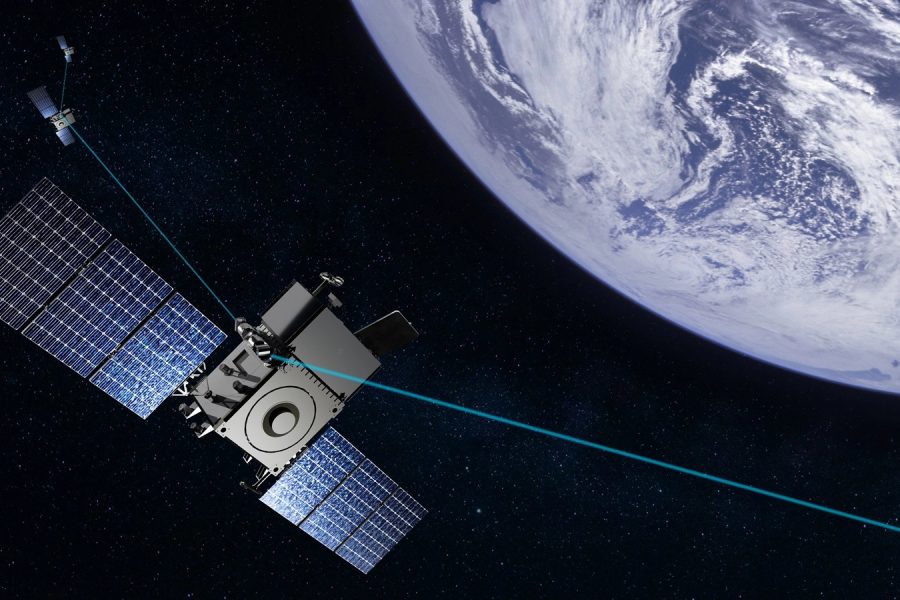
The Space Force has a major role to play with those kill webs, both by transporting the data between sensors and shooters and collecting data of its own.
When asked during a panel discussion what bottlenecks threaten kill chains, Elaine Bitonti, a vice president at RTX’s Collins Aerospace, pointed to data transport.
“When you’re going to have that type of scale of event, how are we going to get all of the data from the different shooters, the different sensors, and how are we going to quickly process that into decision-making?” Bitonti asked. “We’re going to have to be doing that on a scale that’s never been done before, and so that’s really a difficult problem.”
In any future large-scale conflict, experts expect that the United States would have to prosecute hundreds of kill chains to strike targets across vast distances and in contested areas.
Col. Jason West, commander of System Delta 85, said his team is getting after that problem. Established in August 2025 to delivers tools for space domain awareness, missile warning/tracking, missile defense, battle management, and space intelligence, System Delta 85 has hit the ground running.
“Look at solicitations on the street, and it actually maps,” West said during a separate media roundtable. “We’re upgrading the way we do data transport, we’re upgrading federation, and we’re upgrading the way we do battle management.”
Shannon Pallone, program executive officer for battle management, command, control, communications, and space intelligence, said scale is not the only challenge with long-range kill chains; speed is also critical, to reduce uncertainty as quickly as possible for decision-makers.
“We’re really looking across the portfolio, industry, on how do we integrate better? How do we integrate faster? How do we simplify the architecture?” Pallone said. “All of that takes latency out of the system and really trying to methodically attack it in terms of where do we get the biggest improvements first?”
But space won’t just be needed to move data from one point on Earth to another—increasingly, long-range kill chains will deal with threats in orbit too.
The Space Force is still bolstering the first link of that chain, said Col. Bryon McClain, PEO for space combat power: space domain awareness.
McClain cited the work of famed Air Force veteran and author John Boyd, who coined the term Observe, Orient, Decide, Act Loop. The OODA Loop has been used across the military as a decision-making framework to gain combat advantages, and the Space Force is no different.
“Any part of a kill chain, whether that’s one person inside a fighter, whether it’s operational or whether it’s strategic, that’s what you have to do,” McClain said.
Observing, or creating domain awareness, can help operators understand threats to their own kill chain or ways to disrupt an adversary’s, and Space Force leaders have been touting the need for better space domain awareness for months now.
McClain and others pointed to a recent development boosting that domain awareness: a partnership with the Defense Innovation Unit soliciting satellites capable of taking close images of spacecraft in geosynchronous Earth orbit: essentially, a way to spy on adversary satellites.
DIU has dubbed it the Geosynchronous High-Resolution Optical Space-Based Tactical Reconnaissance program, or GHOST-R. The goal is to rapidly place satellites in orbit to track both friendly and adversary satellites and capture images good enough to determine their purposes.