
The Space Development Agency wants to launch hundreds of satellites into low-Earth orbit over the next few years—and thanks to a new contract, it now has a way to get rid of some when their service life is over.
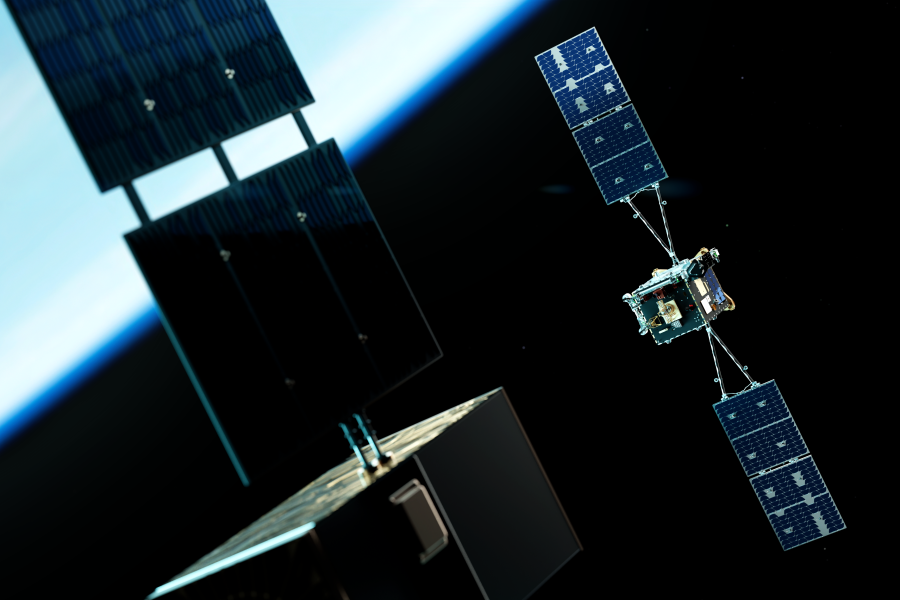
Starfish Space announced the $52.5 million deal for “disposal as a service” on Jan. 21. The startup firm is targeting 2027 to launch its Otter spacecraft, use it to dock with an SDA satellite, and drag it down.
“The disposal process looks like Starfish climbing into the operational belts or orbits, docking with the client satellite that’s been selected; we will bring both of us down to a lower altitude, separate, let the client spacecraft then go through a faster cycle of de-orbiting,” Starfish cofounder Trevor Bennett told Air & Space Forces Magazine.
Once a satellite reaches a certain altitude, it is quickly pulled by Earth’s gravity toward the surface. Some satellite manufacturers design their spacecraft to burn up in the atmosphere, while others time the descent so the satellite crashes into a remote area of the Pacific Ocean often called the “satellite graveyard.”
Starfish’s Otter doesn’t follow the satellite it’s deorbiting, though. Bennett said it can climb back into low-Earth orbit and repeat the disposal process multiple times. While he declined to specify how many satellites one Otter spacecraft can dispose of, he did say “it’s not one, it’s not two, it’s actually much more than that and gets closer to 10.”
The contract with SDA is for an initial launch and to dispose of at least one satellite, with options for more, Bennett said. Both Starfish and SDA declined to say how many satellites may be covered by the disposal contract. Considering the 2027 timeline, it is almost certain the satellites being de-orbited will be from SDA’s “Tranche 0” demonstration layer, which included 27 spacecraft.
Back in September 2024, SDA tapped six companies—including Starfish—to conduct feasibility studies for satellite disposal as a service. While Starfish’s study turned into an operational contract, an SDA spokesperson said the agency had no other contract awards to announce.
Satellite disposal is a growing market for the entire space industry. In the past, operators would move spacecraft near the end of their service life into so-called “graveyard orbits,” away from any active satellites. But that’s becoming less feasible as companies plan to launch tens of thousands of satellites in the near future, particularly in the crowded low-Earth orbit.
Given how crowded things are becoming and the decades or more it can take for a satellite’s orbit to naturally “decay,” pulled by Earth’s gravity into the atmosphere, there is concern about space junk.
U.S. Space Command committed to “limiting the generation of long-lived debris” as one of the tenets of responsible behavior in space it released in 2023, but Bennett said the issue goes beyond simply being a good steward of the environment.
“[SDA] now have a set of orbital … planes that are of value to them, and so they want to make sure that stays clear and they can continue to operate in those,” Bennett said. “The ways that a dead satellite could impose extra problems in the constellation is consistent maneuvering for conjunction avoidance, or it’s retaining a slot that they would otherwise use for another spacecraft, or the desire to just pull it out so that it doesn’t just sit there and become an object for inspection or characterization by somebody else.”
Bennett also noted that there is often uncertainty about just how long a satellite’s service life can be, which can cause operators to de-orbit a spacecraft preemptively rather than risk it dying and cluttering up orbit. Disposal services, he argued, will allow SDA to see just how long its first satellites can operate without worrying about de-orbiting them—and thus inform their future decisions for the broader constellation.
Satellite disposal is just one mission area where Starfish is focusing. The company also wants to use Otter essentially as a “jetpack” for older satellites by docking with them and propelling them in orbit. The company announced a deal with the Space Force back in May 2024 for such a mission, with a launch targeted for 2026. Bennett declined to share more details on how that mission is progressing.
More broadly, though, the Space Force has dipped its toes into the market for space mobility and logistics, to include service life extension “jetpacks,” fuel depot satellites, or satellites with robotic arms for on-orbit repairs.
“What we’re trying to get to is an industry that does rely on on-orbit servicing, or spacecraft to spacecraft interaction, a lot,” Bennett said. “And the first stepping stones are these, go do some disposal missions, go do a jetpack or life extension mission in [geosynchronous orbit], and do some other dynamic space operation capabilities.”