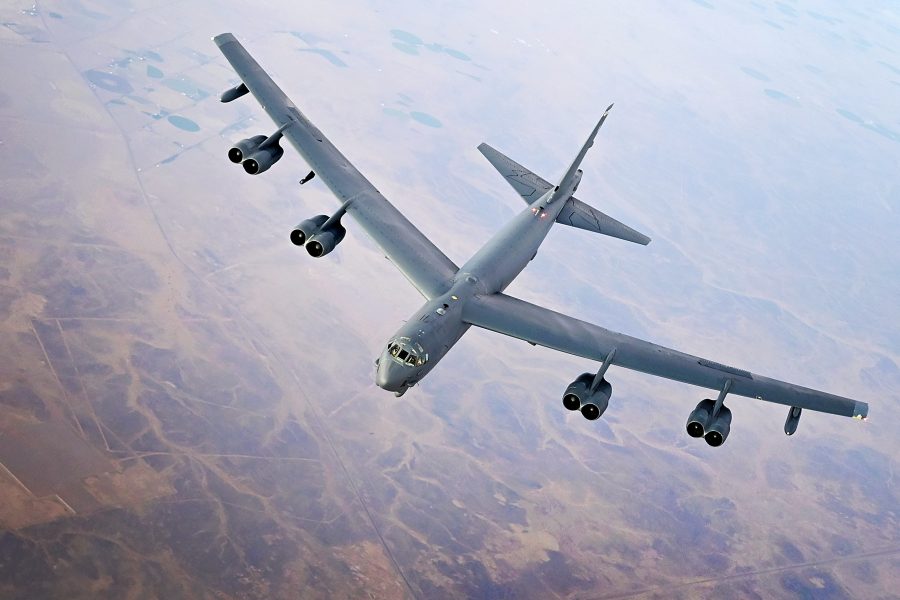
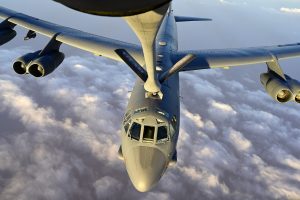
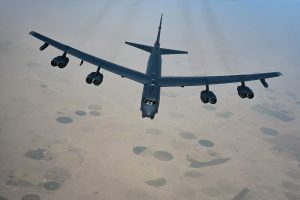
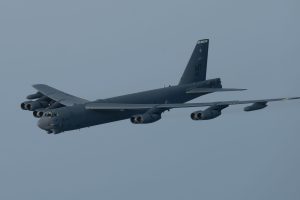
A U.S. Air Force B-52 Stratofortress, assigned to the 5th Bomb Wing, conducts a presence patrol mission over the U.S. Central Command area of responsibility June 12, 2024. The U.S. remains committed to regional security and is prepared to respond to any state or non-state actor seeking to broaden or escalate conflict across the region. (U.S. Air Force photo by Master Sgt. Matthew Plew)
Audio of this article is brought to you by the Air & Space Forces Association, honoring and supporting our Airmen, Guardians, and their families. Find out more at afa.org
Air Force B-52 bombers roared over the Arabian Peninsula twice last week, flying alongside an American MC-130J and allied fighters during bomber task force missions.
The Stratofortresses, originally from Minot Air Force Base, N.D., came from RAF Fairford, U.K., where they are currently deployed for a bomber task force.
The June 12 and June 14 flights “incorporated fighter escorts from several coalition nations,” Air Forces Central said in a release, though they did not disclose what nations flew alongside the B-52. The release noted that the flights included passes over the Red Sea and Arabian Gulf.
“Bomber Task Force missions highlight the U.S.’s ability to rapidly field combat airpower while enhancing training opportunities and interoperability for regional allies and partners operating alongside U.S. forces,” the release stated.
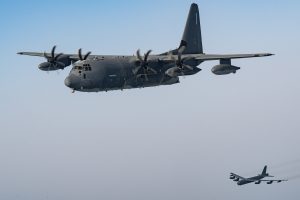
On at least one flight, the B-52 was joined by a U.S. Special Operations Command-operated MC-130J. AFCENT noted in its release that the MC-130J took part in familiarization training this spring, with Airmen in the Middle East orienting themselves on “palletized effects”—cruise missiles on a pallet dropped out the back of cargo aircraft.
The B-52s’ tour over the Middle East comes as the region remains on edge. Israel’s war against Hamas in Gaza continues, and Houthi rebels in Yemen have intensified their attacks on shipping in the Red Sea. Over the past several days, U.S. Central Command said it struck several Houthi missile launchers, sensors and drones, though it did not disclose what assets it used to conduct the strikes.
In April, B-1 bombers on a rotation in Spain deployed to Turkey for exercises, bringing them close to the Middle East. In February, B-1s flew from the continental U.S. to take part in dozens of airstrikes in Iraq, Syria, and Yemen. And last November, B-1s flew three missions in CENTCOM over the course of eight days.
It’s been a little while longer since a B-52 flew over the region—in March 2023, a B-52 from Minot was escorted by fighters from seven different countries during a bomber task force mission.
Audio of this article is brought to you by the Air & Space Forces Association, honoring and supporting our Airmen, Guardians, and their families. Find out more at afa.org
Seven F-22 Raptor pilots have recently been awarded one of the military’s highest decorations for their actions during operations in the Middle East. Six of the pilots were decorated with the Distinguished Flying Cross for their role in Operation Midnight Hammer, the June 2025 strikes against Iranian nuclear facilities.
Three T-7A Red Hawk trainer jets flew together at Joint Base San Antonio-Randolph, Texas, on Sept. 16—one physical aircraft in the air and two virtual ones controlled from simulators on the ground, all sharing one common operating picture.
The Air Force and Defense Innovation Unit have selected seven companies to move forward on a program meant to produce a low-cost, semi-autonomous drone to succeed the MQ-9A Reaper, multiple sources confirmed to Air & Space Forces Magazine.
The Air Force awarded Boeing a $2.38 billion contract for 22 F-15EX Eagle II fighters on Sept. 29, narrowly meeting a deadline to use funds from last summer’s reconciliation bill or face cuts.
The Navy has awarded Boeing a contract worth more than $20 billion to build its new carrier-based sixth-generation fighter, the F/A-XX. Boeing is also building the Air Force’s sixth-gen F-47.
The Pentagon on Sept. 28 announced a contract potentially worth $20.7 billion for RTX to build Advanced Medium-Range Air-to-Air Missiles used by Navy and Air Force aircraft and for ground-based interceptors.
For the past four years, the idea of autonomous drone warfare like Collaborative Combat Aircraft has been discussed as a future concept, rather than near-term reality. But now that promised vision appears imminent, with the Air Force promising at least 1,000 such drones by 2032.
The Air Force’s emerging Collaborative Combat Aircraft program would suffer delays if Congress fails to pass a budget before the end of this calendar year, a top service official said Sept. 28.
Six U.S. Air Force F-35A fighters and 200-plus Airmen deployed to India on Sept. 26 for their first appearance in a large-scale exercise on Indian soil.
✓
Thank You!
Check your inbox to verify your email address and finish setting up your AFA account.
★
Welcome Back!
An account with this email already exists. Please log in to continue.
Subscribe to the Air & Space Forces Daily Report
The latest news from Air & Space Forces Magazine, as well as news from other leading publications, delivered right to your inbox every morning!
We’re sorry, there has been an error. Please review your input or try again later.