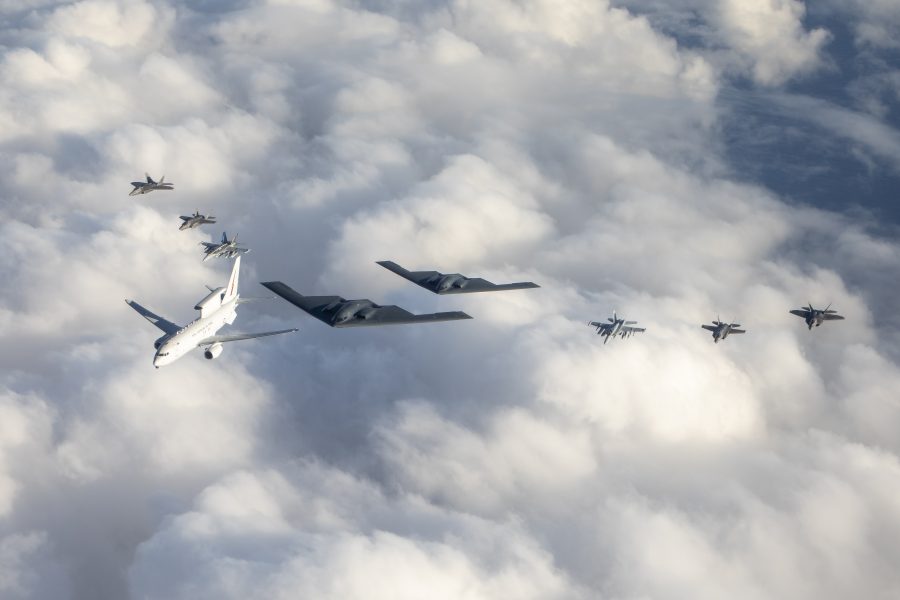
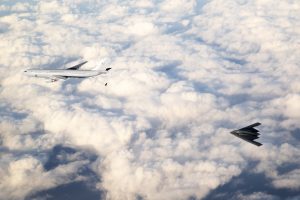
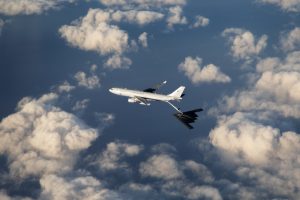
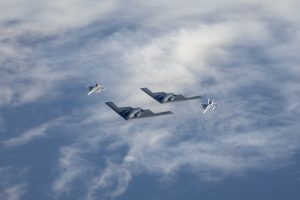
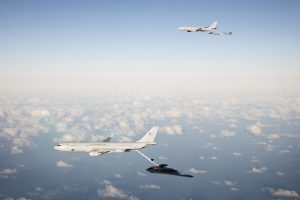
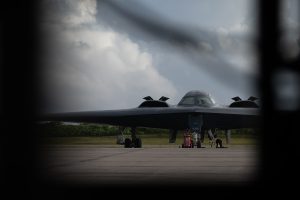
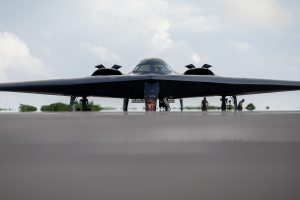
A Royal Australian Air Force E-7A Wedgetail, two EA-18G Growler jets and two F-35A Lightning II jets fly in formation with two United States Air Force B-2 Bombers and two F-22 Raptor fighter jets. Royal Australian Air Force photo by FSGT Christopher Dickson
Audio of this article is brought to you by the Air & Space Forces Association, honoring and supporting our Airmen, Guardians, and their families. Find out more at afa.org
The three B-2 Spirits that touched down in Australia last week for a Bomber Task Force have been making waves across the Indo-Pacific, with show-stopping formation flight and a rare landing at a strategic location.
Two of the B-2s conducted a flight escorted by American F-22s, two Royal Australian Air Force F-35As, two EA-18G Growlers, and one E-7A Wedgetail throughout the airspace of southeastern Australia on Aug 19—an impressive display of airpower between the two allies featuring some of their most advanced fighter, bomber, electronic warfare, and airborne early warning and control aircraft.
Australian KC-30A tankers later joined the flight to refuel the bombers and the Growlers mid-air.
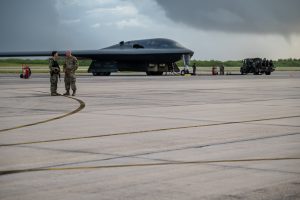
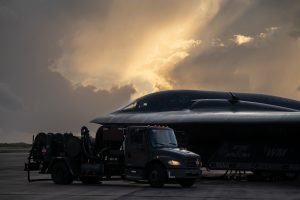
Later in the week, one of the B-2s made a quick pit stop at Diego Garcia in the Indian Ocean, located some 3,000 miles from the mainland. Airmen from the 110th Expeditionary Bomb Squadron changed crews while the ground team quickly refueled the bomber and got it airborne again, all with the engines running—a process known as “hot pitting.”
The team has streamlined this process to ensure more efficiency with fewer personnel.
“In the past, our hot pit crews have been a large group, with a big footprint, going out and setting up,” Col. Matthew Howard, 110th EBS deputy commander and B-2 pilot, said in a release. “With more iterations of this process, we’ve been making it leaner under the Agile Combat Employment concept, where we can land a jet with the minimum number of people, turn the jet, and then get it airborne.”
These bomber missions are designed to enhance readiness “to respond to any potential crisis or challenge in the Indo-Pacific” through joint operations, the release added.
“If we lose a tanker or don’t get a tanker for aerial refueling, a hot pit enables us to move our jet from location to location, refuel and complete the mission,” added Howard.
Diego Garcia hosts a Naval Support Facility and provides access to the Indo-Pacific, Southwest Asia, the Middle East, and Africa. It regularly sees USAF bombers fly in, such as in March when two B-52 Stratofortresses landed there. It has been four years, however, since the Air Force has announced a B-2 landing on the island.
The B-2s are currently deployed to RAAF base Amberley, along with two KC-135R tankers from the Illinois National Guard.
Earlier this month, the Air Force also deployed F-22s from the 27th Expeditionary Fighter Squadron to Australia. The Raptors, along with the RAAF’s F-35s, conducted a joint hot pit refuel mission at the nation’s western base, Curtin. The strategically located base is still undergoing development, as it prepares to host more temporary operations.
“We’re willing to take risks if it means better agility and combat capability,” Master Sgt. Luke Ashman, 27th Expeditionary Fighter Generation Squadron aircraft section chief, said in a release. “The execution of this went very smoothly, the RAAF seems to operate on the same wavelength as us.”
These bomber and fighter operations with Australian forces follow the U.S.-Australian ministerial conference earlier this month, where the two countries’ defense chiefs said they would increase the presence of U.S. aircraft in Australia.
“We’re increasing the presence of rotational U.S. forces in Australia” Defense Secretary Lloyd J. Austin said at the time, to include “more maritime patrol aircraft and reconnaissance aircraft operating from bases across northern Australia.” He added that the allies are planning on “more frequent rotational bomber deployments.”
Audio of this article is brought to you by the Air & Space Forces Association, honoring and supporting our Airmen, Guardians, and their families. Find out more at afa.org
The Air Force’s decision to more than double its purchase of F-15EX Eagle II jets may bolster the service’s fighter fleet, but it also comes with risks and questions officials will have to manage in the years ahead, a new Pentagon report warns.
The Air Force’s new nuclear security helicopter, the MH-139A Grey Wolf, achieved initial operational capability this month—a significant milestone in the service’s effort to replace its Vietnam War-era UH-1N Hueys but years later than originally planned.
The Air Force has issued a $100 million contract to combine its long-disjointed systems for managing aircrew readiness with software that is expected to reach initial operational capability next year, starting with the T-6A Texan II and the C-17 Globemaster III.
Lt. Gen. Jason D. Voorheis has taken command of the Air Force Life Cycle Management Center, a sprawling organization with a $400 billion portfolio, establishing him as one of the service’s top acquisition officials.
Inflation and rising costs for critical upgrades are swelling the price of the F-35 fighter, according to a newly released acquisition report on the fifth-generation jet.
The iconic “whup-whup-whup” of the 1st Helicopter Squadron’s UH-1N Hueys still echoes in the skies of the Washington D.C. area. But on Aug. 27, a new helicopter that first flew half a century after the Huey sat beside the stage for the activation of a squadron that’s a full 57…
The U.S. military’s ability to access air bases in Europe will be a central consideration as the Trump administration makes decisions on the future American military posture on the continent, the top Pentagon policy official said.
The Air Force awarded a sweeping—and potentially massive—F-15 contract to Boeing this week, one that a top aviation expert said could provide a new approach to major program acquisitions and greater stability for the defense industry.
The Pentagon on Aug. 25 announced a pair of Air Force contracts to Raytheon and Boeing, totaling more than $766 million, for advance work on adding new radars to the B-52H Stratofortress.
✓
Thank You!
Check your inbox to verify your email address and finish setting up your AFA account.
★
Welcome Back!
An account with this email already exists. Please log in to continue.
Subscribe to the Air & Space Forces Daily Report
The latest news from Air & Space Forces Magazine, as well as news from other leading publications, delivered right to your inbox every morning!
We’re sorry, there has been an error. Please review your input or try again later.