
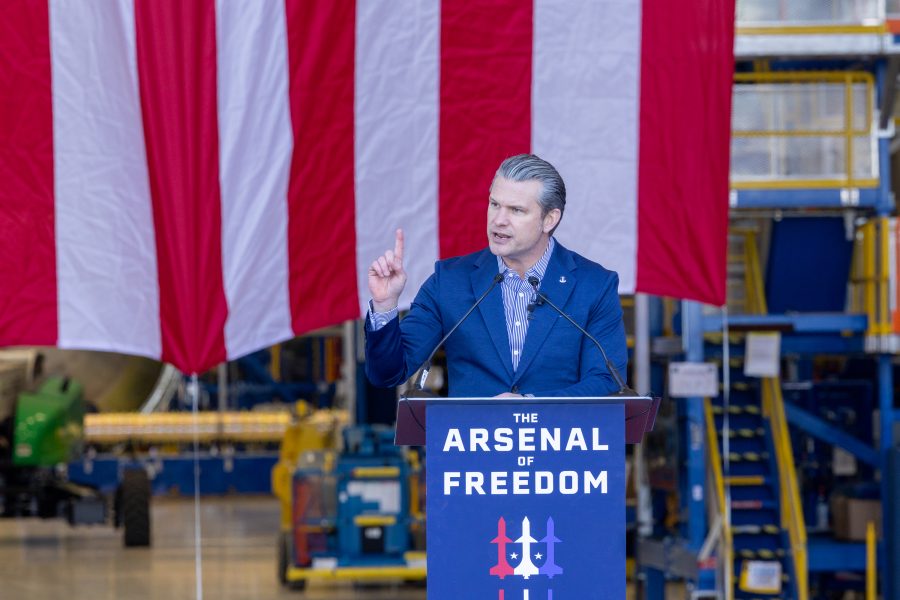
KENNEDY SPACE CENTER, Fla.—Defense Secretary Pete Hegseth exhorted the U.S. space industry to step up its efforts in a forceful Feb. 2 speech in which he called for a new era of American “space dominance.”
“I don’t mind people making lots and lots of money,” Hegseth told an audience of Blue Origin employees in an address intended to ensure the Pentagon has a competitive space industrial base.
“I’m a capitalist. We all are. But we need to raise the bar,” Hegseth added, speaking at the company’s Rocket Factory in Merritt Island.
The U.S. military’s future space capabilities will depend heavily on the efforts of companies like Elon Musk’s SpaceX and Amazon founder Jeff Bezos’ Blue Origin. Many observers have been concerned that the U.S. might become overly reliant on SpaceX to perform the lion’s share of its national security launches and saw Hegseth’s visit as an attempt to spur more competition in the military space sector.
“I think that the context is important,” said Todd Harrison, a senior fellow at the American Enterprise Institute and an expert in space policy. “Folks across government are getting more and more concerned about the level of dominance of SpaceX, both in launch and in satellite production. And part of DOD’s acquisition approach is to not get locked into a single source, so I think visiting Blue Origin is a tacit way of highlighting that they want there to be other sources when it comes to space in particular.”
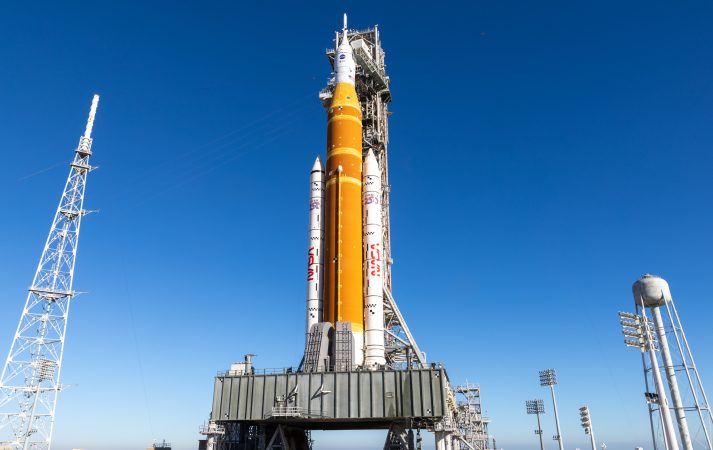
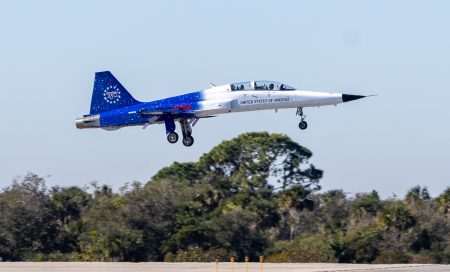
Hegseth’s visit included a trip to the Aretmis II spacecraft that will soon launch four astronauts around the moon, the closest America has come to its site of first triumph in the space race in nearly 50 years, and an aerial tour of Cape Canaveral in a fighter jet with NASA Administrator Jared Issacman.
Hegseth’s remarks were part of his “Arsenal of Freedom” tour of American defense firms across the country, in which he has touted acquisition reforms made last fall aimed at boosting competition and commercial solutions on munitions, production, shipbuilding, and artificial intelligence. The visit on Feb. 2 was his first to focus solely on space capabilities.
“The Arsenal of Freedom tour hit the Space Coast today, and [Hegseth]’s words are a powerful reminder that the strength of our nation is built on the ingenuity and unwavering spirit of our service members side by side with our industry partners,” Chief of Space Operations Gen. B. Chance Saltzman wrote in a post on X.
Spacepower has evolved in Pentagon parlance. Space is often called the ultimate high ground due to the nature of the domain—and it has become a critical piece of all military operations, from detecting missile launches by Iran and its proxies to Ukraine’s use of satellite Internet for command and control.
Saltzman has led Space Force leaders in articulating the need for “space superiority” to counter the growing threat from Russian and Chinese adversaries to America’s on-orbit capabilities. The U.S. military has been seeking to leverage more proliferated satellite constellations and signal space weapons America might use in self-defense.
Hegseth said the Trump administration understood the importance of space since he first came to office. The Space Force was established in 2019 as the sixth branch of the U.S. military during Trump’s first term.
“He established it for a reason,” Hegseth said. “President Trump, given the companies we have in this country like this one, can now make that vision a reality for the American people, a huge conundrum for our adversaries who are counting on a whole different dynamic.”
But the underlying purpose of Hegseth’s speech, officials said, was to promote the Pentagon’s new push for more competition, a theme he also struck when visiting SpaceX in January, currently the U.S. military and intelligence community’s go-to provider for the National Security Space Launch program, along with United Launch Alliance. Hegseth also visited startup Rocket Lab last month while in California.
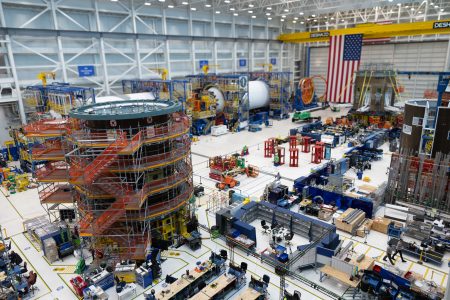

“We will continue to work with our partners because we have to dominate the space domain,” Hegseth said. “That means we’ll ensure that we keep building rockets and engines and landers that you make here at scale and at speed.”
Blue Origin is on track to compete for future National Security Space launches with SpaceX and ULA, a joint Boeing-Lockheed Martin venture. Its New Glenn rocket is in the process of being certified for NSSL missions.
But the firm has lagged behind its Texas-based rival led by Musk, and the two companies have at times engaged in an open rivalry, particularly among their billionaire founders.
“You see, we don’t care. You care, but we don’t care what company name is printed on the side of a rocket. You should care. I know you hope it says ‘Blue Origin,’” Hegseth said. “We don’t care what company name appears on ladders, on planes or what company name is painted on a satellite. We just want the best. And we don’t care how many lobbyists or accountants companies have. If you create the best, the fastest, at cost on behalf of taxpayers and warfighters, you’re going to win.”
Hegseth’s visit to the Space Coast, however, was not solely focused on the military, and he spent much of the day at NASA facilities.
In a Dec. 18 executive order on “Ensuring American Space Superiority,” Trump called for renewed space exploration, a return to the Moon, and a future lunar outpost. But the White House did not reestablish the National Space Council, which was led by Vice President Mike Pence in Trump’s first term, who pushed the Artemis program and other civilian space efforts. Issacman, an avid space enthusiast, had his nomination for administrator pulled in the spring amid a row behind his ally Musk and Trump, before he was renominated and confirmed late last year.


“[Space policy] is getting enough attention within DOD,” Harrison said. “I think the problem right now is it’s not getting enough attention at the White House.”
Charles Galbreath, director of the Spacepower Advantage Center of Excellence at AFA’s Mitchell Institute for Aerospace Studies, saw Hegseth’s visit as an encouraging sign.
“I think it’s a clear indication of how the Department of War and this administration understand the importance of the space domain and maintaining superiority in that domain to enable successful military operations in all other domains,” said Galbreath, a retired Space Force colonel.
“It was clear that this administration views space superiority as not just a military responsibility, but a whole-of-government activity that requires the best civil, the best commercial, the best military capabilities so that we can leverage economic, informational, and even diplomatic elements of national power, in concert with military capabilities,” Galbreath said.