
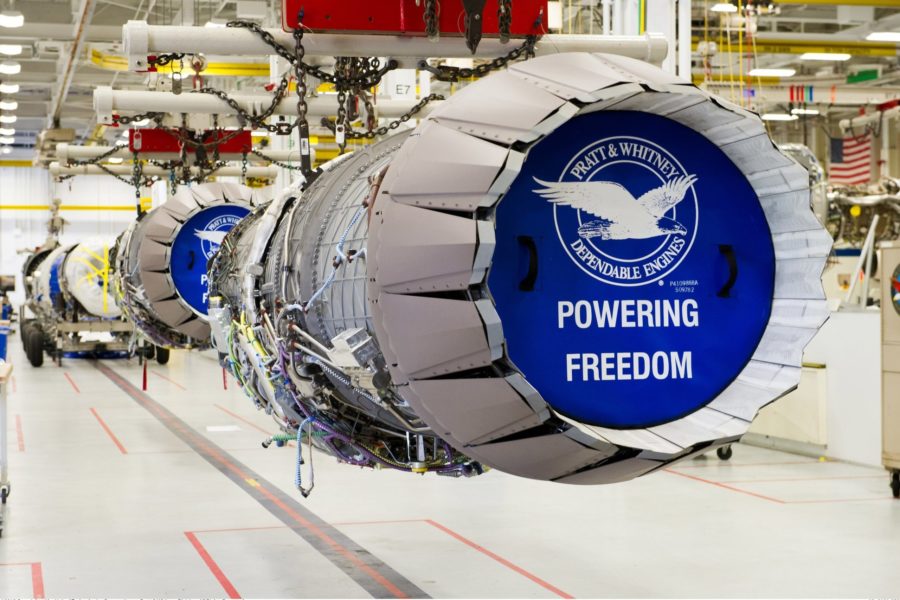
The Pentagon awarded RTX’s Pratt & Whitney a $1.6 billion contract for sustainment work on the F-35’s engine on Nov. 28.
The deal includes everything from software maintenance to spare parts for the F135 engine and runs through November 2026, spanning a dozen locations around the globe. One of the main centers for the work is Oklahoma City, where the Air Force’s Oklahoma City Air Logistics Complex is located.
In a contract announcement, the Department of Defense listed nearly 20 maintenance and sustainment activities covered by the contract, highlighted by “global maintenance services for F135 propulsion system at unit and depot levels, as well as replenishment spare parts.”
The contract—which has not been completely finalized—is about $298 million more than what Pratt & Whitney got in December 2024 for similar services, and $904 million more than what it got in November 2023.
Naval Air Systems Command is the contracting authority for the deal, but the Air Force is obligating the biggest chunk of cash to start: nearly $56.5 million from its 2026 operations and maintenance budget.
The sustainment contract is the latest big F135 deal for Pratt & Whitney. In September, the Pentagon awarded Pratt $670 million to procure spare parts for the propulsion system. A month prior, in August, Pratt got $2.8 billion to produce Lot 18 of engines to power all variants of the F-35.
Like this most recent deal, the Lot 18 contract was not completed, or “definitized” in Pentagon parlance. The finalized contract, along with a deal for Lot 19, is not expected until early 2026, the F-35 Joint Program Office told Air & Space Forces Magazine in October.
F-35 sustainment has long been a major expense for the Pentagon and drawn the ire of lawmakers. The F135 in particular suffered maintenance issues in 2021 to the point that more than 40 Air Force F-35s were without engines, though officials later said they were able to alleviate those issues.
While Pratt continues F135 sustainment, it is also working on an Engine Core Upgrade program to enhance the fighter’s powerplant. The Air Force and the F-35 Joint Program Office are pursuing the upgrade because new capabilities in the F-35’s “Block 4” package require more power and more cooling. The service considered pursuing an entirely new engine based on its work with adaptive engine technology, but ultimately decided not to do so due to cost concerns.