
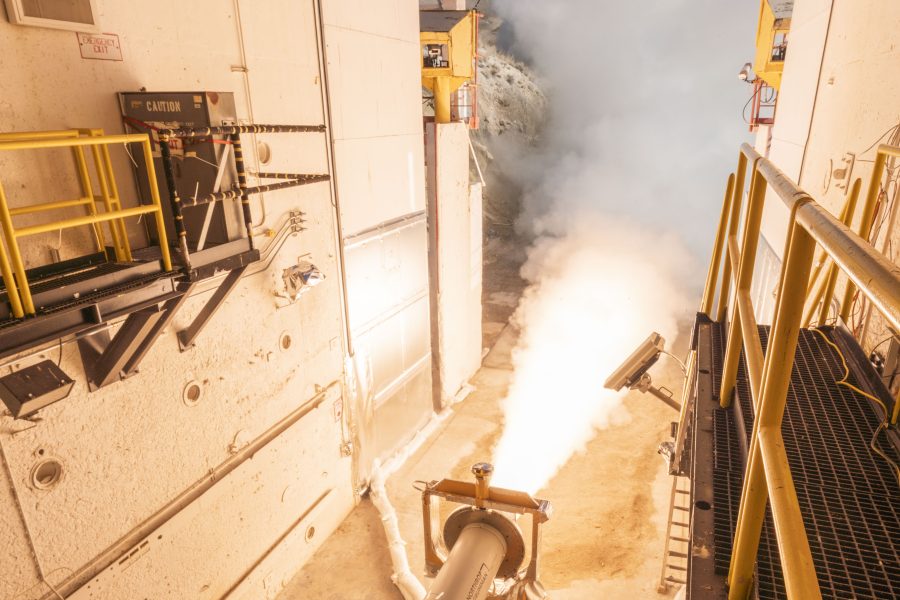
Northrop Grumman test fired its newest solid rocket motor Dec. 4, part of an internally funded effort to rapidly design and build SRMs using advanced manufacturing techniques.
The SMASH!22 motor configuration, which the company tested at its facility in Promontory, Utah, is one of two new SRMs the company built in 2025 through its Solid Motor Annual Rocket Technology demonstrator program, or SMART. Northrop will test the second motor, BAMM, early next year. Jim Kalberer, vice president of the company’s propulsion systems business, told reporters that the one-year design-to-test timeline is a significant reduction from what it normally takes to conceptualize and build a new motor.
“What we have done with SMART is challenge our way of thinking about the design process and how we iterate through that design process,” he said. “So, we have moved from clean sheet to [critical design review] in eight months. And typically, a solid rocket motor design and test effort would take three years, to put that into perspective.”
The company has been running annual SMART demonstrations for the last three years, funneling the lessons learned and the resulting technology, materials, and tooling throughout its product lines and processes. The SMASH variant tested last week included a low-cost propellant that Northrop validated in last year’s demo, which the firm plans to insert into existing programs, Kalberer said.
The company has also implemented some of the robotic manufacturing processes its demonstrated through SMART, like the application of a liner inside the rocket motor. Spraying that liner used to be “a hand operation,” Kalberer said, but through SMART, Northrop demonstrated and validated a robotic solution that allows it to install the liner faster and with less touch labor.
Among the technologies introduced in this year’s demo, he said, are a new welding method and some 3D-printed components.
“It allows us to bring those technologies, informed by our customers, up the technology readiness level and the manufacturing readiness level so they can be inserted into existing products, improving our speed of manufacture and addressing affordability,” Kalberer said. “It also positions us for being able to respond to the new and urgent needs.”
Northrop also uses SMART to expand its SRM supplier base. Kalberer highlighted a recent partnership with Titomic, an Australian company that specializes in cold spray additive manufacturing technology.
Northrop and L3Harris-owned Aerojet Rocketdyne currently dominate the U.S. solid rocket motor market, which has undergone significant consolidation over the last three decades. New entrants like Anduril and Ursa Major, however, have made progress developing their own capabilities to meet growing demand for SRMs, which power key U.S. missile systems.
Over the last few years, Northrop has invested more than $1 billion in a significant expansion of its propulsion enterprise, through an effort called “Propulsion 2030.” Those investments will nearly double the capacity of its SRM facilities in Utah and triple the output potential at its Allegheny Ballistics Laboratory in West Virginia, Kalberer said. The firm also expects to grow its manufacturing footprint in Elkton, Md., by almost 25 percent.
“It’s not just in the facilities and in capacity at Northrop Grumman,” Kalberer said. “It goes from the supply chain through our production and on to delivery to our customers.”