
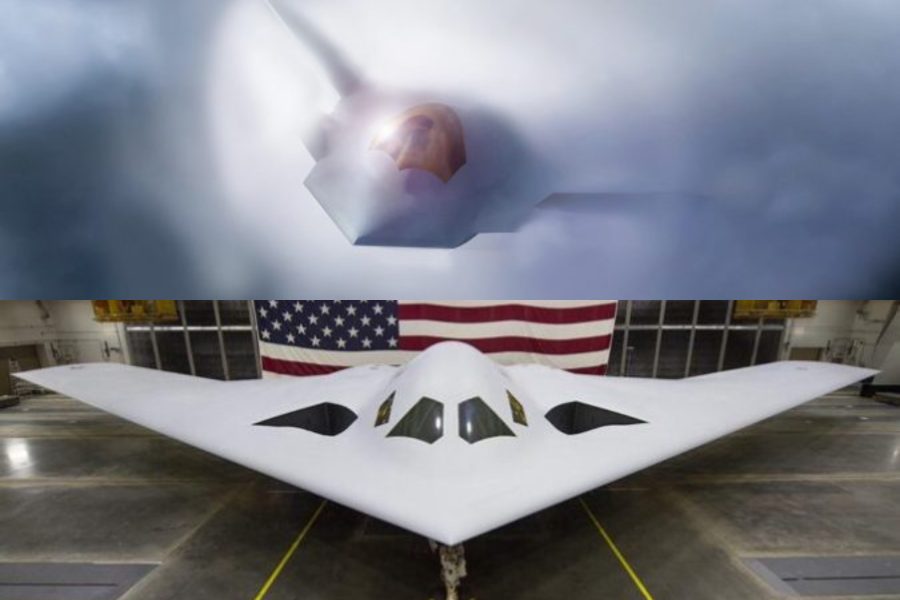
In order to deny China “sanctuaries” from which it can launch air and missile salvos during a potential invasion of Taiwan, the U.S. Air Force needs to buy far more B-21 bombers and F-47 fighters than currently planned, according to a new report from AFA’s Mitchell Institute for Aerospace Studies.
Working together, those sixth-generation aircraft will be able to penetrate adversary airspace and fight “from the inside out,” delivering decisive blows against bases and other critical infrastructure deep in mainland China, authors Heather Penney and retired Col. Mark A. Gunzinger wrote in their new report, “Strategic Attack: Maintaining the Air Force’s Capacity to Deny Enemy Sanctuaries.”
As things stand now, the Air Force has said it intends to buy “at least” 100 B-21s and 185 F-47s. Such quantities are enough for one-off missions into enemy airspace like Operation Midnight Hammer, which consisted of strikes on Iranian nuclear facilities led by B-2 bombers and F-35 fighters. But Penney and Gunzinger say they are far from enough to sustain pressure in a broader conflict: “a raid force, not a campaign force,” Penney told reporters during a briefing on the report.
Instead, the analysts recommend the Air Force double B-21 procurement to “at least” 200 bombers and increase the F-47 by nearly two-thirds to 300 aircraft.
“F-47s operating with B-21s and other aircraft in the Air Force long-range strike family can be [the Pentagon’s] ‘sanctuary denial force,’” they wrote.
In the interim—given that it could take a decade or more to build out expanded fleets—Penney and Gunzinger argue the Air Force must not retire any B-2s and should increase buys of the F-35 to bolster its penetrating capabilities.
Like much of the rest of its fleet, the Air Force’s inventory of bombers and fighters has shrunk precipitously since the Cold War. The current plans for the B-21 and F-47 do little to add capacity and instead mainly replace aging platforms like the B-1 and F-22.
But those plans are driven by budgetary restrictions, not operational needs, Penney said. And given that the Air Force needs to hold some bombers in reserve for nuclear deterrence and some fighters back for homeland defense, the actual numbers available for long-range strike missions are even smaller than they appear—driving the report’s recommendations for significant additions.
“Two hundred [B-21s] isn’t based off of a full-up World War III scenario, but it does look at what’s the number needed for ‘hold back’ and how do you be credible and effective in denying that sanctuary and hitting those key centers of gravity in China, and also having enough attrition reserve to be able to sustain a protracted conflict?” Penney said.
Stand-in vs. Stand-off
At the heart of the report’s recommendations is an argument that the current Air Force fleet is “unbalanced” in favor of stand-off capabilities that launch strikes from farther away.
Some advocates say the service needs to invest more in stand-off capabilities like hypersonic weapons and the sensors needed to guide them to targets, collectively known as long-range kill chains, arguing that such a move would limit aircraft losses in a conflict. But Penney and Gunzinger contend that stand-off strikes alone are not enough.
“The service’s current combat force mix is now weighted toward earlier-generation non-stealthy bombers and fighters,” Penney and Gunzinger write. “If not modernized with the right quantities of next-generation stealthy aircraft, this legacy force would have to close thousands of long-range kill chains in hundreds of hours in a peer conflict, a feat that is beyond the Air Force’s current and projected capacity.”
Acquiring an extra 100 B-21s and 115 F-47s would come with significant upfront costs—rough estimates peg the total north of $100 billion—but stand-off forces aren’t cheap either, particularly in a conflict that would require striking hundreds if not thousands of targets, Penney noted. The U.S. Army’s Dark Eagle Long-Range Hypersonic Weapon costs upwards of $40 million per shot, so striking just 25 targets would cost $1 billion.
And that’s assuming those stand-off forces work. Gunzinger and Penney noted in their report that long-range kill chains are technically complex and present a broad “surface area” for enemies to attack and disrupt them. Missiles’ range and firepower are inherently limited compared to the heavy weaponry and intercontinental range of a bomber.
Stand-in forces, meanwhile, allow leaders to use airpower to its full potential, Penney argued. In World War II and Operation Desert Storm, she noted, long-range strikes disrupted adversaries’ war machines and accelerated the end of the conflicts.
On the other hand, in Korea and Vietnam, and even now in Ukraine’s war against Russia, policy decisions to not strike deep into enemy territory created sanctuaries where “adversaries [can] husband their resources, produce war materiel, train replacement warfighters, secure their military leadership, and protect lines of communication to their fielded forces,” Penney and Gunzinger wrote.