
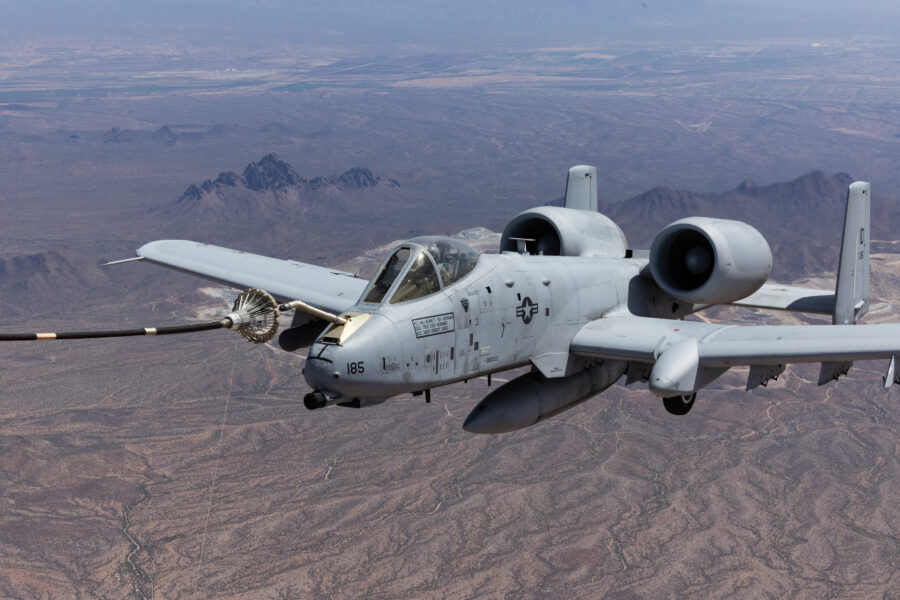
The Air Force has developed a probe refueling adapter that could give the aging A-10 Thunderbolt II more options for refueling.
The Air National Guard Air Force Reserve Command Test Center led the effort, along with multiple other organizations, to provide the A-10 with probe-and-drogue air refueling capability in addition to its flying boom option, according to a release.
The probe-and-drogue system utilizes a flexible hose with a funnel-shaped drogue on its end. The end of the hose plugs into a probe on the receiving airplane.
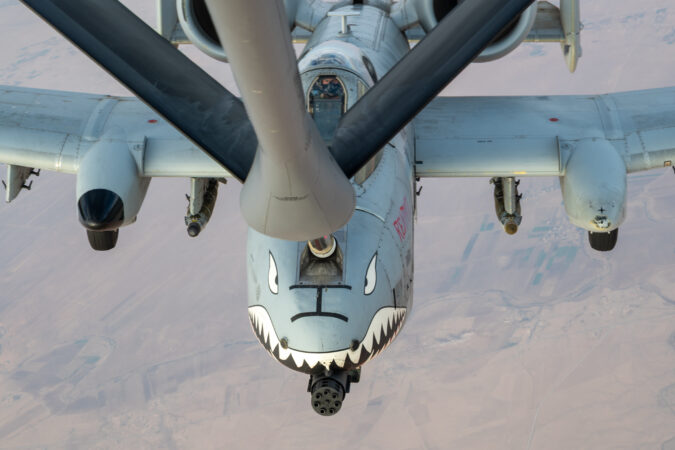
The flying boom uses a firm, telescoping tube with a stabilizer controlled by the tanker’s boom operator. The operator controls the boom, lining it up with the fuel receptor on the receiving aircraft.
The new adaptor fits in the nose of the A-10 where its air refueling receptacle is located. This allows the Warthog to refuel from aerial tankers that only have probe/drogue systems like the Air Force’s search and rescue HC-130J or special ops MC-130J, or the Marine Corps’ KC-130J, while sidestepping problems the aircraft has had with the KC-135 Stratotanker and the KC-46 Pegasus.
“The probe adapter enables A-10s to refuel from C-130 tankers, whose airspeeds and altitudes prove more compatible with A-10 operations and whose mission sets align more closely with close air support and combat search and rescue operations,” according to the release.
The A-10 has been in the Air Force fleet since the 1970s and is still playing a key role in U.S. combat operations, even as the service pushes to retire the venerable jet, saying it is old and not suited for high-end conflicts.
Just in recent weeks, the Air Force doubled its A-10 presence in U.S. Central Command for Operation Epic Fury, sending 18 A-10s to join the dozen already participating in the conflict with Iran. Commanders used the low- and slow-flying aircraft for counter-maritime missions in the Strait of Hormuz.
The refueling adapter project came from a combatant command’s urgent need, per the release, which did not specify which command or when the need was identified.
“Once the combatant command issued the requirement, all of the standard acquisition processes began immediately, but everyone involved understood the urgency,” said Lt. Col. Luke Haywas, Director of Test for AATC.
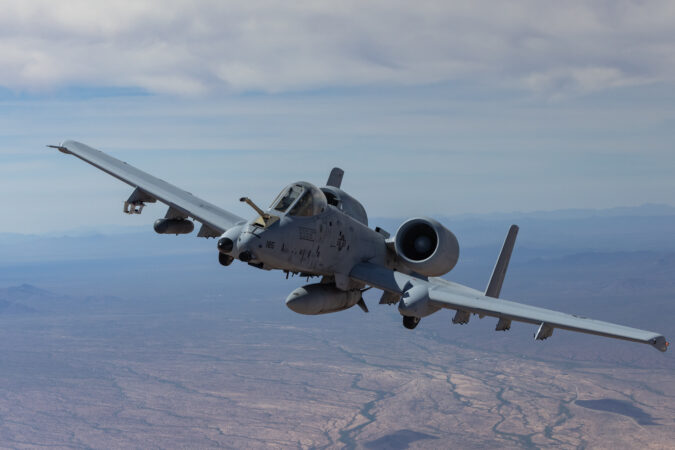
An unnamed industry partner built the probe adaptor. The A-10 Program Office provided engineering oversight for aircraft integration. The innovation hub ARCWERX enabled rapid contract acquisition. Luke Air Force Base manufactured supporting components, and the 418th Flight Test Squadron provided the HC-130 tanker and crew for the first refueling mission, which took place April 2, according to the release.
Maintainers can install or remove the adapter in hours, giving units the option to configure the A-10 for either boom or probe refueling.
Until now, the A-10 has had to rely on the KC-135 for refueling. That is not ideal, as the attack aircraft can’t always provide enough power to lock onto the tanker’s flying boom.
Having the option to switch between refueling methods now means that the A-10 can receive fuel from the C-130-based tankers that are more compatible with A-10 missions. Most fighter aircraft, such as the F-15EX, F-16, F-22, and F-35, conduct refueling at 345 miles per hour, while the A-10 flies at about 230 miles per hour for refueling.
The C-130 tankers can also take off on shorter runways, giving the Air Force more options for staging aircraft for long-haul missions.
Those options are critical to the service’s Agile Combat Employment strategy, moving aircraft around the theater using remote or austere sites for refueling or rearming.
With shorter runway requirements, tankers could take off and immediately fuel fighters like the A-10, allowing them to carry more munitions on takeoff.
Though the KC-46 sports both a refueling boom and a probe-and-drogue system, the tanker has struggled with issues related to its boom refueler, including some that have caused mishaps. The Air Force is working with manufacturer Boeing to revise the aircraft’s Remove Vision System for the boom operator and redesign its boom telescoping actuator. The A-10 is the only fighter aircraft not cleared for combat operational refueling with the KC-46 as the tanker awaits those fixes.
The Air Force currently plans to purchase 263 KC-46 tankers to partially replace its aging fleet of 375 KC-135s, which average more than 63 years in service.
Beyond the KC-46, the service is also developing what it calls the Next-Generation Aerial refueling System, or NGAS. The program is still early in its development, and officials haven’t specified whether it will have a boom, a probe-and-drogue, or a combination.
At least one option being offered is going for both. In February, contractors Northrop Grumman and Embraer jointly announced they will pitch the KC-390 Millennium aircraft as an agile refueler. Part of the work the team will do on the KC-390 includes developing an autonomous refueling boom in addition to its existing probe-and-drogue system.
