
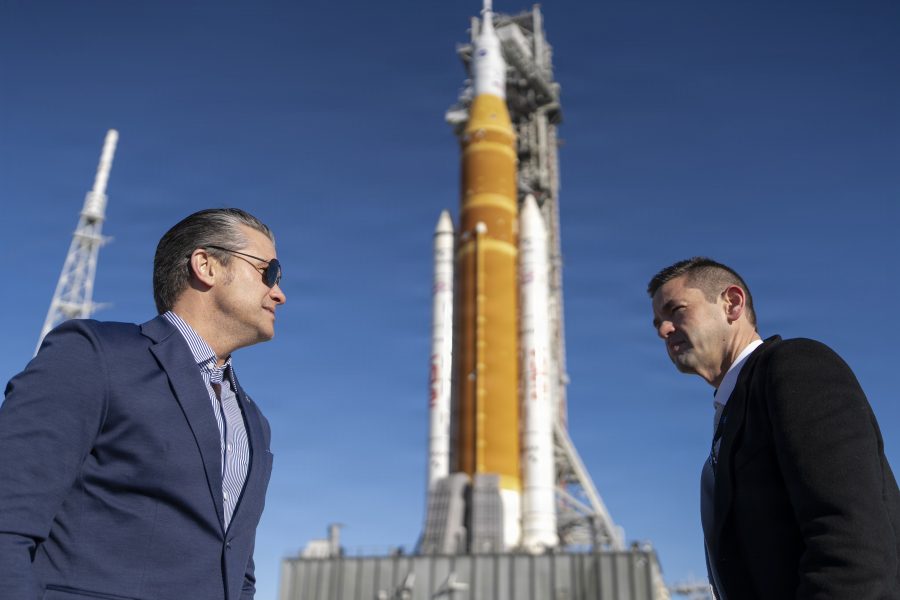
While NASA and the Defense Department have different objectives in space, the two agencies can collaborate more to avoid duplicative spending and take better advantage of mutually beneficial technology development, says NASA Administrator Jared Isaacman.
Speaking to an audience of national security professionals Feb. 10, Isaacman emphasized the historic relationship between the two agencies, which includes work on the rocket-powered X-15 in the 1960s, hitching rides on one another’s rockets, and more recently, collaborating on advanced air mobility. And while NASA’s current push to return to the Moon through its Artemis program is focused on exploration, Isaacman noted the mission also has broader economic and national security implications, which once again tie the agency to the Pentagon.
“NASA’s mission and national security are inseparable,” he said during the National Security Space Association’s Defense and Intelligence Space Conference in Reston, Va. “We didn’t go to the Moon alone in 1969 and we are not going at it alone now. Together, we will ensure American space capabilities are robust, secure, and awe inspiring to our adversary.”
Speaking with reporters after his speech, Isaacman said the agencies share common interests and should look for ways to partner when it makes sense.
“The partnerships are historic and have been since NASA has been established,” he said. “ We obviously have very different missions, but there are ways to be smart about our resource allocation.”
That could mean using a NASA-certified launch vehicle for defense applications or sharing technology developments in areas like navigation, communications, and nuclear propulsion.
“We don’t need to have three bespoke initiatives underway,” Isaacman said. “There’s probably areas where we can collaborate for reactor design, power conversion, cooling and transport. … There are areas that I think collaboration is natural.”
President Donald Trump signed an space policy executive order in December that emphasized the need for more collaboration between NASA and DOD, and positioned the White House’s Office of Science and Technology Policy as the “coordination council” between the two agencies. That order highlighted nuclear propulsion and cislunar operations as priorities for the administration.
Isaacman said OSTP’s role in orchestrating those efforts is key.
“I think that was the point of the space policy, saying let’s get organized here and collaborate,” he told reporters. “We both have due-outs to OSTP as part of that executive order where we can all get around the table and make sure that we’re not, again, doing lots of bespoke things. Whether it’s communication, [positioning, navigation, and timing] around cislunar space, we’re going to want to avoid lots of different bespoke programs if there’s faster ways that help enable us for our peaceful mission of science and discovery and, obviously, [the Department of War] for their missions.”
Meanwhile, some lawmakers are worried NASA and DOD’s missions may become too intertwined during the Trump administration. In a letter to former acting NASA Administration Sean Duffy last September, Rep. Zoe Lofgren, D-Calif., said she has “serious concerns” about NASA’s relationship with the Air Force, though she didn’t cite specific examples.
“NASA must remain focused on its mission as a civil space agency and a scientific agency,” said Lofgren, ranking member of the House Science, Space, and Technology Committee. “It cannot permit unrelated priorities to distract it from its mission or impair its ability to achieve its ambitious objectives in space for the benefit of humanity here on Earth.”