

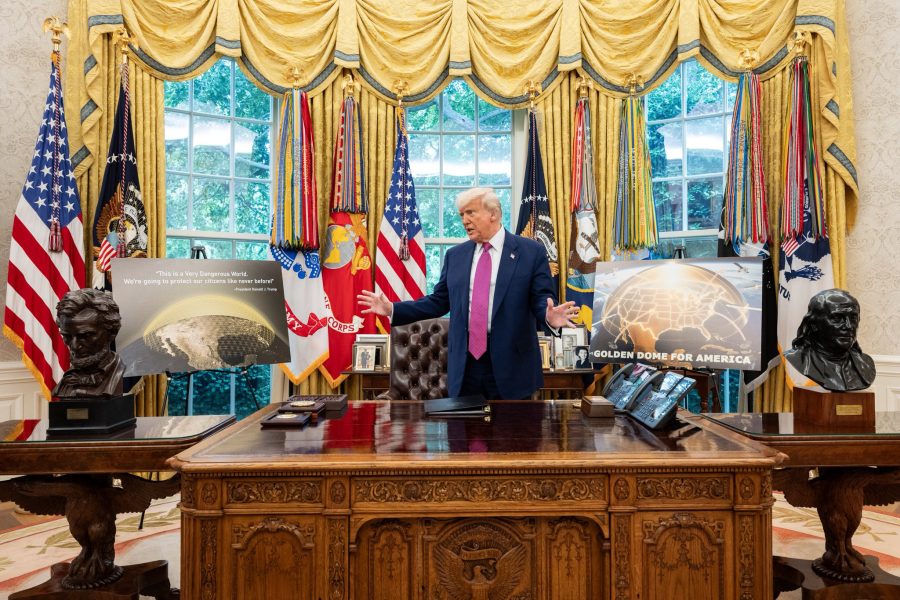
The Missile Defense Agency chose a diverse pool of more than 1,000 companies to compete for task orders through its Scalable Homeland Innovative Enterprise Layered defense effort—a $151 billion contract mechanism to experiment, test, and prototype capabilities for Golden Dome and other homeland defense needs.
Through the 10-year indefinite-delivery, indefinite-quantity contract, MDA wants to establish a deep bench of firms that can respond to the Pentagon’s missile defense needs, a top priority for the Trump administration. The list of vendors includes traditional defense firms like L3Harris, BAE, and General Dynamics as well as commercial companies, smaller software and hardware shops, and consulting firms like Accenture and Booz Allen Hamilton.
“This contract encompasses a broad range of work areas that allows for the rapid delivery of innovative capabilities to the warfighter with increased speed and agility,” the Defense Department said in a Dec. 2 contract announcement, adding that the department will use rapid acquisition tools to quickly deliver technology to the field.
While Golden Dome isn’t the only defense project that will benefit from SHIELD, it’s a top focus for the Pentagon. Since the start of President Donald Trump’s second term in office, Pentagon officials have been developing a plan for a layered network of sensors and interceptors—on the ground and in space—that would protect the U.S. from advanced missile attacks. That plan is largely complete and awaiting approval from Defense Secretary Pete Hegseth. Officials have said the architecture will include a mix of existing capabilities and more advanced technology, like space-based interceptors.
Trump has said Golden Dome will cost $175 billion to develop over the next three years. The Pentagon already has $25 billion in hand from congressional budget reconciliation legislation passed earlier this summer.
Last month, the Space Force awarded initial prototype contracts to multiple firms to develop space-based interceptors designed to take down missile threats within minutes after launch—work directly tied to Golden Dome. The service plans to kick off a separate prototype competition in early December for kinetic midcourse interceptors designed to take out a missile in flight. It plans to award those contracts in February.
The MDA IDIQ selections announced this week are “the first of many,” according to MDA spokesman Mark Wright. The agency received 2,463 responses to the solicitation it issued in September. The companies identified thus far have not received any funding to date; that will come after MDA issues and awards task orders for prototyping, experimentation, testing, and other activities.
“MDA will complete source selection activities on the SHIELD IDIQ (which includes completing discussions with offerors and making any additional awards) before soliciting any firm requirements under Task or Delivery Orders,” Wright said in a statement.