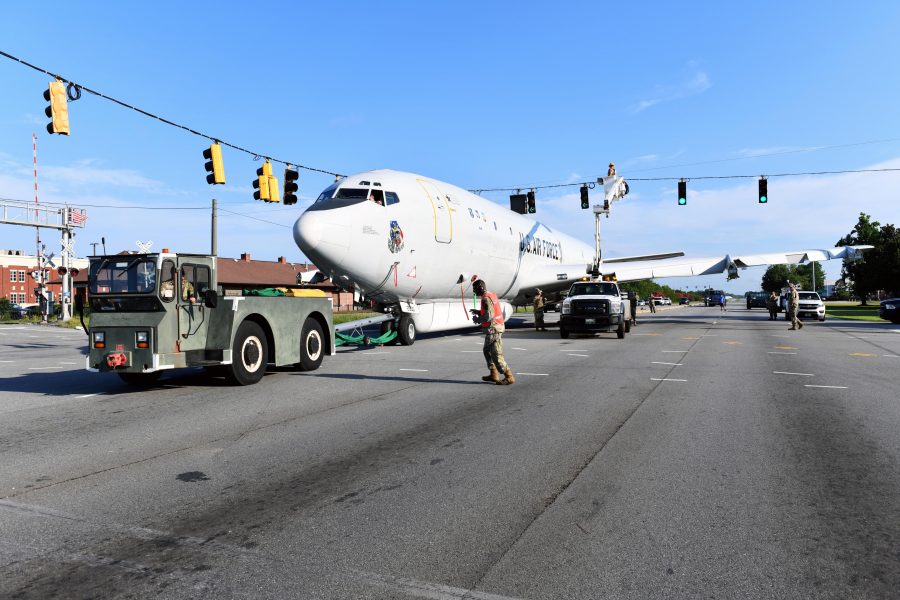
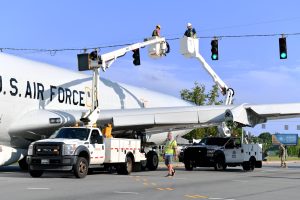
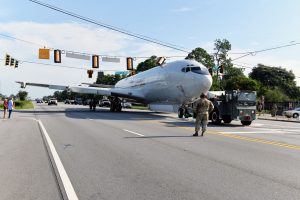
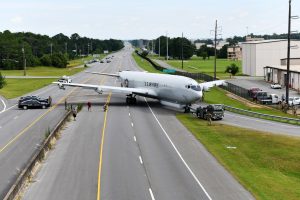
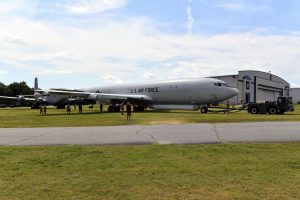
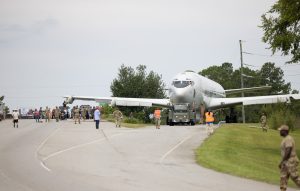
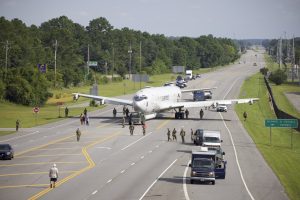
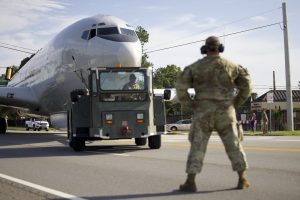
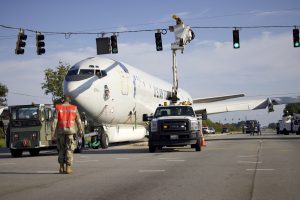
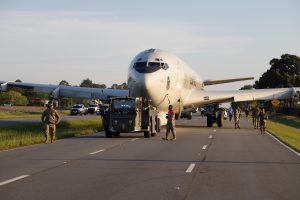
461st and 116th Air Control Wings’ maintenance crews guide the E-8C Joint STARS 00-2000, along Georgia Highway 247 towards the Museum of Aviation at Robins Air Force Base, Georgia, July 16, 2023. A Georgia Department of Transportation high-lift truck worker raised the traffic signal wires at the intersection of Watson Boulevard and Highway 247 to provide clearance for the aircraft. U.S. Air Force photo by Rodney Speed
Audio of this article is brought to you by the Air & Space Forces Association, honoring and supporting our Airmen, Guardians, and their families. Find out more at afa.org
An unusual vehicle made its way down Georgia State Highway 247 on July 16—an E-8C JSTARS aircraft.
Airmen from the 116th and 461st Air Control Wings helped tow the airframe, tail number 2000, four miles down the road from Robins Air Force Base, Ga., to the local Museum of Aviation, where it will remain on display. The targeting, battle management, and command and control jet was retired in May, a spokesperson for the 78th Air Base Wing told Air & Space Forces Magazine.
Images shared on social media and with Air & Space Forces Magazine show Airmen working with Georgia Department of Transportation workers and the Houston County Sheriff’s Office to maneuver the 171,000-pound jet past traffic lights and other obstructions.
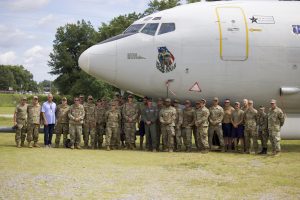
One image particular shows the aircraft’s nose art and nickname, “The Watchman,” with Col. Christopher Dunlap, commander of the Georgia Air National Guard’s 116th Air Control Wing, and other Airmen involved in the operation.
The move marks yet another milestone for Robins as it goes through the process of transitioning away from the E-8 and standing up four new missions. In June 2021, the Air Force first announced plans to cut the JSTARS from Robins, which has hosted the aircraft since 1996.
In its place, Robins is getting a Battle Management Control squadron, an E-11A Battlefield Airborne Communication Node (BACN) squadron, a Spectrum Warfare group, and support units focused on the Advanced Battle Management System.
This past March, the Air Force budget request revealed a plan to accelerate the divestment plan, with the entire fleet retiring by the end of fiscal 2024. Lawmakers have not signaled any interest in blocking those retirements.
Robins, meanwhile, is winding down its E-8 mission. The 16th Airborne Command and Control Squadron, one of two JSTARS squadrons under the 461st Air Control Wing, was inactivated in February, and the 129th and 330th Combat Training Squadrons flew their final flights the same month.
Exactly how many E-8s are still in the fleet is unclear. In December, the 78th Air Base Wing said in a release that six had been divested, but a spokesperson declined to offer an exact number this week, citing operational security. With at least one more gone in tail number 2000, though, things are clearly winding down, and the spokesperson confirmed the final retirements are still planned for “early fiscal year 2024,” which starts Oct. 1, 2023.
The 12th Airborne Command and Control Squadron, the last flying unit left in the 461st Air Control Wing, made its final operational flight July 12.
Audio of this article is brought to you by the Air & Space Forces Association, honoring and supporting our Airmen, Guardians, and their families. Find out more at afa.org
Roughly two of every five fighters in the Air Force fleet could be F-35As by 2035, according to a new fighter force structure report the service submitted to Congress on Oct. 16. Lt. Gen. David Tabor, deputy chief of staff for plans and programs, revealed the new estimate during an…
The Air Force Life Cycle Management Center is moving forward with a program to upgrade a quarter-century-old computing system for some F-16 fighter jets.
The U.S. Navy on Oct. 15 accepted a C-130J-30 Super Hercules plane that it will modify to become the first of its new nuclear command, control, and communications aircraft—a route the Air Force is considering for a similar NC3 mission under congressional direction.
More than 40 years after the original YF-117 operational prototype flew test runs from a Lockheed Martin Skunk Works facility, an F-117 returned for a $1 million refurbishment to look its best when it assumes its place in history alongside other iconic aircraft on permanent exhibit at the National Air…
A U.S. Air Force F-22 pilot controlled a YFQ-44A Fury Collaborative Combat Aircraft this month while both aircraft were in flight, according to an Oct. 16 release, another milestone in the service’s ambitious CCA efforts.
The Marine Corps recently conducted its first-ever “ripple” release of eight Small Diameter Bomb IIs from an F-35B, a key early step in proving out the capability for all F-35 variants.
The Air Force will field operational prototypes for an autonomous drone to replace its MQ-9 Reaper in 2028, Secretary of the Air Force Troy Meink said Oct. 14.
One of the Air Force’s critical B-2 Spirit stealth bombers has returned to Whiteman Air Force Base, Mo., after an extensive course of maintenance to restore its stealth coating and preserve its structural integrity.
BAE Systems has received a contract from Lockheed Martin to install an upgraded Block 4 electronic warfare system into new F-35 Joint Strike Fighters, as well as to retrofit some older jets.
✓
Thank You!
Check your inbox to verify your email address and finish setting up your AFA account.
★
Welcome Back!
An account with this email already exists. Please log in to continue.
Subscribe to the Air & Space Forces Daily Report
The latest news from Air & Space Forces Magazine, as well as news from other leading publications, delivered right to your inbox every morning!
We’re sorry, there has been an error. Please review your input or try again later.