
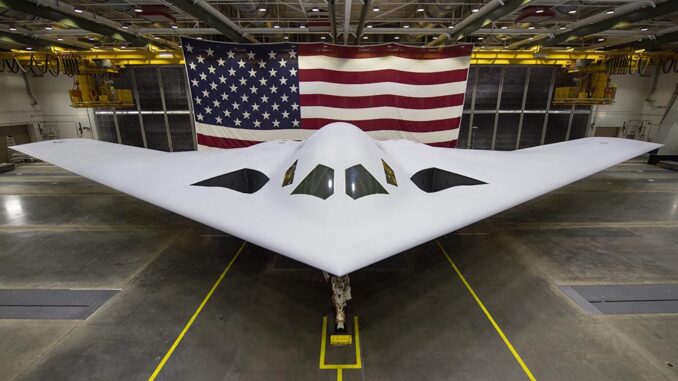
Northrop Grumman expects to strike a deal with the Air Force to accelerate B-21 bomber production by the end of March, CEO Kathy Warden said Jan. 27.
Warden also said the Pentagon and Northrop have agreed to a third lot of low-rate initial production for the B-21 as the secretive bomber moves closer to operations.
Congress approved $4.5 billion for the “expansion of production capacity” for the B-21 as part of a massive reconciliation package passed last July, and officials have been hammering out the details even before that.
“We continue to work closely with the Air Force on plans to increase the production rate of the program,” Warden said on an earnings call. “Our priority is to establish a mutually beneficial agreement that accelerates the delivery of this game-changing capability to our nation. … I am optimistic that we will come to an agreement with the Air Force this quarter.”
The current fiscal quarter ends March 31.
The contract will be large. The Air Force outlined plans in its 2026 budget request to spend all $4.5 billion from the reconciliation bill this fiscal year: nearly $2.4 billion in research and development and $2.1 billion in procurement.
Yet details on what exactly the deal will entail remain scarce and are likely to remain shrouded in classification, if past B-21 contracts are any indication. The Air Force has declined to reveal any metrics for how much production will be expanded, and it is unclear if the long-term goal is to buy extra B-21s beyond the current program of record of 100 aircraft, or simply reach that baseline quantity faster.
Warden did reveal that Northrop plans to invest between $2 to $3 billion over multiple years for “facilitizing for that acceleration,” though she did not explain what that meant. Northrop previously announced in April that it had spent $477 million on a “process change” to “enable a higher production rate.”
The exact production rate for the B-21 remains classified, though sources had previously suggested it is around seven per year. That rate is different, however, from low-rate initial production, which is expected to cover 21 aircraft over five lots.
Warden confirmed that Northrop received the contract for the third of those lots in the final quarter of 2025, as well as a contract for advanced procurement for the fifth lot. She also pointed to the first flight of a second B-21 test aircraft as a sign of progress on the program.
Despite this, lawmakers recently moved to trim the B-21’s funding in the proposed base fiscal 2026 budget, cutting $620 million from procurement and adding $409 million for research and development for a net cut of $211 million. Appropriators cited “classified adjustments” to explain the changes.
An Air Force spokesperson told Air & Space Forces Magazine that “the B-21 program of record has not changed. We are in low-rate initial production. We don’t have additional details to share at this time.”
Sentinel Restructuring
While Northrop is preparing to accelerate B-21 production, Warden said the company is not expecting to start production on the Air Force’s other major nuclear program, the Sentinel intercontinental ballistic missile, anytime soon.
“We still believe that the program will be in development for several years and not transitioning into production until later in the decade, and that production will very much be guided by the milestone achievement during development,” Warden said, adding that “transition to production is outside of that two-to-three-year window at this point.”
The Sentinel lacks a firm schedule at this point, because the Air Force is restructuring the program in the wake of major cost and schedule issues that sparked a review called a “Nunn-McCurdy breach.” The Pentagon cleared the Sentinel to continue in July 2024 but rescinded the decision allowing the program to move into engineering and manufacturing development and ordered a restructure.
Officials said that if the program had continued on its trajectory at that time, it would have been 81 percent over budget and three years late. Northrop and Air Force leaders say they are working to mitigate those overruns.
“We are in the middle of supporting the U.S. Air Force as they restructure the Sentinel Program, and coming out of that, they will firm a schedule that both locks in new time ranges for milestone B, initial operating capability, final operating capability,” Warden said. “And so I don’t want to get ahead of the Air Force in talking about that, but certainly, as I have shared and the Air Force has as well, we are working to accelerate the timelines that were published coming out of the Nunn-McCurdy breach two years ago.”