
Congress moved one step closer to passing a defense budget and avoiding another government shutdown Jan. 22 as the House passed a mammoth appropriations package. The Senate must now pass the legislation by Jan. 30 to avoid a shutdown.
With a winter storm bearing down on Washington, D.C., and other East Coast cities, the House passed the $838.7 billion defense spending plan, adding hundreds of millions to Air Force programs including the F-47 fighter and E-7 airborne early warning and control aircraft. Yet when it came to the Air Force’s nuclear weapons programs—which include the new B-21 Raider bomber, the LGM-35 Sentinel intercontinental ballistic missile, and the future Long-Range Standoff missile—lawmakers were more guarded.
The measure reduces B-21 and LRSO spending slightly and directs more oversight over the Sentinel, which has suffered delays and cost overruns.
The House bill, which the Senate is expected to pass next week, is on top of from the reconciliation package included in the Big Beautiful Bill Act signed into law last summer, which directed $157 billion to defense.
B-21
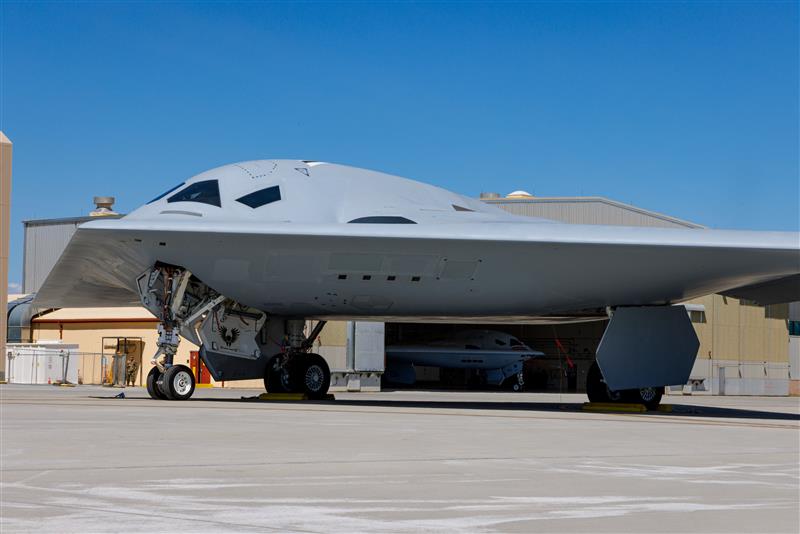
The B-21 was among the biggest winners in the reconciliation package, gaining $4.5 billion to expand production capacity. But lawmakers trimmed $620 million from the administration’s B-21 procurement request in the 2026 budget bill and instead added $409 million for research and development, effecting a net cut of $211 million. Appropriators cited “classified adjustments” to explain the changes.
In all, the appropriations package invests $5.6 billion for the new bomber, on top of $2.4 billion from the reconciliation package expected to be spent this year. The appropriation includes:
- $2.76 billion in research and development
- $1.97 billion in procurement
- $862 million in advance procurement
Still unclear is how production capacity will be expanded, and whether that translates into faster production or a larger total purchase than the original 100 bombers or some combination of the two. Speaking with CNBC from Davos, Switzerland, on Jan. 21, President Donald Trump mentioned that “we just ordered 25 additional B-2 bombers.” Assuming Trump meant B-21s, that could refer to accelerated acquisition plans or something else. B-2 production ended in 2000.
“The B-21 program of record has not changed,” an Air Force spokesperson told Air & Space Forces Magazine. “We are in low-rate initial production. We don’t have additional details to share at this time.”
Sentinel
Lawmakers endorsed the $2.65 billion the adminstration sought for the Sentinel ICBM, but pressed for more information on the program. Curiously, the Air Force budget request released in June referenced $1.5 billion in “mandatory” reconciliation spending, but the new appropriations package and accompanying language in a joint statement does not clarify that reference.
The joint statement directs the Pentagon to conduct “quarterly briefings on the Sentinel program to the congressional defense committees,” and adds that those briefings should include “a detailed breakout of efforts utilizing discretionary and mandatory funding in fiscal year 2026, and an updated spend plan that includes the entire requirement (discretionary and mandatory) for the Sentinel program in fiscal year 2026.”
LRSO
The Long-Range Standoff weapon, the planned successor to the nuclear-tipped AGM-86 Air-Launched Cruise Missile, is anticipated to be ready around the end of the decade. The weapon would be launched by the B-52 bomber.
Air Force officials have generally offered positive—if sparing—updates on LRSO, but after the Air Force trimmed the program’s funding by $146.1 million to $693 million total in fiscal 2025, they cut further in 2026, cutting requested funds by nearly $217 million to $582 million.
Lawmakers wrote that some procurement funding was “early to need” and nearly a quarter of the research and development money could be cut as “program carryover.”