
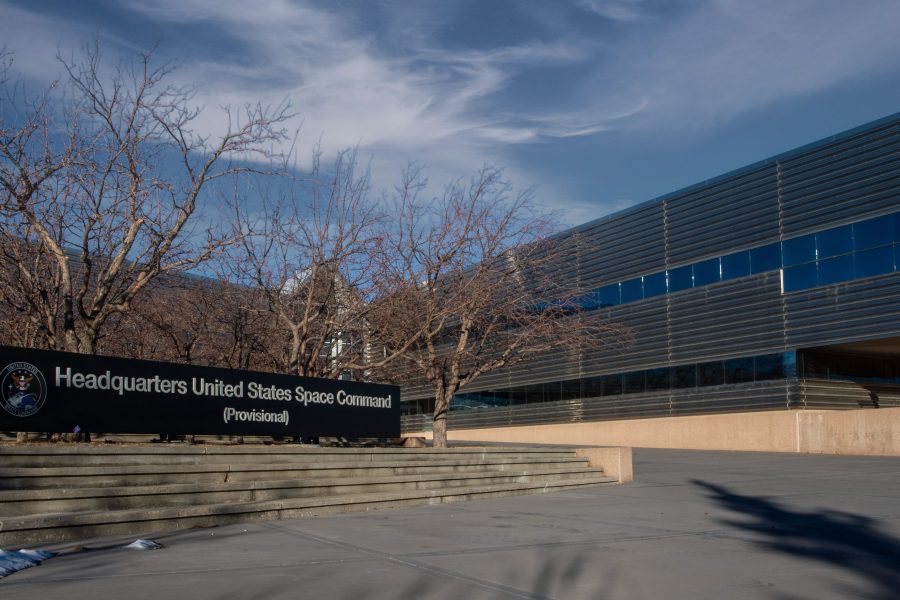
Some Colorado officials are seeking to distance themselves from the state’s lawsuit against the Trump administration over its decision to relocate U.S. Space Command headquarters from Colorado Springs, Colo., to Huntsville, Ala.—signaling a decreased appetite for extending the yearslong political debate that has dogged the combatant command’s future plans.
The Colorado Springs Chamber & Economic Development Corporation plans to file an amicus brief opposing the state’s suit, which they argue could harm military readiness, according to a draft viewed by Air & Space Forces Magazine.
“This amicus brief is a clear stance on our region’s commitment to mission readiness and strategic innovation over politics, because protecting the nation is bigger than any headquarters debate,” the organization’s CEO Johnna Reeder Kleymeyer said in a Jan. 21 statement.
Federal and local officials—some of whom initially decried President Donald Trump’s decision to relocate the command—have endorsed the chamber’s filing.
Rep. Jeff Crank (R-Colo.), who represents Colorado Springs in Congress, told Air & Space Forces Magazine he supports the chamber’s brief as a statement of political opposition to state Attorney General Phil Weiser’s lawsuit, which was filed Oct. 29, adding that the gesture sends a clear message that the region expects to maintain a strong foothold in the aerospace industry despite the headquarters decision.
“We all fought the [basing] decision, and to this day believe that it’s not the right decision from a national security standpoint that you move Space Command Headquarters out of Colorado Springs,” Crank said in a Jan. 15 interview. “But to simply do political exercises like this isn’t productive. . . . We’re looking forward where the attorney general with his lawsuit is looking backwards.”
Last September, President Donald Trump announced his intent to move SPACECOM’s headquarters from Peterson Space Force Base in Colorado Springs to Redstone Arsenal in Huntsville. In an Oval Office meeting attended by Republican members of Alabama’s congressional delegation, Trump indicated the decision was influenced, at least in part, by Colorado’s mail-in voting laws.
In response, Weiser’s office filed a lawsuit, alleging that the Trump administration was retaliating against the state for its mail-in voting laws and said the move violates its authority to regulate elections. The suit also claims the White House neglected standard basing procedures and didn’t provide proper notification to Congress before announcing the move. The complaint calls for a stop-work order on all efforts to transition SPACECOM headquarters to Alabama.
Weiser’s office declined to comment on claims the lawsuit is politically motivated, but said the complaint is an attempt to “protect” the state and defend its rights.
“That’s why our state is standing against this unlawful decision to move Space Command HQ lest we face further illegal coercion to forfeit to the federal government our constitutional authority to regulate elections,” he told Air & Space Forces Magazine in a statement.
Trump’s announcement and the ongoing lawsuit continue a yearslong back-and-forth over which state should host the command’s headquarters. When SPACECOM was re-established in 2019, it was temporarily placed in Colorado Springs. In 2021, at the tail end of Trump’s first term in office, he announced Huntsville would permanently host the headquarters. Two years later, after a series of reviews and reports, President Joe Biden reversed course, declaring SPACECOM would remain in Colorado.
Amid the whiplash over where the command would permanently settle, Colorado lawmakers and local Colorado Springs officials have advocated for the headquarters to remain in the region. In 2020, the Colorado Springs chamber launched a national public relations campaign to advocate for the command to remain in the state. And immediately following Trump’s announcement in September, the state’s congressional delegation issued a joint statement decrying the decision.
But since last fall, some local and federal officials have shifted toward a message of optimism about the move. In October, Colorado Springs Mayor Yemi Mobolade told Air & Space Forces Magazine that while the city is “disappointed” in the president’s decision, officials expect that the administration’s pursuit of Golden Dome—an advanced missile defense shield that will rely heavily on space sensors and interceptors—and its emphasis on space capabilities will help balance the economic impact of the SPACECOM move.
While officials initially estimated that relocating the command’s headquarters would result in the region losing around 1,700, Crank said that estimate has since been adjusted down to 1,000, as some operational elements will stay put. He said he plans to continue to fight for more of the command to remain in Colorado and also expects mission growth at the Space Force’s local installations between now and 2027.
“The focus is to keep as much here as we can,” he said.
Meanwhile, Space Command is still in the initial planning phases of the headquarters transition and officials have said it will take years to fully operationalize the new location. The command has established an internal planning team, “Task Force Voyager,” to spearhead logistics for the move.
In December, Defense Secretary Pete Hegseth, Air Force Secretary Troy Meink, and SPACECOM Commander Gen. Stephen Whiting traveled to Redstone Arsenal in Huntsville in December to endorse the move and unveil a new sign for the command.
“It is common sense that this is precisely where Space Command should be,” Hegseth said during remarks at the Dec. 12 ceremony. “It is common sense that we need to move rapidly and expeditiously.”