

AURORA, Colo.—The Air Force plans to put Collaborative Combat Aircraft in the hands of Airmen to experiment with the semi-autonomous drones this summer, Gen. Dale R. White said Feb. 25 at AFA’s Warfare Symposium.
Col. Timothy Helfrich, portfolio acquisition executive for fighters and advanced aircraft, added that the Air Force will build on a demonstration earlier this month in which an F-22 flew with a surrogate drone, and fly a Raptor with one or both CCAs now under development.
Those milestones come as the Air Force expects to choose between the General Atomics’ YFQ-42A and Anduril Industries’ YFQ-44A airframes later this year and between autonomy software offered by Collins Aerospace and Shield AI. Both aircraft are intended to be software agnostic.
“We’re going to be doing lots of demonstrations and testing, whether it’s with weapons, with quarterbacks, coming up this year, but one of the big events will be … really going to be making that decision to go into what we call EMD light, or engineering and manufacturing development light, and production,” Helfrich said. “It’s really picking the vendors that we’re going to go with for the Increment 1 program. That’ll happen this year, and then we will get moving pretty darn quickly into production.”
USAF has seen a flurry of CCA program developments in the past two weeks. General Atomics’ YFQ-42A made its first flight using Collins’ mission software, the Air Force announced Feb. 12. Eleven days later, on Feb. 23, GA announced its MQ-20 Avenger had teamed up with an F-22 in flight over Edwards Air Force Base, Calif., and that it had successfully taken commands from the Raptor pilot. That same day, Chief of Staff Gen. Kenneth S. Wilsbach announced Anduril’s YFQ-44A had started inert weapons tests, and that the General Atomics jet would soon follow. Then on Feb. 25, Helfrich revealed that the YFQ-44A had flown with not one but two autonomy software systems.
The current contractor-led phase of developmental testing will soon give way to Air Force-led operations, said Lt. Col. Matthew Jensen, commander of the Experimental Operations Unit.
“As [the vendors are] doing the basics and the necessary work to do applied sciences, we are training and learning how everything works, starting to validate some of the concepts and ideas, and then that’s really going to help us as we shift the weight of effort from developmental test to experimental operations, where we are learning and iterating ideas rather than worrying about validation and verification of system requirements,” Jensen said.
Notably, Jensen made no mention of initial operational test and evaluation, as is typical for most Air Force acquisition programs. White, speaking to reporters, said that was deliberate.
“I hate to call it flight test, because it’s an experimental ops unit,” White said. “It’s really operator orientation, because these are the operators.”
The EOU, established in June 2025, has to this point developed “a bunch of whiteboard ideas” on tactics, techniques, procedures, and concepts for how the Air Force will operate CCAs, Jensen said.
But once the unit actually gets the aircraft and the autonomy software—“this summer,” White said—its members will be able to test those ideas and customize them to the individual foibles of each system.
“As we … learn what capabilities really each mission autonomy and each platform brings—they’re not equal—we will leverage their strengths, figure out where our weaknesses are as a force, and try to help fill those weaknesses,” Jensen said.
A key way to do that will be flying the CCAs themselves—not a surrogate—with manned fighters. Helfrich said the goal is “integrating F-22s with our actual CCA,” and Jensen said his team will take CCAs to major exercises “as soon as we can.”
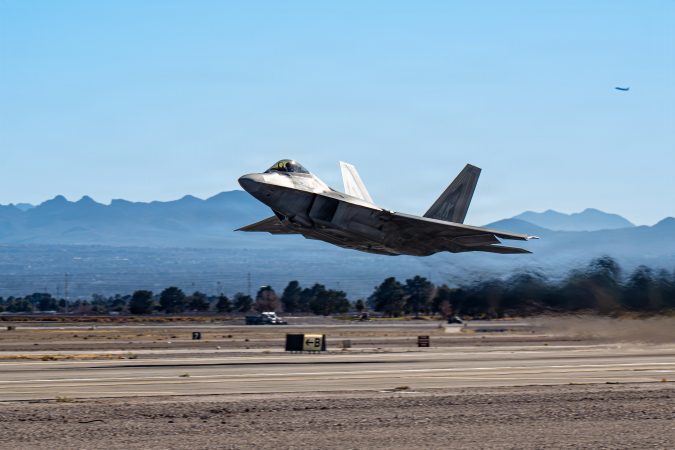
“[That] will probably surprise some people when they show up to Red Flag and they’re like, ‘why are the robots flying with us?’” Jensen said. “But you know, we’ll drive it and see what happens.”
Officials won’t just be looking at how the CCAs perform in those exercises, added Brig. Gen. David C. Epperson, commander of the U.S. Air Force Warfare Center. They’ll also be looking at how the human aviators respond.
“That’s the crux of having the EOU and getting platforms actually in their hands, so that we can start to get sets and reps,” Epperson said. “And what we’re going to see over time as these [vendors] change their mission autonomy as we advance the program … we’re going to understand better how those changes matter to both the CCA, but also to the quarterback and how we train up that aircrew as we move forward.”
The interaction between human and artificial intelligence won’t just be in the air, added Jensen—the EOU has already determined that it wants pilots to be able to “debrief” with the autonomy software just like they currently do with each other after a sortie.
“I want to be able to talk to a large language model and explain what the autonomy did at a certain time and certain place, and provide the reasons why it did it,” he said.
The insights generated from these kinds of experimental ops won’t just feed into the production decision Helfrich described; White said the data will feed into the Air Force’s deliberations about Increment 2 of the CCA program.
“We’ll start flying this summer, and we’ll start doing the constant refinement type work later this year, towards the back end of the year, once we get more and more data,” White said.