
Trump Promises a $1.5 Trillion Defense Budget
What a 50% Spending Boost Might Mean for the Air Force and Space Force.
By Courtney Albon
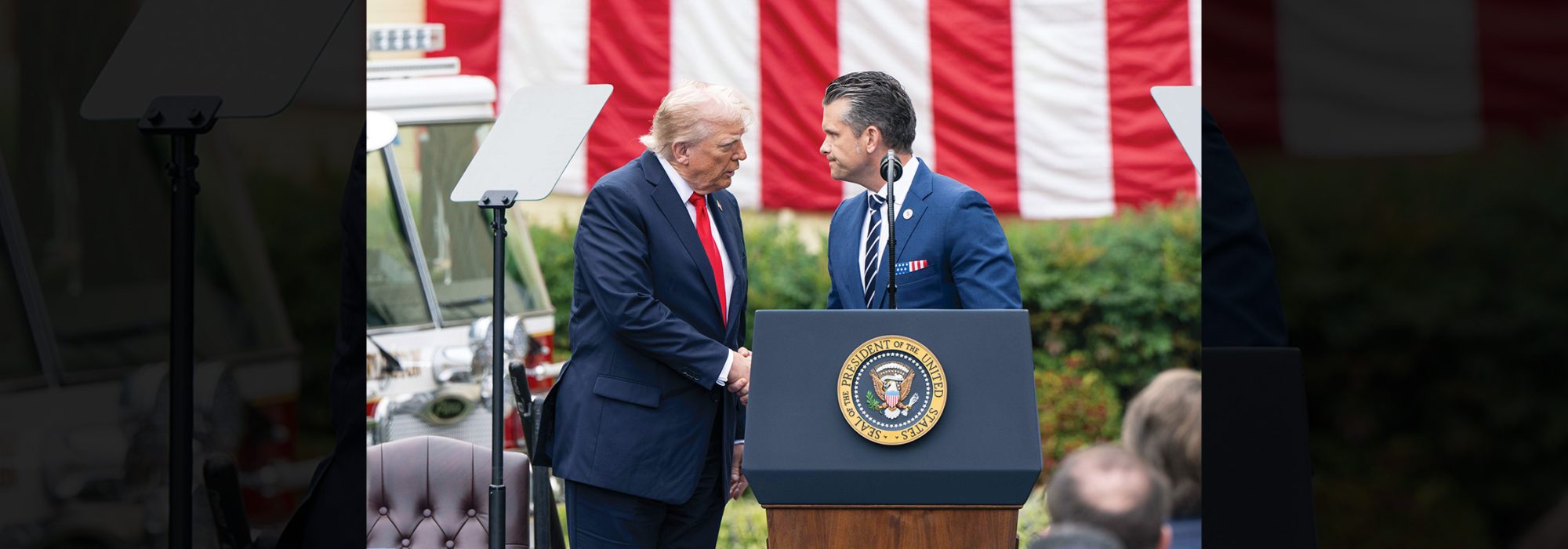
President Donald Trump was so impressed with the military’s successful Operation Absolute Resolve in Venezuela Jan. 3 that he soon took to social media to assert his plans to increase defense spending dramatically: to $1.5 trillion in fiscal 2027.
A $1.5 trillion budget would equal just under 5 percent of 2025.
It the President follows through—and Congress agrees—both major “ifs” at this stage—the 2027 budget would be about $500 billion over and above anticipated 2026 spending levels, an increase unseen in more than 70 years.
“This will allow us to build the ‘Dream Military’ that we have long been entitled to and, more importantly, that will keep us SAFE and SECURE, regardless of foe,” Trump said in the Jan. 7 Truth Social post. He suggested the funding could come from tariff revenue. It was unclear if the President was mapping out a negotiating position or stating policy with the announcement, but he laid out his reasoning in his post.
GOP leaders in Congress were quick to praise Trump’s commitment to raising the defense top line, led by Senate Armed Services Committee Chairman Roger Wicker (R-Miss.), a longtime advocate for raising defense spending to 5 percent of GDP—just as European NATO members have been asked to do by President Trump.
Wicker and House Armed Services Committee Chairman Mike Rogers (R-Ala.) said in a joint statement that raising the budget to $1.5 trillion would help accelerate key modernization programs across all the armed services.
“Increased investment will lead to tangible hard power: accelerated shipbuilding and aircraft production, a modernized arsenal, and innovative technologies that ensure our warfighters remain unmatched,” the lawmakers said. “These efforts prioritize the needs of our men and women in uniform and deliver the ‘Dream Military’ President Trump has envisioned.”
Analysts and former defense officials responded more cautiously. Exactly how the funding would be distributed among the services is unclear, at least until the White House releases its 2027 budget request in February or March. It is also possible the topline could shift between now and then. Also not clear is whether tariff revenue alone—which Trump has also earmarked for other administration goals, including reducing the federal debt and distributing rebate checks to middle-class Americans—would be sufficient to fund the increase.
Defense analyst Byron Callan of Capital Alpha Partners was pessimistic about Congress going along with such an increase in a Jan. 7 note to investors. While Republicans successfully passed an extra $150 billion in 2026 defense funding in the Big Beautiful Bill Act, using a procedural process called reconciliation, Trump’s proposal comes at a politically charged time, in the midst of an election year.
Republicans hold a razor-thin margin in both the House and Senate, and fissures are beginning to show in the Republican coalition.
Callan questioned whether the Pentagon could even digest such an increase, noting that the U.S. defense industrial base is not equipped to absorb such rapid increases in spending. “It raises multiple questions about how funding would be spent and how this increase could be absorbed by the defense sector,” he wrote.
MODERNIZING THE AIR FORCE
Yet for the Air Force and Space Force, a massive injection of additional capital could help reverse years of shortfalls, accelerate their massive modernization portfolio, and ramp up aircraft and satellite production.
Balancing those new-build requirements with the needed investments in workforce, training, and industrial base support could be tricky, and risky without long-term, sustained budget growth.
The Air Force typically garners about 20 percent of the military’s budget, although a sizable portion of that passes through the Air Force and is spent elsewhere. But assuming that portion remains consistent, the Department of the Air Force increase would be about $100 billion in 2027.
Retired Lt. Gen. Dave Deptula, dean of AFA’s Mitchell Institute for Aerospace Studies and former Air Force deputy chief of staff for intelligence, surveillance, and reconnaissance, said he thinks the service should use the potential influx to rebuild aircraft inventories with new aircraft purchases to replace aging fleets, and to increase sustainment and flying-hour accounts to improve the service’s combat readiness. The service could use some funds for F-47 and Collaborative Combat Aircraft, he said, but focusing on existing production lines will address the most pressing needs first.
“You can come up with all kinds of ways to spend the money,” he told Air & Space Forces Magazine. “The most logical one from the Air Force’s perspective is you just start increasing the procurement buys.”
Todd Harrison, a senior defense and budget fellow at the American Enterprise Institute, suggested the Air Force would do well to focus any additional funding to cover cost overruns on programs like Sentinel, the long-delayed replacement to the Minuteman III intercontinental ballistic missile, and to accelerate the F-47 next-generation air dominance fighter and the recapitalization of its aerial refueling fleet.
“I would not count on this being a sustained increase in funding, so I would avoid increasing force structure,” Harrison said. “It would make more sense to buy down the acquisition bow wave as much as possible while the money is available.”
Deptula and Mark Gunzinger, the Mitchell Institute’s director of future concepts and capability assessments, in a policy paper published at the start of the Trump administration, proposed a
$45 billion budget increase for the Air Force. The paper outlined a plan to acquire an extra 32 F-35As, 24 F-15EXs, and 10 B-21s annually, as well as a fleet of at least 26 E-7 early-warning and battle-management jets.
They also called for funding a Next-Generation Aerial Refueling System program to be able to start production in the mid-2030s and advocated for fully funding the Sentinel program. Deptula also said the ground-based air defense mission, flying hours, and weapon systems sustainment should also be top priorities for the service, and could be funded with an increase in the $100 billion range.
But Deptula emphasized that one-time boosts are far less valuable than sustained annual funding. “Key to this increase will be that this level for defense spending cannot only be a one-time shot,” he said. “It needs to be a re-leveling for future multiyear defense appropriations.”
MEETING DEMAND FOR SPACE CAPABILITIES
The Space Force has the smallest budget share of all the military services, around 3 percent of total Pentagon spending, or $26 billion in fiscal 2026—though reconciliation increased that to about $40 billion. If its portion of a $500 billion defense increase were proportionate, it would receive an additional $15 billion in 2027.
But both Deptula and Charles Galbreath, senior resident fellow for space studies at the Mitchell Institute, argued that the Space Force should receive a greater than proportionate share of the increase to help it add personnel and meet the increasing demand for space-dependent missions, such as space-based moving target indicators, and to increase its space superiority and counterspace capabilities.
Harrison was skeptical of this approach, arguing for his part that the Space Force is “flush with cash” for current obligations, due to reconciliation funding. More resources could help address unmet mission needs like building out its data transport layer, he said, but he argued that USSF should focus on delivering existing programs before launching new ones.
“The challenge for the Space Force is more about execution on programs than funding,” Harrison said.
The Space Force will play a major role in the Pentagon’s Golden Dome missile defense architecture, which is envisioned as a multilayered missile defense shield that will combine existing sensors and missile tracking capabilities alongside advanced intercept technology. Galbreath suggested increased funding could speed development and scale production of existing sensors.
“There’s certainly a layer of sensors that has to be increased and expanded,” he said. “The C2, synthesizing all of that information, is also critical. There is progress that’s being made on that front, so I would expect additional funding to help accelerate the delivery.”
For the more challenging developmental elements of Golden Dome—space-based and ground-based interceptors—additional funding could allow the Space Force and other agencies to spread contracts among more companies, increasing competition to reduce risk and accelerate development.
“If you’ve got today three companies that are pursuing space-based interceptors, maybe you increase that to seven or 10 if you’ve got additional funding, knowing that some of them are simply going to fail,” Galbreath said. “And then once you’ve got winners, you’re going to put a whole lot more money into those to scale them to meet the threat environment.”
Beyond program increases, Galbreath suggested funding could be used to enhance the Space Force’s training enterprise and to increase the workforce it will need to manage acquisition programs and operate new systems. He cautioned, however, that the service should focus on sustainable investments initially, in case funding levels aren’t maintained in future years.
“You don’t want to buy 20 weapon systems if you only have personnel or sustainment funds for 10 in the out-years,” he said. “You’ve got to manage your growth in a realistic way.”
EXECUTION CHALLENGES
Both Galbreath and Deptula said they expect the defense industrial base is well positioned to take advantage of additional funding—whether to expand production lines or fill personnel gaps created by significant government cuts over the last year. “We’re not talking about inventing new stuff,” Deptula said. “We’re talking expanding what is either already on the books or on the drawing boards. … With sustained funding, the production lines that are already in existence can increase output at meaningful rates.”
Similarly, Galbreath said the space industry is ready and waiting for a demand signal from the department. But a significant increase in production demands could pose challenges for the growing space industrial base.
“The big question I have is supply chain and pace,” he said. “Will we be able to produce the quantities of capability at the rate the government needs to match the spending profiles as well as the operational demand signal we see from an emerging threat? President Trump when he unveiled the $1.5 trillion, he said we’re looking at the threats and that number is based off of a realization of how significant those threats are. We have to meet them.”
New Defense Strategy Prioritizes Western Hemisphere
By Matthew Cox and Greg Hadley
The Pentagon released its new National Defense Strategy Jan. 23, emphasizing a new commitment to the Western Hemisphere. But while that focus garnered most of the headlines, the strategy’s subtle shifts on China raise questions about how the Trump administration aims to leverage U.S. military power in the Indo-Pacific. The 2026 National Defense Strategy says the U.S. will practice “realistic diplomacy,” emphasizing “deconfliction and deescalation” in its relations with China so that the two economic rivals and their trading partners in the Pacific can “enjoy a decent peace.”
“Our goal in doing so is not to dominate China; nor is it to strangle or humiliate them,” the strategy states. “Rather, our goal is simple: to prevent anyone, including China, from being able to dominate us or our allies.”
The United States will erect “a strong denial defense” along the first island chain, the strategy explains, referring to the Pacific islands that include Japan, Taiwan, portions of the Philippines, and Indonesia. It will ensure the U.S. military can conduct “devastating strikes and operations against targets anywhere in the world, including directly from the U.S. homeland.”
But the unclassified version of the strategy released to the public leaves the term “denial defense” undefined.
“We will be strong but not unnecessarily confrontational,” the strategy concludes. “This is how we will help to turn President [Donald] Trump’s vision for peace through strength into reality in the vital Indo-Pacific.”
PIVOTING EAST
Beginning in 2011, successive U.S. administrations have sought to reorient U.S. defense priorities from Europe and the Middle East to a greater focus on China and Asia. President Barack Obama’s administration coined the term “pivot,” but with combat operations in Afghanistan, Iraq, and Syria, never fully made the shift. The first Trump administration’s 2018 NDS leaned further toward China, coining the term “long-term, strategic competition” in which the U.S. and other great powers, including China, were facing off economically, technologically, and militarily. When the Biden administration published its NDS in 2022, it dubbed China “the “overall pacing challenge for U.S. defense planning.”
The 2026 NDS still cites deterring China as a top priority, but defense analysts see a clear rhetorical shift in the new document. It is an “acknowledgment that we’re probably not going to establish superiority vis-à-vis China,” said Michael O’Hanlon, who directs foreign policy research and the Center for 21st Century Security and Intelligence at Brookings. “We’re not looking to defeat China or change its regime. We’re not looking even to chase the elusive goal of military supremacy against China, because we think that’s not really attainable.”
By giving up the “pacing challenge” language from the 2022 document, a former Air Force official argued, the new document “will be read as a weaker position that the United States is taking in terms of deterrence and resolve.”
Retired Air Force Lt. Gen. David A. Deptula, dean of AFA’s Mitchell Institute for Aerospace Studies, disagreed. “I don’t see any surprises in [the new NDS],” he said. The focus on the Western Hemisphere does not reduce concerns about China, he added: “I think the way people interpret homeland defense is sometimes a miss.”
References to “denial defense” inside the first island chain are critical, Deptula said.
“The best way to achieve homeland defense is by deterring any adversary from shooting at our homeland, and the way you deter them is by ensuring that we have a very well-established power projection force that can crush them if they were to engage in any type of aggression against the United States,” Deptula said. “If you want to deter China, you make sure they understand that they’re not going to be able to operate from a sanctuary, and that from the first instance of aggression on their part, their homeland is coming under attack,” Deptula added. “We’re not going to let their missiles freely launch against us. That is some-thing that often times people overlook. They think, oh, homeland defense—we need to supply more catcher’s mitts so we can catch those missiles that they shoot at us.”
But defending the homeland has both defensive and offensive components, he said.
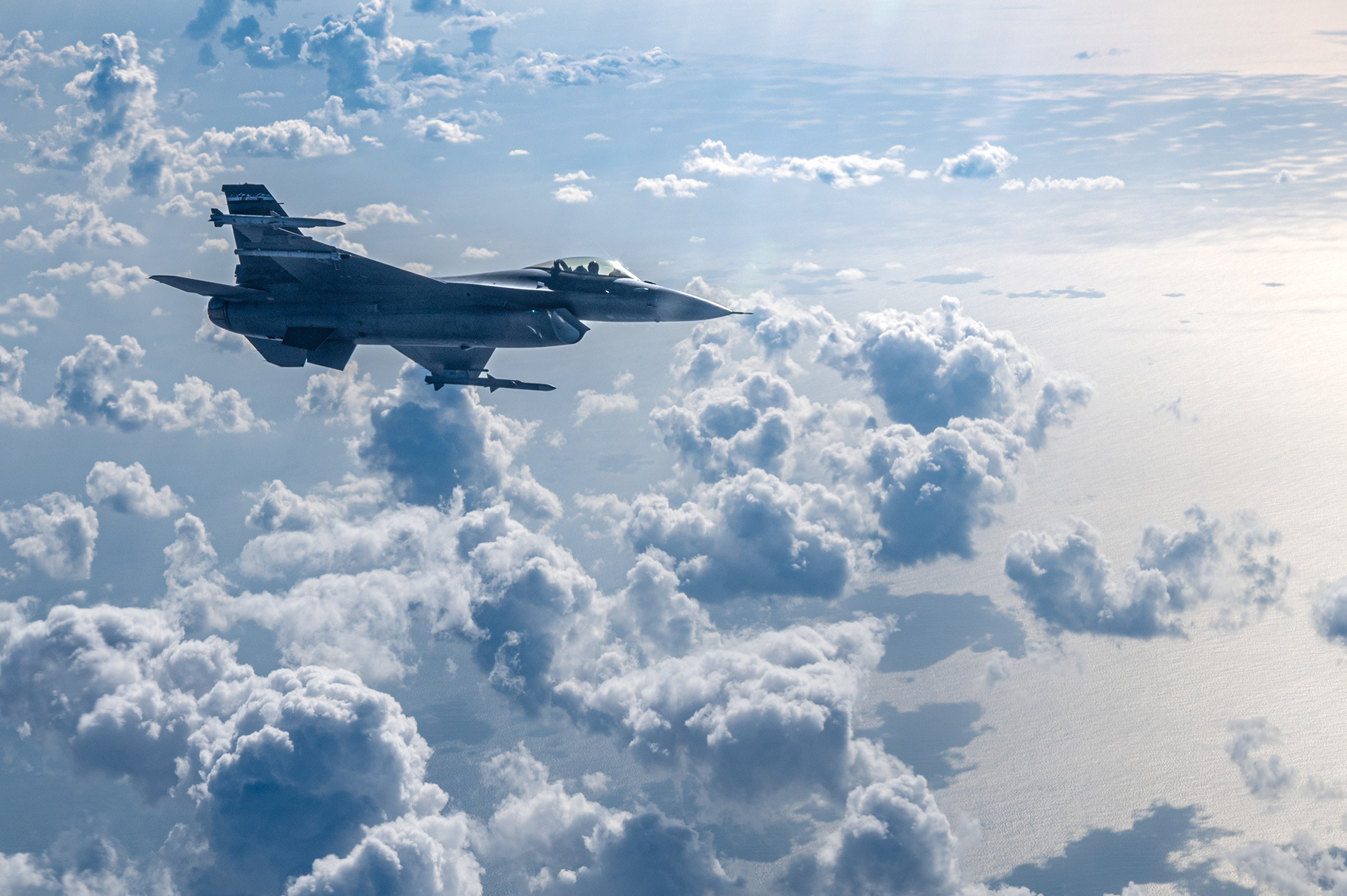
Elaine McCusker, a senior fellow at the American Enterprise Institute who was the Pentagon Comptroller during the first Trump administration, said it’s clear that investments in such weapons as the F-47 Next-Generation Air Dominance fighter, the B-21 Raider long-range bomber, and the Golden Dome missile defense shield are all intended to “deter China or compete with China or see China as a pacing challenge.”
Not spelling that out specifically could itself be strategic. How the U.S. develops its strong denial defense against China will be telling. Deptula said the denial defense should include equipping airbases in the first island chain with long-overdue passive defense capabilities like robust reinforced hangars and facilities that can endure an attack.
“You can expect Pacific airpower to be judged by whether it can survive the opening salvo attack,” Deptula said. Hardened aircraft shelters, the ability to disperse forces and use deception to make it more difficult for enemy forces to mount accurate attacks on U.S. bases will be key, he said.
A recent RAND study recommended that the Air Force invest in rapid runway repair capabilities, blast-resistant shelters, and other passive measures to ensure fighter sorties can launch despite repeated bombardment.
Historically, Deptula said, “These things have not been funded. You’ve got to be able to generate sorties. … We need to be able to sustain our attacks.”
The denial defense portion of the strategy will lean on the Air Force’s agile combat employment concept (ACE), pushing it from an “operational concept to an operating system,” Deptula said. ACE envisions small teams of Airmen setting up ad-hoc airfields in remote locations, dispersing airpower and making it more difficult to target.
“If you’re going to disperse to a variety of airfields in the Pacific … it needs to be dozens, and those dozens of airfields need to be pre-positioned [with the] weapons, fuel, command and control required to allow them to contribute to a viable campaign,” Deptula said. “But [the Air Force] needs to be funded to do that.” O’Hanlon said the details not laid out in the NDS will likely show up in budget requests, including “purchases of munitions” and “to increase submarine production” or B-21 bomber production. Former Air Force Global Strike Command boss Gen. Thomas A. Bussiere told the Senate Armed Services Committee in May that he supported expanding the requirement for B-21s from 100 to 145.
O’Hanlon said the real tell will be in classified documents and budgets. “I would look in the classified budgets for things like radiation hardened satellites, anticipating the possibility of nuclear detonations in space, by any great power that was losing a conventional war and wanted to find a place to go in between conventional war and all out nuclear war.”
How the U.S. views its allies in the Pacific is also telling in the new NDS, which suggests South Korea is capable of taking primary responsibility for deterring North Korea.
The Trump administration has “been fairly clear in telegraphing” it plans to adjust its forward posture in Europe and on the Korean Peninsula. “That that leads to questions in terms of the U.S. ability to address threats to the homeland before they manifest here at home,” the former Air Force official said. “It’s worrisome in terms of the total deterrence posture and being able to leverage our alliance architecture in the Indo-Pacific.”
Deptula again disagreed, arguing that U.S. forces have been adjusting force posture in South Korea by moving Air Force units from Kunsan Air Base to Osan Air Base.
“Quite frankly, there’s already a transition occurring in the context of how U.S. force posture is on the Korean Peninsula,” Deptula said. “The South Koreans themselves have become a very capable force. … I think what you’re going to see is that U.S. airpower is going to still remain a principal element when it comes to operations with the South Koreans, but it is going to need to be supplemented more with longer-range capabilities so that force presentation necessary for deterrence doesn’t dip or slack off.”
Still, the former Air Force official said the new strategy’s use of a “strong denial defense” of the first island chain “makes me worry that there are trade-offs being made for other types of capabilities and concepts that are important for deterring Chinese aggression in theater.”
President Trump’s plan to increase the defense budget top line to $1.5 trillion in fiscal 2027—a potential boost of more than $500 billion above anticipated 2026 spending levels—deserves scrutiny in light of the NDS, the former Air Force official said. “Where is the $1.5 trillion going? How is the U.S. military preparing to demonstrate combat credibility for that deterrence, and how is that driving military modernization? Those questions are left unanswered, at least in the unclassified version of the strategy.” At the same time, the former official questioned what a greater focus on the Western Hemisphere suggests. Strategically, it could mean focusing on keeping China and its Belt-and-Road initiative out of South and Central America, and reducing China’s influence in critical locations like the Panama Canal.
But it could also mean changing the mix and design of U.S. forces, the former Air Force official suggested. Might more operations in the Western Hemisphere require different capabilities? “Does that then lead to the need for a high-low mix for the joint force overall?” the official wondered. “And are we back … in the post-911 era, where we know we need to be modernizing the military for contested environments and the demands of a China-like war fight, but the force is being used day-to-day in these low-intensity ways that require a different mix of capabilities?” The Trump administration has said little about the strategy beyond releasing the document. But the President is gearing up for a State of the Union speech in February, and a budget that should follow no later than March. Those two releases should shed more light on how the administration intends to leverage the strategy to shape its future investments.