
We love letters! Write to us at letters@afa.org. To be published, letters should be timely, relevant and concise. Include your name and location. Letters may be edited for space and the editors have final say on which are published.
Long Overdue
I would like to express my deep appreciation to you and Matthew Cox for publishing “Prepare to Abandon the Aircraft” [September/October 2025, p. 34]. As one of two on-scene forward air controllers who witnessed the shoot down of Stinger 41, I believe that Matt’s article is an excellent and factual account that captured the horrific nature of what happened over 53 years ago. Along with former Secretary of the Air Force F. Whitten Peters, Col. Roy Davis and other combat veterans, I believe that the USAF should recognize the heroism demonstrated by the whole crew on that fateful afternoon.
The original submission for the awards to individual crew members was lost during the final days of combat as the AC-119Ks were transferred to the Vietnamese Air Force and the 18th Special Operations Squadron flag was cased. In spite of two detailed submissions, each one with increasing fidelity replicating the original awards package, the Air Staff has denied both.
As a sanity check, I contacted 24 general officers who during their careers were in a position to approve the awards as recommended in the original submission. All agreed that they would have approved the recommendations for award. Our bureaucratic process has failed these Airmen and their families.
My hope is that our Air Force will review this issue and correct this oversight. Our heroic Airmen and their families deserve nothing less. If anyone is interested in supporting our cause, please go the Stinger41.com to join our efforts to contact the Secretary of the Air Force.
Lt. Gen. Tom Waskow,
USAF (Ret.)
Cornelius, N.C.
Bearly Noticed
Great article “Defending the Northern Flank,” in the November/December issue [p. 35]. I was stationed at an intelligence-gathering squadron at Kadena Air Base, Japan, in the late ’70s. We monitored Soviet Air Force activities, including their tracking of the weekly TU-95 flights from Petropavlovsk to Cam Ranh Bay. We worked with the 18th Wing and set up a “Bear Hunt.”
With a couple of F-15s deployed to Clark Air Base, Philippines, a predicted best intercept point for the Bear was passed, the Eagles intercepted a very surprised Bear, and took photos. The wing’s intelligence officer and the pilots brought us a photo of an F-15 flying with the TU-95 signed by the pilots. They also showed us a photo of the top of the Bear and said it would not be seen by the general public. The photo was taken from the F-15 flying inverted over the TU-95.
Maj. Pete Siegel,
USAF (Ret.)
San Antonio
Evolution of War
I’m old enough to remember that in order to become the USAF Chief of Staff, you essentially needed to be CINCSAC (Command in Chief, Strategic Air Command) before stepping up to lead the force. Having just read the November/December edition of Air & Space Forces Magazine it’s totally clear that the Fighter Mafia has a firm grip on senior leadership in today’s Air Force.
You acknowledged in Gen. David Allvin’s farewell article [p. 6] that he, and Gen. Norton Schwartz, have been the only nonfighter pilots to be Chief of Staff since the Vietnam era. This issue also included former Chief of Staff Gen. Merrill McPeak’s view [p.2] on—
(surprise!) more flying time for fighter pilots.
If it hasn’t occurred to our senior USAF leadership yet, the next war will not be a fighter-centric conflict. The Russian-Ukraine war has demonstrated vividly that the next war will be a drone swarm war controlling the air space above the tactical battlefield. Special Operations and strategic/tactical airlift complement and support this new vector of warfare. Ukraine is producing over 2 million drones per year, are we? The USAF solution? Fighter controlled collaborative combat aircraft cost billions of dollars while the average cost of Ukrainian drones are a few hundred dollars.
Priorities and leadership counts. We need leadership that understands special operations and asymmetric warfare incorporating the lessons of Ukraine. The great biography of Maj. Gen. Edward G. Lansdale on the last page of this issue is dispositive. We are headed in the wrong direction. Yogi Berra once said, “We’re lost, but we’re making good time.”
Color me worried.
Maj. Jarold B. Gilbert,
USAF (Ret.)
Tampa
Preventative Measures
This was an excellent article [“Realistic Expectations for Golden Dome by 2028,” November/December, p. 29]. Rather than relying only on massive retaliation, I think deterrence would be stronger by relying on both defense and attack. It would certainly be more effective against terrorists or a terrorist nation that wasn’t worried about retaliation.
However, I think there would be another benefit to come from Golden Dome which is deterrence of a conventional war. SpaceX has been awarded a $2 billion contract to develop satellites to track missiles. This is just a start. My guess is that this is the beginning of a constellation of SAR (synthetic aperture radar) satellites, which I would estimate to number about 600, a small number compared to the 9,000 Starlink satellites.
Such a constellation could give the U.S. the ability to use radar to look at any place in the world. Of course, the entire world couldn’t be scanned continually. The system could just look at limited areas, … but those areas could be anywhere in the world.
A potential war that such a system might deter would be an invasion of Taiwan by Communist China. If the system can track missiles, it would be able to track ships very easily and aircraft as well. Xi Jinping has repeatedly threatened an invasion, and he might try it with 25,000 ships and 1,500 aircraft. But if a constellation of 600 SAR satellites could track the location of every ship and every plane at even 5-minute intervals, it might be possible to destroy most of them … as was done with the Iranian missiles/drones sent to attack Israel.
If Xi realized this, he might be deterred from attacking. The probable cost of an invasion attempt could easily be $1 trillion. My guess is that the satellite constellation will cost $30 billion—so it would be a bargain.
William Thayer
San Diego
For Your Consideration
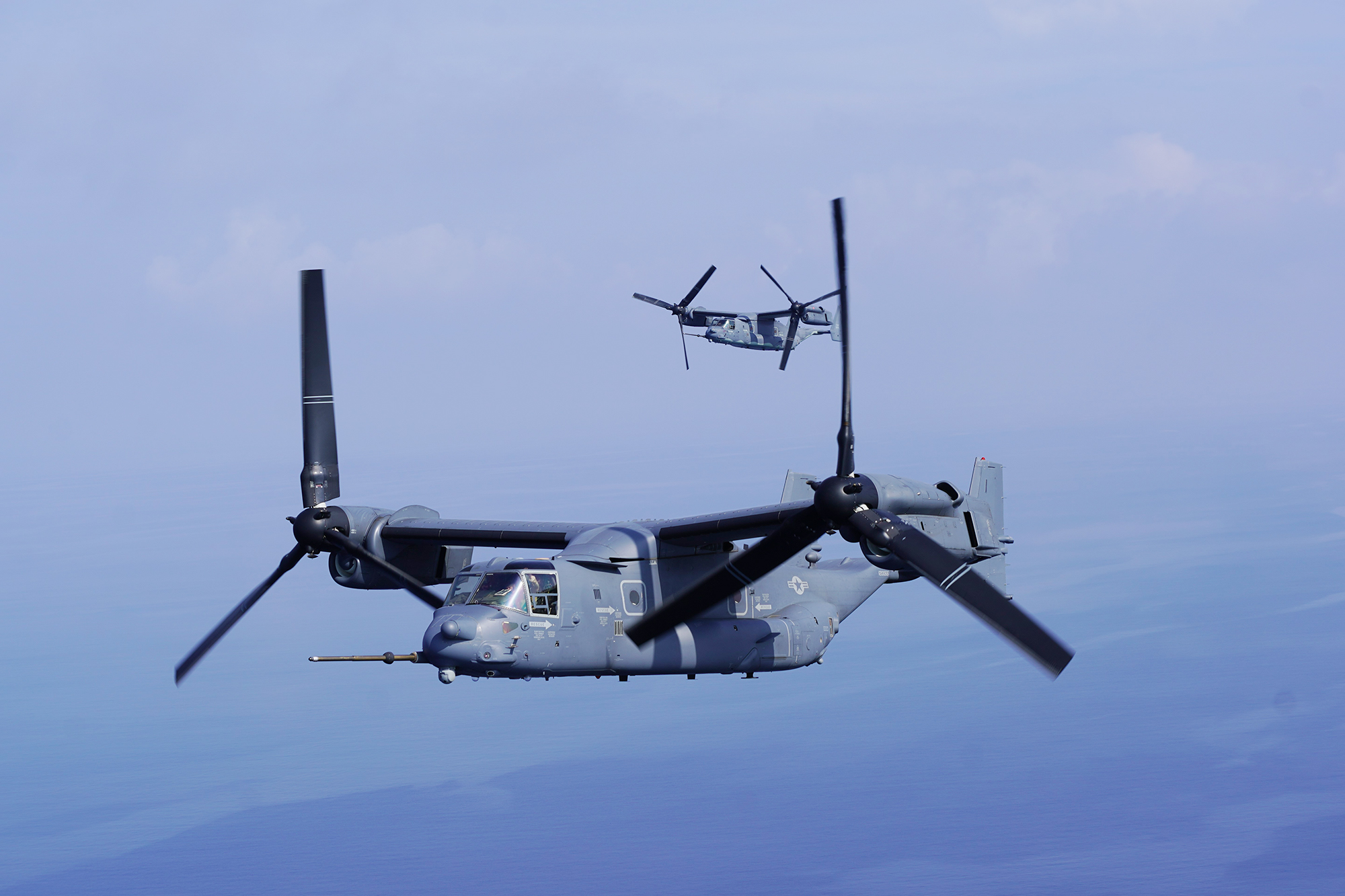
In light of the Army moving forward with the MV-75 series of aircraft from Bell/Textron, the Air Force needs this airframe. With the problems coming from the V-22 series of rotary wing aircraft I can understand some hesitancy. I am not well versed on the security plans for defending the fixed silos of the nuclear triad either.
A quick look, though, and this aircraft offers a cruising speed rated at well past the MH-139A series of utility helicopters. This could offer a quick return flight or less flight time and possibly increased load to respond to remote sites.
This will offer the landing capability of a helicopter with the airspeed greater then some small planes. I am not an expert though. The Air Force should work to gain authorization for purchase of some of these, free of the Army, and possibly improve mission capability with fuel tanks for extended range and enhance internal layout for medevac variations. This should be a viable replacement for the V-22’s without losing a unique mission capability.
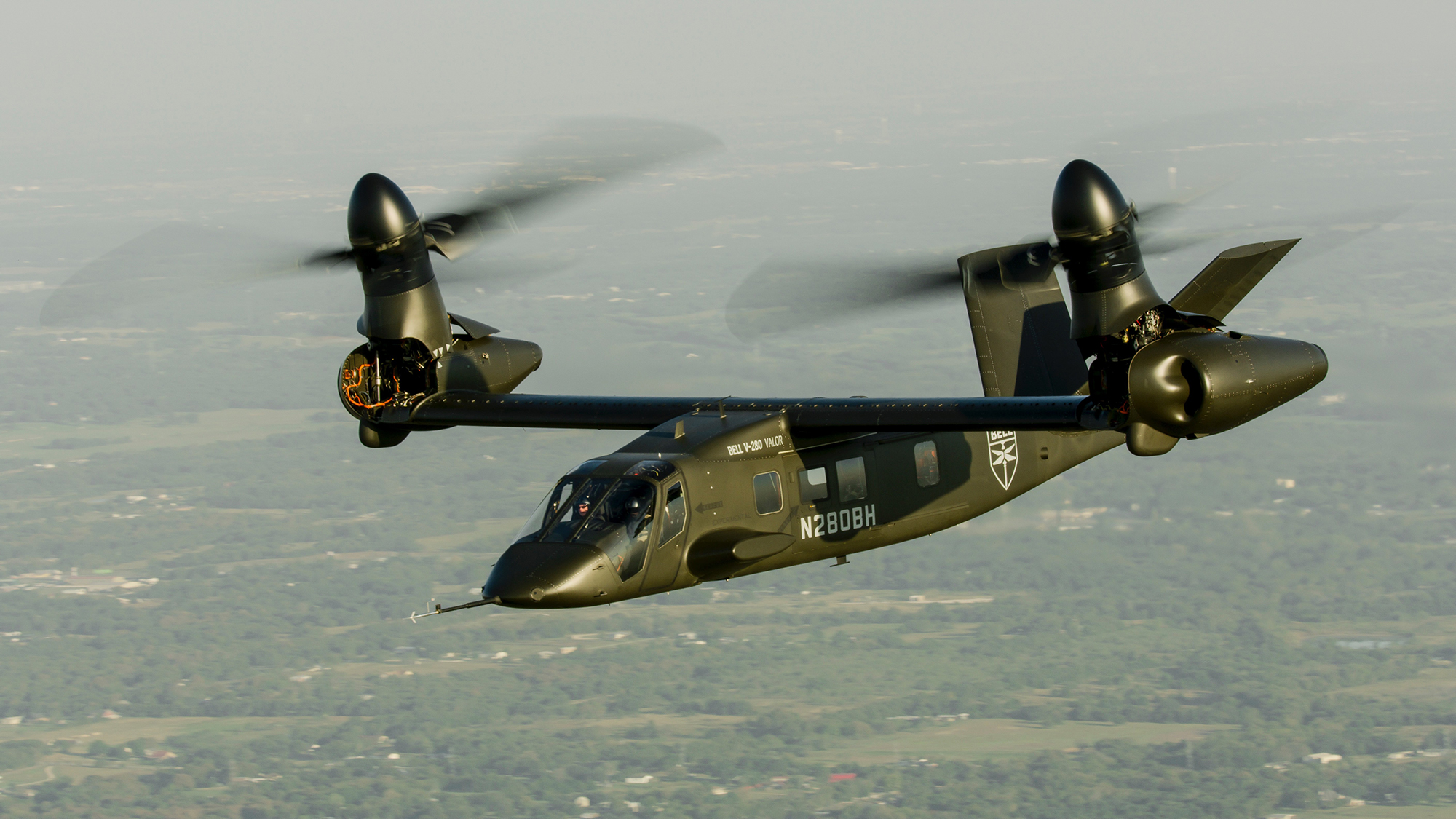
A Bell V-280 in flight above and the CV-22 Osprey below. The MV-280 is comparable in capacity to an HH-60, which can carry about half as many troops as an Osprey. The main difference between the two tilt-rotor aircraft is in the engineering. The CV-22’s entire engine pivots when it transitions to vertical flight, while the V-280 engine remains static, and only the rotors pivot. Bell Textron
Cpl. Jesse Reagan,
USA
Union, Ore.
Targeting Policy
There are several levels of targeting starting with the commander in chief, who establishes the policy that will eventually lead to the actual destruction of a target. The policy initially drives intelligence-collection requirements and service operations training and readiness objectives for nuclear, conventional, and other missions.
The Secretary of War must have all services trained and prepared to execute all targeting missions. The Joint Chiefs of Staff (Chief and Service Chiefs) will determine which service or COCOM would be best available and capable to accomplish a specific mission.
The tasked commander of the COCOM or subunified command will have developed a campaign plan to accomplish the specific overall mission and would establish the objectives for any portion of the plan.
The supporting air component or its air operations center (AOC) will publish the air tasking order (ATO) to execute the campaign plan and identify the specific unit and weapon system and munition(s) that will be used.
The AOC target officers may identify specific aimpoints and convey them to the tasked unit(s). This may or may not be in the ATO. At the unit, the pilots or aircrews will be designated to attack the target and may be advised how many aircraft and bombs would be required to damage or to destroy the target.
Pilots and aircrews would plan and deconflict with other support functions their tactics depending on the target area terrain and defenses and decide whether they will drop one or more bombs on a single pass or perform several passes.
Based on the intelligence available at the time, if the basic target in question is a facility, equipment or function, generally speaking, the people who may be injured or killed are “collateral damage.” On the open battlefield or in urban warfare, personnel combatants could be the primary targets, of which facilities, equipment, and functions could become the collateral damage. In either case, it is only realistic to understand, good or bad, that collateral damage could occur.
Unfortunately, this is a part of the “fog of war.”
Lt. Col. Russel A. Noguchi,
USAF (Ret.)
Pearl City, Hawaii
It’s the Real Thing
Retired Gen. Merrill McPeak nailed it! [See “Guest Editorial: More Flying Hours: Build Skills & Loyalty,” p. 2.] As a fighter pilot in the ’60s, ’70s and ’80s, I totally agree. There is no substitute for stick and rudder time. I realize that modern sims are state of the art, but they cannot replace the sweat and adrenalin of the real thing.
Combat ready pilots should fly every day.
Lt. Col. Jim Webster,
USAF (Ret.)
San Diego
Gen. Merrill McPeak is right on target. The reason I know is that I started my 30-year career in an odd way to be commenting on the subject. Twenty-eight of my 30 years were spent as an Air Force physician. So, what the [heck] do I know about flying?
My first two years were served at Nellis Air Force Base, Nev., as the Disaster Preparedness Officer (DPO) picking up the pieces of F-4s and other aircraft that had “departed controlled flight” during Red Flag combat drills.
I spoke to a lot of pilots because I loved walking down to the flight line from the DPO that was in the basement of a VOQ (Visiting Officers’ Quarters) next to the “Bomb Shelter”—the Officers’ Club stag bar—and engaging with them and the ground crews. They flew hard. They flew constantly.
They each believed that they and their wingman were the hottest damned combat pilots on Earth, and God help the suckers in the mock (and sometimes real) Russian airframes they flew against on the North Range.
When they weren’t landing after blowing lines of excessed jeeps to pieces or defeating sharp-as-nails Red Force pilots they were doing carrier landings in the club.
It was the constant honing of those skills and that attitude that made them fearsome opponents in the air. I respected that. Then, somehow timidity driven by the increasing cost of aircraft and the fear of having a crash—or worse, the loss off an Airman-in-training—led to less and less flying, excused by the highs cost of avgas.
By the time I retired, squadron commanders were having to explain why they couldn’t get more flying hours for their sky-hungry crews.
Some say AI-augmented drones will replace pilots, costing less per downed aircraft, less fuel and less lives. I think that’s bull. Drones will certainly play a role in future air wars, but the core of battle success will be the combat pilot who lives to be in the air drilling and fighting.
Thank you, general, for pointing that out. I hope someone is listening.
Col. Terrence Jay O’Neil,
USMC (Ret.)
Londonderry, N.H.