
How a rogue planning cell engineered the most decisive air war in modern history.
When the exercise “Internal” Look kicked off at a mock command center at Eglin Air Force Base, Fla., in July 1990 no one knew quite how prescient the whole operation might be. Presaged with a series of fictional messages sent by Central Command Headquarters to participating Army, Navy, Air Force, and Marine Corps units, the exercise scenario was built around a 300,000-man Iraqi military force massing in preparation for an invasion of the Arabian Peninsula. But almost as soon as it began, those fictional messages started overlapping with actual message traffic describing very similar events taking place in real time. Planners had to stamp the fictional messages “Exercise Only” as life and art played out in parallel.
Real life eventually interfered. Iraq’s very real disputes with its neighbors over the price of oil, war debts owed to Kuwait from Iraq’s lengthy war with Iran, and charges that Kuwait was pumping Iraqi oil out of wells drilled diagonally beneath the nation’s borders had Saddam Hussein boiling mad. Intelligence and military analysts debated what would happen next.
This is the first in a multipart series about Operations Desert Shield and Desert Storm.
By the end of July, a U.S. Navy “picket line” was in place in the Persian Gulf, the ships’ radars trained on Iraq to provide early warning in case its air force launched an assault on its neighbors to the south. U.S. Air Force tankers flew in to exercise with the United Arab Emirates in a show of solidarity. Iraq continued to move men and equipment to its southeastern borders. Increasingly, the signs looked more like war than bluster.
Briefing Pentagon leaders in “the tank,” Army Gen. Norman Schwarzkopf, commander in chief of U.S. Central Command, told Defense Secretary Dick Cheney he believed an attack was imminent. But Schwarzkopf said he expected Saddam to stop after seizing Kuwait’s Rumaila oil fields. Following the briefing he bid goodbye to Cheney and Chairman of the Joint Chiefs of Staff Gen. Colin Powell and flew back to his headquarters in Tampa.
Schwarzkopf was climbing onto an exercise bike when Powell called later that night: Iraqi troops had crossed the border. It was soon apparent that Schwarzkopf’s prediction had only been half right. Saddam’s forces didn’t stop at Kuwait’s oil fields, but flooded across the entire country. Three days later, the fighting was over.
Col. John Warden was enjoying a summer cruise Aug. 3 when he learned of Iraq’s invasion. A strategic planner and director of Warfighting Concepts on the Air Staff, he oversaw several divisions in the Pentagon, including Checkmate, a planning cell originally conceived for combating the Soviet Union but more recently reoriented to look at other strategic challenges. Warden, a slim, intellectual type, was a favorite of new Air Force Chief of Staff Gen. Michael Dugan, who had taken over just a month before, a deep strategic thinker who had turned his National War College thesis into a published book on airpower.
Warden felt stuck. “My conclusion was the United States was almost certainly going to be going to war with Iraq,” he recalled, and here he was trapped on a cruise ship for another couple of days.
A war with Iraq presented an opportunity to apply Warden’s airpower theories in real life, and he turned the challenge over and over in his head. “I was sure we could use almost exclusively airpower to defeat Iraq and reverse the invasion,” he thought.
Now all he had to do was get to Washington and convince the rest of the Department of Defense. He was a colonel in a place where 1-stars sometimes have to stand by to get the coffee. He hardly stood a chance.
Warden returned to work at the Pentagon Monday, Aug. 6, immediately calling in his division chiefs for a discussion. “Look, we’ve been thinking about how to use airpower better,” he recalled saying, in a recent interview. “We know how to put something together that would defeat Iraq. So we’re going to plan it. I don’t know how we’re going to convince anybody to do it, but let’s just build it. And then we’ll go from there.”
Warden told his boss, Maj. Gen. Robert Minter Alexander, the Air Force director of plans (XOX), who in turn reported the conversation up the chain to Dugan and Vice Chief of Staff Gen. Mike Loh. Warden might have waited until he had more of a plan in place, but he didn’t. It proved fortuitous.
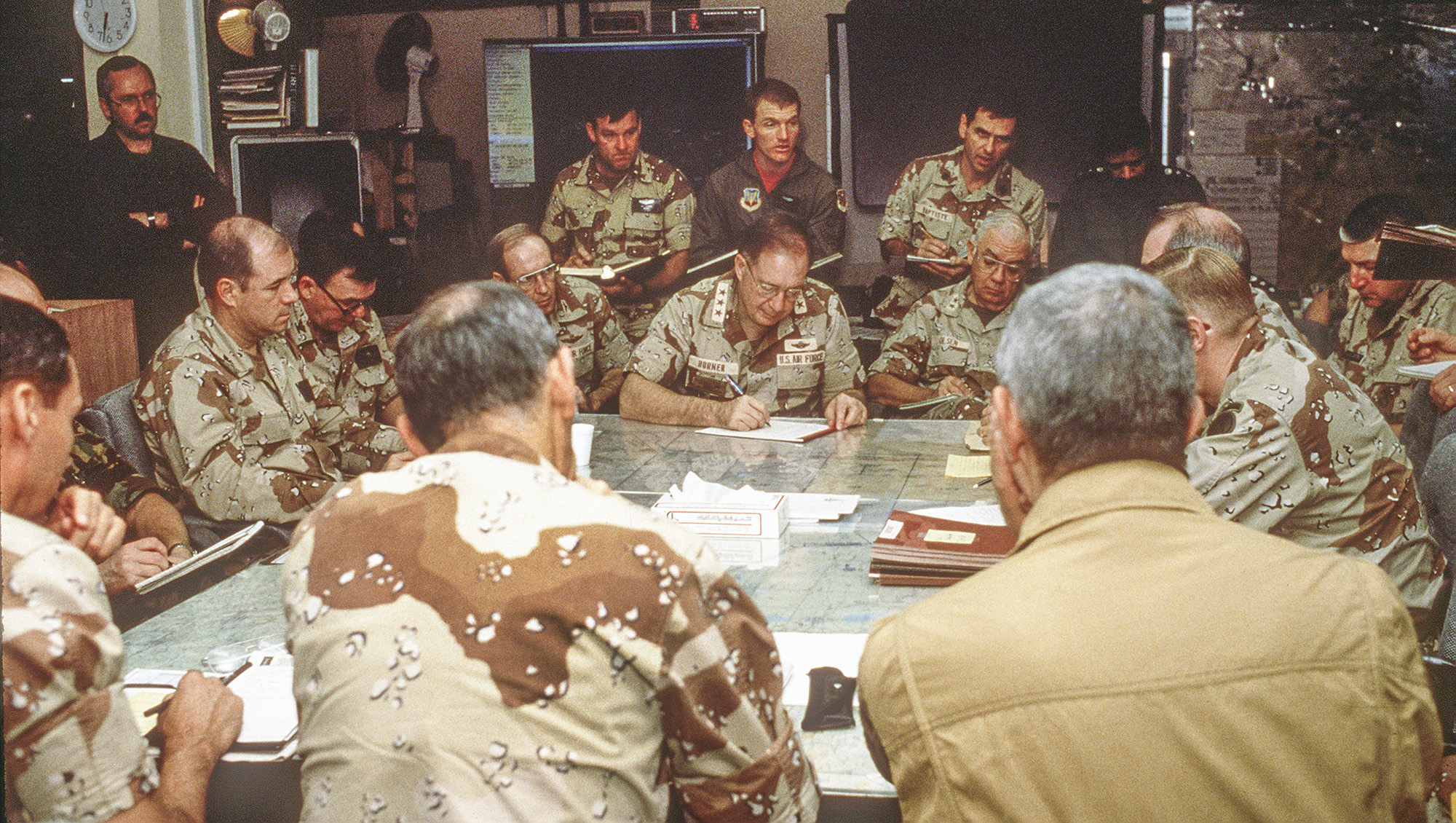
Schwarzkopf and Central Command planners were knee- deep in logistics and the rapidly unfolding crisis. Cheney and Schwarzkopf had flown to Saudi Arabia to confer with Arab leaders, then left behind Chuck Horner, commander of the 9th Air Force, to represent him. Now Schwarzkopf wanted to keep Horner there while he attended to other planning in Tampa. U.S. Air Force jets were flying into Saudi Arabia, beginning with F-15Cs and later F-16s from Torrejon, Spain, but logistics were proving challenging otherwise. The U.S. had few forces in theater and it would take months to build up a ground force large enough to deter, let alone stop, Saddam from crossing south into Saudi Arabia.
Meanwhile, Iraqi forces kept pouring into Kuwait. Schwarzkopf needed a means to counter that advance and stop it if necessary. His overarching fear was that Iraq’s army, then the fourth largest in the world—the U.S. Army was smaller, in fact, at No. 9—would drive down into Saudi Arabia and the Gulf states, led by its Republican Guard’s Soviet-built T-72 tanks. Schwarzkopf needed options, in a hurry. And he was unimpressed by the ideas percolating up from air planners on his staff in Tampa.
A bear of a man, 6-foot-3 and 240 pounds, Schwarzkopf had played football at West Point. The son of an Army brigadier general, he had begged off a three-year assignment at West Point early in his career—good duty for those who could get it—to volunteer for duty in Vietnam in 1964. There, he earned three Silver Stars, valor awards for bravery and heroism in an ugly war. Now, a quarter century later, he was at the pinnacle of his career, and about to embark on a new war in a new context. President George H. W. Bush launched Operation Desert Shield on Aug. 6, and Schwarzkopf suddenly contemplated the idea that, as commanding general of a major military campaign, he was living through a significant moment in American history. Briefly, he conceded in his autobiography, “It Doesn’t Take a Hero,” he imagined that he might find himself Army Chief of Staff one day.
Now, however, he had a problem. He knew it would take months to build up a formidable land force in the Middle East and he feared that Iraq would take advantage of that fact and push its forces forward. He needed a way to deter, and if need be counter that advance. He could worry later about what it would take to dislodge the Iraqi army from Kuwait, but he couldn’t wait for a solution to stop their advance. After discussing the problem with Powell, another Vietnam veteran, he called the Air Force for help.
Chief of Staff Gen. Mike Dugan was out of the office giving a speech. A secretary patched Schwarzkopf over to the Vice Chief, Loh. The CENTCOM CINC asked first for clarity: Could he keep Horner in place? Horner’s commander was Air Tactical Command boss Gen. Bob Russ, but Loh didn’t pass the buck. He assured Schwarzkopf he could keep Horner, and promised to confer with Russ to make it so. But then the CINC hinted at something more.
“We have a decent plan for air/land operations,” Schwarzkopf said, according to “Heart of the Storm,” a history of the planning operation by Col. Rich Reynolds, published by Air University after the war. “But I’m thinking of an air campaign and I don’t have any expertise.”
It was music to Loh’s ears: an Army general calling the Air Staff for help in constructing a strategic air campaign. This was the stuff of dreams for an Airman. Army leaders saw their land forces as the nation’s iron fist, a combination of armor, artillery, and gritty infantry that literally and figuratively ground out the nation’s battles. But Schwarzkopf faced a massive logistical hurdle. He was up against a larger foe, had virtually no land forces in theater, and by his calculation, little time to work with. He needed a means to stop Iraq in its tracks, and he couldn’t wait weeks or months for enough American GIs to assemble in theater. Airpower was his only viable alternative.
Loh and Dugan conferred. In the modern construct, as defined by the Goldwater-Nichols Act of 1986, Loh and Dugan had no place building war plans. Their responsibility was strictly to “organize, train, and equip” the Air Force; it was combatant commanders like Schwarzkopf who were responsible for developing and executing war plans. Even within the Air Force, the operational leaders were Russ and Gen. Jack Chain, commander of Strategic Air Command, not the Washington headquarters. But they reasoned the call had come to the Air Staff and the Air Staff was positioned to answer the need.
Asked for help with a strategic air campaign, the only question on their minds was who to direct it to. They already knew Warden was working the issue, and he was exactly the guy Dugan wanted for the job. The challenge would be dealing with all the other people whose noses might get out of joint because they weren’t involved in the process.
That included Russ, at Air Tactical Command and Horner, whose de facto role as the top Airman under Schwarzkopf was to formulate and execute the air battle plan. But Horner had his hands full bedding down incoming fighters and support personnel and working out rules of engagement and lines of command with his Saudi hosts. Russ, who was technically Horner’s boss, would only hand off the task to people on his staff. That’s not what Loh had in mind, Loh told Russ, trying not to tick off a general who had once been his superior. “I’ve already got the Checkmate guys looking at this.”
This was only partly true. Loh spoke with Warden and his boss, Maj. Gen. Robert Minter Alexander, after he got off the call with Russ. “Put together and brief a strategic air campaign for me, and let me see what you have,” he told them. He had promised Schwarzkopf answers within the week. He gave Warden only days.
“So I took that back to Checkmate,” Warden said. “And now we’re no longer working this on a wildcatting basis, we have a commission.”
In fighter parlance, “fight’s on.” Warden cranked up the intensity and started casting around for additional talent. Loh got Chain at SAC to contribute some SAC expertise and Warden drafted Lt. Col. David Deptula, a tall, loquacious F-15 pilot who had worked for him previously. Deptula was then working directly for Air Force Secretary Don Rice and had spent the prior months drafting “Global Reach, Global Power,” a future vision for the post-Cold War Air Force first published in June 1990.
Deptula was thrilled. “For me this was like manna from heaven,” recalled Deptula, now Dean of AFA’s Mitchell Institute for Aerospace Studies. “It was like, ‘Holy, s—!’ This was an opportunity to prove everything I’d just written about.”
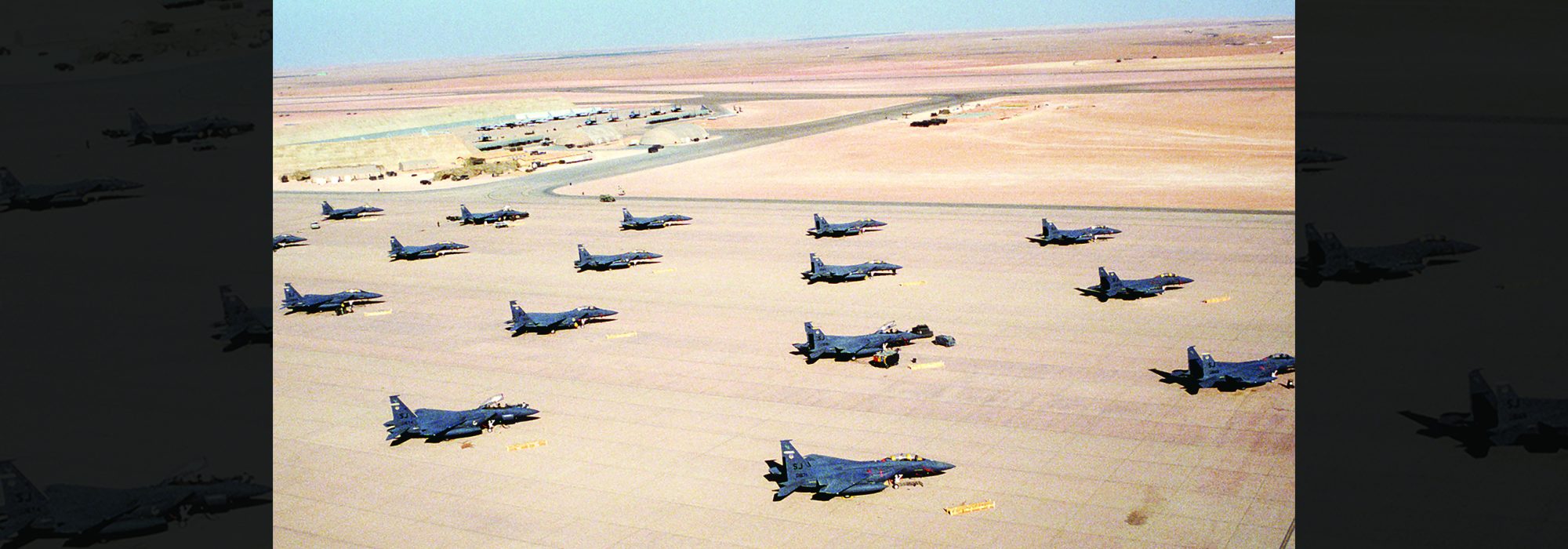
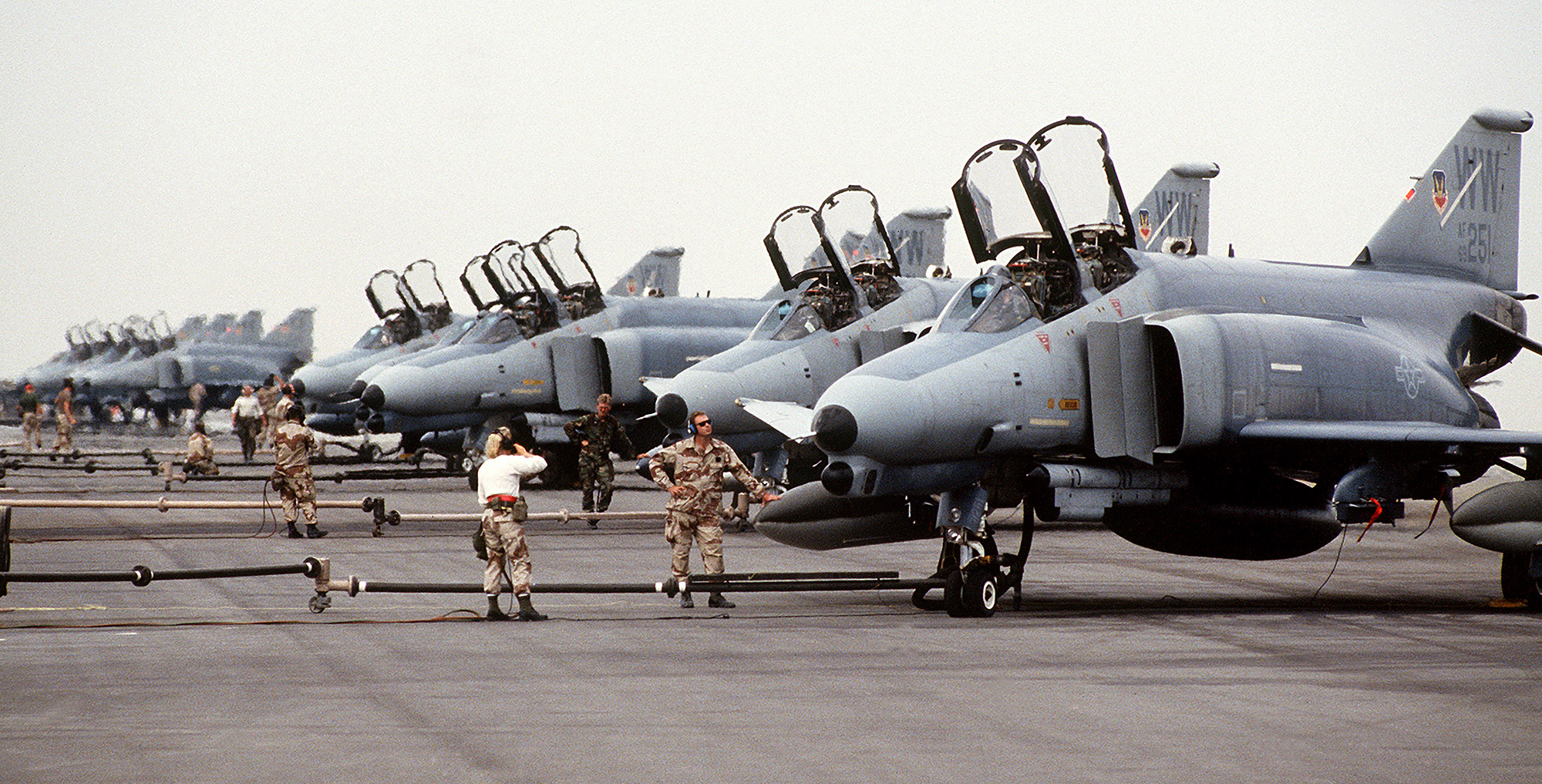
For a whole generation of flyers who joined the Air Force in the mid- to late-1970s and early 1980s, the call to arms that was Operation Desert Shield was an electrifying experience. They’d spent their entire careers training for a fight with the Soviet Union that had never come. Now in the past year, that threat had all but evaporated. So here, without warning, was a new opportunity to put their skills and their weapons—fourth-generation F-15 and F-16 fighters, secret F-117 stealth fighters, advanced laser-guided weapons and more—to the test.
In today’s era, after 35 years of near constant combat operations that depleted the Air Force through constant use, it is hard to fathom what the Air Force of 1990 was like. For America more than 17 years had passed since the end of the Vietnam War and except for brief operations in Grenada in 1982, Libya in 1986, and Panama in 1989, the Air Force had seen virtually no combat beyond the continual vigilance that defined the Cold War years and the military expansion under President Ronald Reagan.
Now a full-scale war against a large, well-equipped military loomed ahead.
Loh wanted a joint plan, but Warden recoiled at the thought. In his view, the military had misconstrued the concept of jointness. He wanted Air Force planners to build the plan and plug in joint capability wherever it made sense, not the kind of muddy compromise that he was sure joint planning would deliver.
“Goldwater-Nichols had inculcated this idea that jointness was a good thing in itself—not joint operations or effective cooperation, but jointness in itself,” Warden recalls. The problem with “jointness” in the Pentagon was that one service could never claim it could do something better than another service without being accused of being parochial and partisan, rather than “joint.” The result was that instead of drawing the best of each service, jointness often delivered a sort of parallel togetherness, in which elements of each service were drawn into every application.
Warden thought planning the air campaign needed to be done by air campaign experts, who would incorporate other services’ capabilities wherever there was advantage in doing so.
In a small conference room in the Pentagon basement, Checkmate planners defined Iraq’s “centers of gravity,” the key pillars that held up the regime, identified and prioritized targets that would need to be destroyed, determined the means necessary to destroy them, and built an operational plan to execute what Warden dubbed operation “Instant Thunder.”
The name was a rebuke to Operation Rolling Thunder, the Vietnam War operation that sought to incrementally ramp up pressure on the North Vietnamese in an effort to force them to the negotiating table. It was the opposite of what Warden was trying to accomplish. “This is not your Rolling Thunder,” he told the Checkmate team. “This is real war. … This is not Vietnam. This is doing it right. This is using airpower!”
Preparing to brief Loh, Warden pulled together a list of “presidential objectives,” carefully harvested from President Bush’s speeches and public comments. They included Iraq’s withdrawal from Kuwait; restoration of Kuwaiti sovereignty; securing the free flow of oil; and protecting U.S. lives. From these, he derived four military objectives: 1)Force Iraq from Kuwait; 2) degrade Iraq’s offensive capability; 3) secure the region’s oil facilities; and 4) render Saddam ineffective as an Arab leader.
When Warden briefed Loh on Aug. 8, the vice chief was enthused. “This is the No. 1 project in the Air Force!” he told Warden and Alexander. “You can call anybody, anyplace … for anything.”
At least, that’s what Loh intended. Reality soon intervened. Alexander dialed up Maj. Gen. James Clapper, head of Air Force intelligence. “I need some of your best intel guys,” he said. “General Loh wants us to put a strategic air campaign together.”
There was a pause. Clapper wanted to know why Loh was getting involved in such a thing. “This is Horner’s job,” he said. Clapper had visited with Horner’s 9th Air Force team, and they already had a strategic air campaign plan, he said. Clapper seemed to want no part in aiding an alternative plan. Russ and his TAC planners were also resistant. Antibodies were everywhere. But at Checkmate, work on the plan continued.
On Friday, Aug. 10, just eight days after the invasion, Alexander, Warden, and three lieutenant colonels headed to Tampa to brief an eager but skeptical Schwarzkopf. While there had been pressure to brief the plan to TAC first, or alternatively to fly to Hanscom Air Force Base, Mass., to brief the Chief of Staff, that wasn’t in the cards. Dugan declined the briefing, telling Loh time was of the essence, then directed Loh to send the team to Schwarzkopf directly, bypassing TAC entirely.
Warden would give the brief and the CINC had done his homework. He’d been briefed on Warden’s book, “The Air Campaign: Planning for Combat,” which included a section headed “War Can Be Won from the Air,” so Schwarzkopf had in mind a latter-day Gen. Curtis LeMay, single-mindedly convinced that airpower alone could achieve any objective at all. This, of course, was anathema to Army thinking. Both Schwarzkopf and Powell worried that airpower advocates would overpromise and underdeliver, distracting or confusing political leadership into thinking they could achieve their objectives in Iraq without committing ground forces to the fight. The two, career Army officers shaped and defined by their experiences in the Vietnam War, saw the “Air-Land Battle” doctrine as a truism, believing fundamentally that airpower needed to be subordinate to and in support of Army forces maneuvering on the ground.
Warden, on the other hand, thought Air-Land Battle fundamentally flawed, even “stupid.” But that was not an issue now, as Schwarzkopf had sought out an air plan, and Warden’s job was to deliver on that request. A Vietnam combat veteran himself, Warden had flown 266 OV-10 Bronco combat missions in Vietnam, and his views were no less shaped by Vietnam than the general’s.
Warden presented Instant Thunder as a strategic answer to a strategic question. Iraq should be looked at as a “system,” comprised of “centers of gravity,” or power centers, such as military command and control, electrical power, oil refineries, railroads, the telephone network, TV and radio transmitters, and so on. The objective of the campaign was not to level Iraq, but to cut off the leadership from the rest of the system, to blind and isolate Saddam so that he could not leverage his centers of gravity to any effect.
It was exactly what Schwarzkopf was looking for. “For our purposes,” Schwarzkopf would later write, “it was enough to silence Saddam, to destroy his ability to command the forces arrayed against ours. If he’d been killed in the process, I wouldn’t have shed any tears.” But there was no need to lay waste to the country, when the goal was to break its ability to fight. How long would it take to destroy Saddam’s air defenses, airfields, munitions plants and the rest?
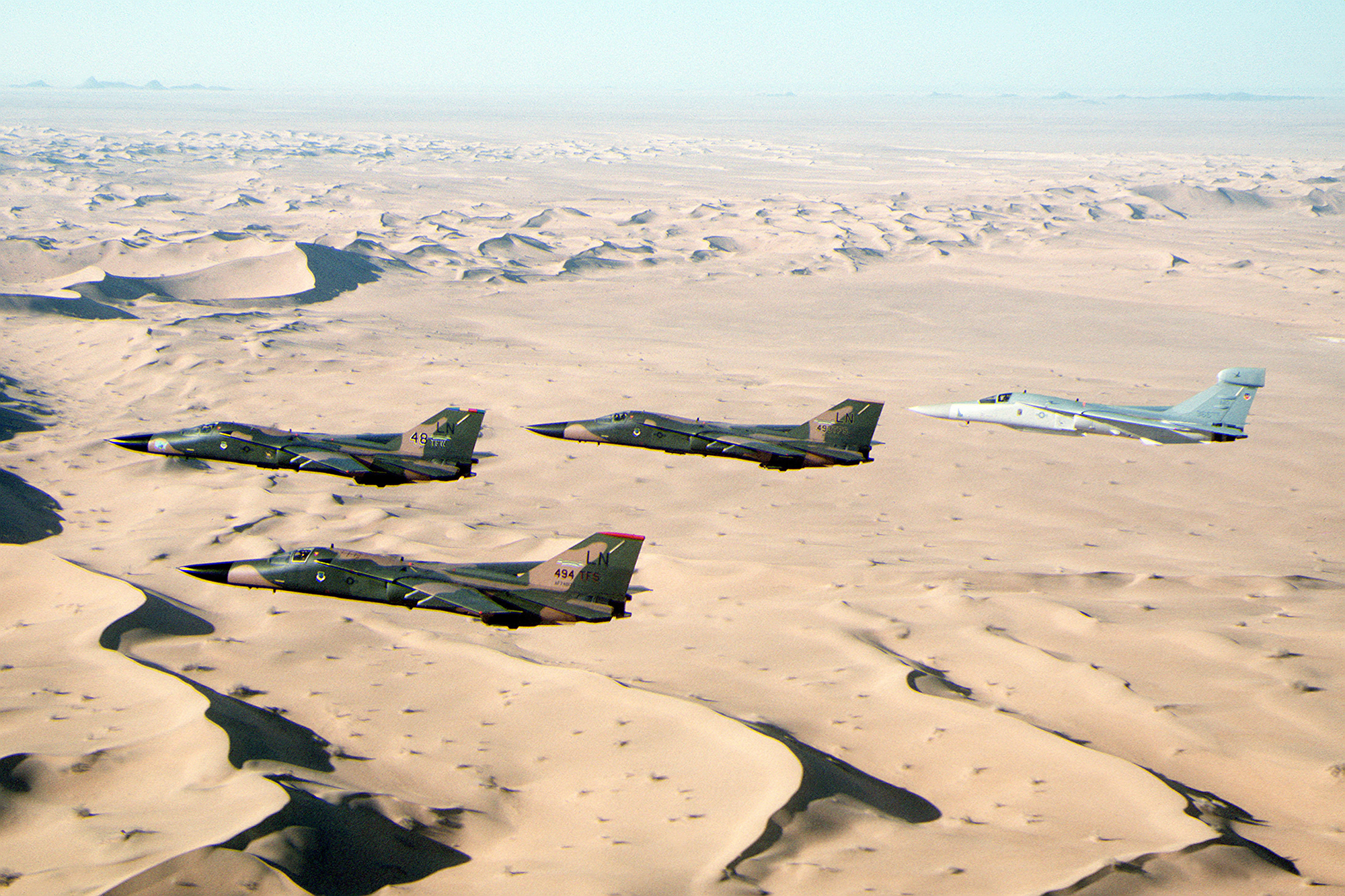
“Six to nine days,” Warden said. But that clock wouldn’t start until assets were in place, so Warden turned to logistics. He needed 500 aircraft and to get them in theater Schwarzkopf would have to change things up. A-10s were needed to threaten Saddam’s tanks. B-52s, F-117s, and F-111s also needed to be in place.
“Do it,” Schwarzkopf said. Up to then, he said, everyone had been leaning backward. “You’re the first to lean forward,” he told Warden.
The CINC had questions, though. What would it take to degrade Iraq’s deployed forces by, say, 50 percent in preparation for a ground offensive? What about the Republican Guard—another center of gravity?
Warden went back to Checkmate to develop the plan further. The following day, a Saturday, Warden briefed Powell at the Pentagon. Again, it went well. Powell asked about the Iraqi ground forces, and Warden warned that once begun, the strategic air campaign had to play all the way through. And Warden argued against hitting Iraqi forces in Kuwait. Powell, however, had other ideas. “If we go this far in the air campaign, I want to finish it,” Powell said. “Destroy the Iraqi army on the ground. … I want to leave smoking tanks as kilometer posts all the way to Baghdad.”
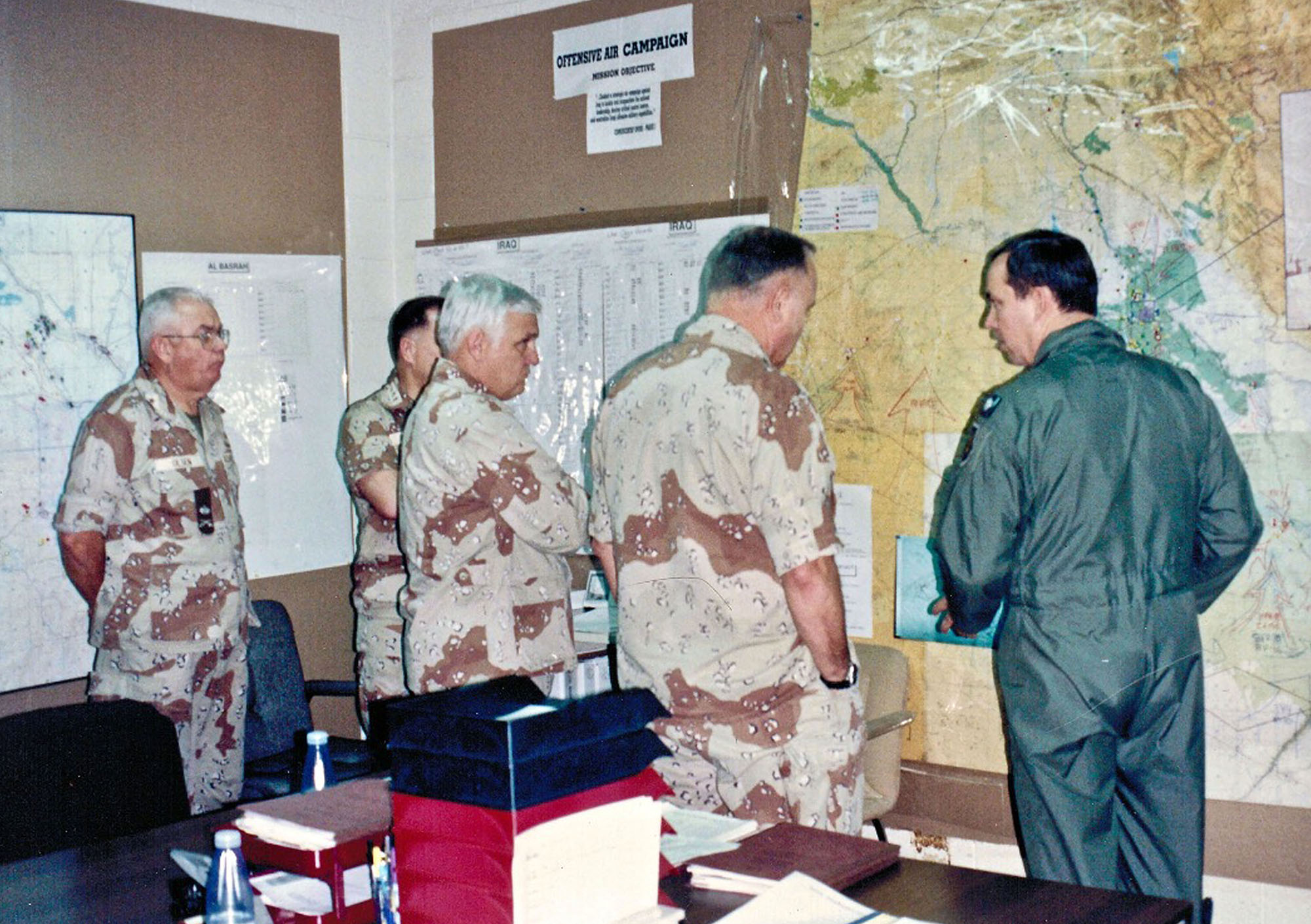
The following Friday, Aug. 17, Warden and Deptula and others were in Tampa briefing Schwarzkopf and a larger team this time.
“We’d worked very hard to put together this initial attack plan, and then we thought, OK, we’re going to hand it over to him, and thanks very much for the opportunity to participate,” Deptula recalled in an interview. “We thought we were done. But no, that’s when Schwarzkopf says, ‘“OK, John, I want you and whoever you want to take, to take this over to Riyadh and brief General Horner.”’
The following day, Warden, Deptula, and Lt. Cols. Ben Harvey and Ron Stanfill were wearing their flight suits, headed to Riyadh in the back of an RC-135 Rivet Joint.
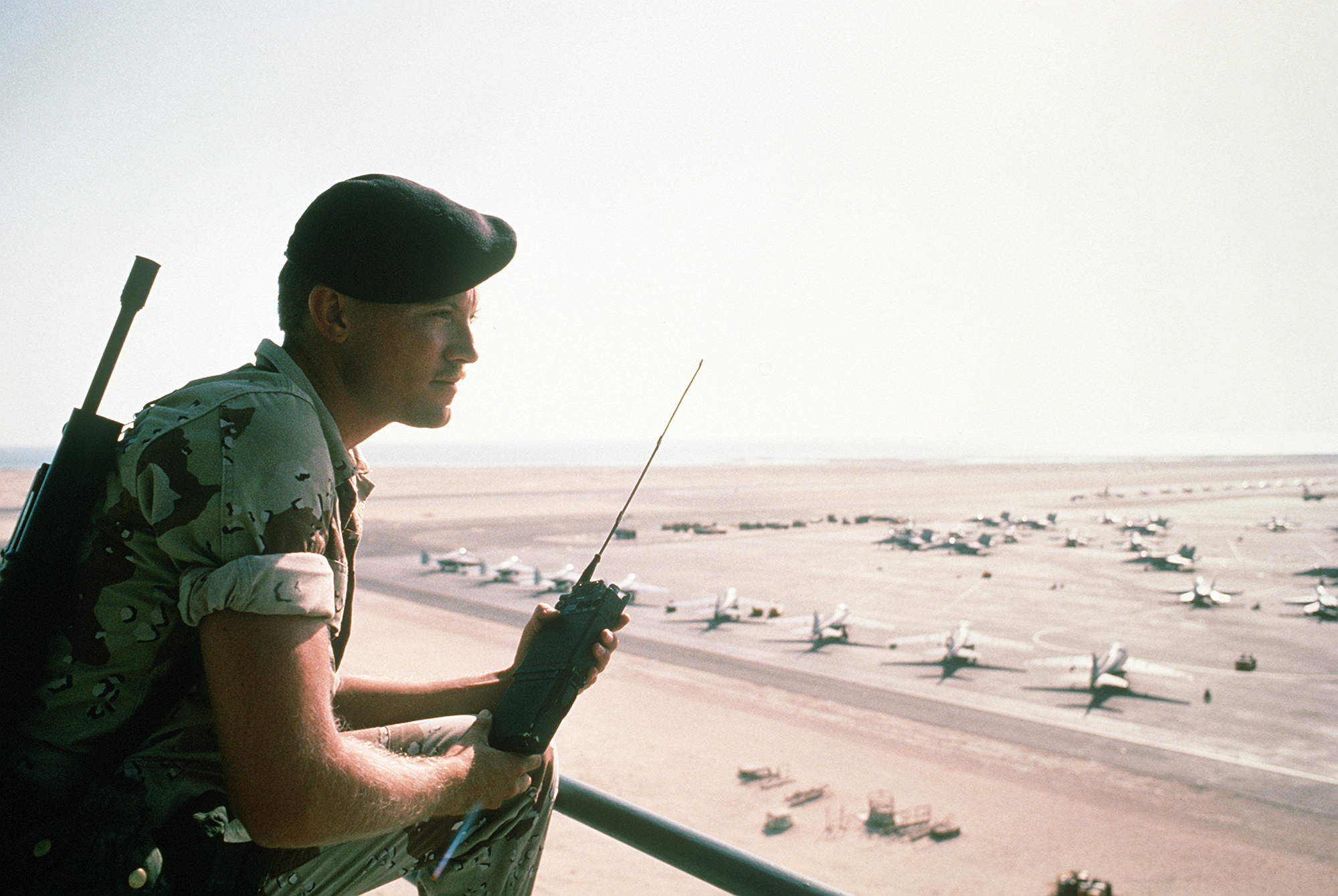
It was a long trip from Andrews Air Force Base, Md., to Riyadh, with a brief stop in Greece. The driver sent to pick them up in Riyadh was expecting a single passenger, and didn’t have room in his car, which was loaded full of gear, for all of them. He dumped them off at a hotel downtown, where rooms were not available. They slept on cots in a ballroom along with dozens of others. The next day they eventually found the location of the Air Force contingent. The initial brief got off late in the evening, and included Horner’s staff, but not the general himself. It seemed to go well. The real test would be with Horner, at a meeting scheduled for 1330 on the second day.
This time, it didn’t go so well. Warden had been told that lip balm and other comfort items were in short supply in the desert, and he carried over a couple of hundred dollars worth of supplies, which he brought along as a gift. He put the bag on the table where Horner was to sit, and waited as the rest of the room filled up.
When Horner arrived, his first move was to sweep the bag to the floor with a sharp expletive, setting the tone. Warden began the briefing, but Horner trolled him, interrupting and waving through the initial slides. When Warden was done, the questions started. One after another, too quick for Warden to answer, Horner criticized the planning, the targeting, the objectives. Perhaps it was performative, the field general showing his staff how to deal with a staff officer from Washington trying to tell them how to fight a war. Warden was thrown off but continued to try to win the general’s favor for his plan, arguing forcefully, convinced he had the answer to the challenge. Eventually, Horner looked around the room and said, “I’m being very, very patient, aren’t I?”
“Yes, sir,” said someone on his staff.
“I’m being very, very tolerant, aren’t I?” Horner asked.
“Yes, sir!”
But Horner wasn’t being tolerant and Warden was clearly being sidelined. Soon after, Horner went around the table, asking the officers who had accompanied Warden if they could stay. None refused the three-star general.
Warden was sent home alone that same day.
Deptula went to work immediately, taking up residence in a conference space that came to be known as the Black Hole because officers who went in never came out, apparently held by an invisible force that sucked them into round-the-clock planning cycles. Information likewise went in, but with everything held at the highest levels of secrecy, little found its way out. For weeks, Deptula remained convinced that the plan had to be ready to kick off in days and the work was relentless, around the clock, continual updating and revising, with no notion that the timeline would be pushed out further. It would be weeks before he realized the timeline was much longer and the kickoff wouldn’t come until after the new year.
Deptula called home and asked for some clothes to be sent over. He had only packed for a few days and his stay was indefinitely extended. A couple of weeks later a bag arrived, carried by a former boss: Gen. Mike Dugan, Air Force Chief of Staff. Dugan had flown to the desert to see how things were progressing, but it would prove to be his last trip as Chief. Days after returning in September, he was fired by Secretary Cheney for openly sharing his views with reporters that “airpower is the only answer available to our country in this instance,” as David Broder reported in the Los Angeles Times.
Powell thought Dugan’s comments usurped his authority, and that he was out of line for speaking so boldly. Cheney backed his Chairman. Dugan, who believed his comments were reasonable and reflective of reality on the ground and the Air Force doctrine that he believed in, asked to retire, effective the following January. He continued to go to work at the Pentagon, but was suddenly an invisible man in uniform.
Warden returned to Checkmate, where he remained in regular touch with Deptula, feeding intelligence, insights, and ideas into the Black Hole. “It turns out, that worked perfectly, with Dave and the guys in Riyadh, and me back in Washington,” Warden said. Deptula became the principal target planner for the duration of the Operation, working closely with Horner and Brig. Gen. Buster Glosson, who became Deptula’s immediate boss.
As the weeks ground on, the United States military continued to deploy forces into Saudi Arabia, a continuous flow for the next four months. By the time the planning was over and the war began on Jan. 16, 1991, some 500,000 U.S. personnel, 14,000 tanks, tens of thousands of trucks, 140,000 allied troops, and at least 1,400 aircraft had arrived in theater.
Instant Thunder was on a roll, and the gathering Desert Storm was brewing.