
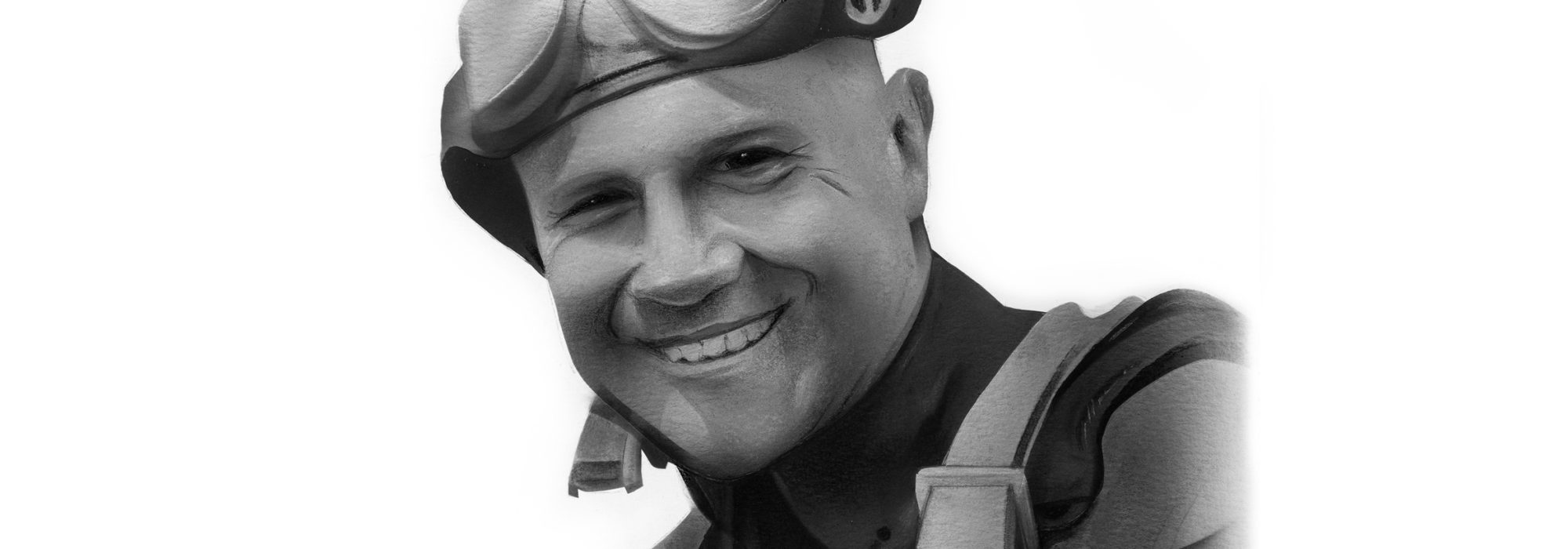
Leader—Warrior—Scholar.
Jimmy Doolittle is perhaps the most recognizable aviator in American history. He was famous throughout the interwar period for his daredevil stunts and racing plane exploits. Soon after Pearl Harbor he flew the legendary raid on Tokyo, leading a group of B-25s that took off from the deck of an aircraft carrier. He was awarded the Medal of Honor for that deed, which was also made into a movie, “Thirty Seconds over Tokyo,” starring Spencer Tracy. In truth, however, Doolittle was far more—he was a scientist and aviation pioneer and also one of the great air combat commanders of the war.
Raised in Alaska and California, at 5’ 4” tall, but strong, Doolittle was pugnacious even as a youth and was a noted boxer growing up. He became a pilot, and after the World War he developed into a great one. He won numerous air races and was photographed sitting on the undercarriage of an Air Service aircraft during flight—just to prove he could do it without falling off. He left the Army in 1930 and went into business with the Shell Oil Co. He had earned one of the first Ph.D.s in aeronautics in the U.S., from MIT in 1925, and used those academic skills, along with his uncanny flying ability, to tackle aviation problems.
Perhaps the greatest bane for pilots in those years was weather. Once flying into clouds, normal sensory perceptions are unreliable—invariably the pilot becomes disoriented, stalls and goes into a spin, and then crashes. Doolittle designed and tested the first “blind flying” instruments that allowed pilots to fly through weather by using cockpit instrumentation only. This was revolutionary. Today, no pilot with any sense would dare to take off without such instruments.
In addition, while at Shell Oil, he pushed for the development of high-octane gasoline. This too was revolutionary. High-performance aircraft depend on high-performance engines, and such engines in turn require high octane gasoline: without it, engines “ping” and lose performance—or simply quit. Such gasoline was not in great demand in the 1930s because medium-performance commercial airliners didn’t need it. One does not put high-octane fuel in a VW Bug. Fighter aircraft, however, needed such gasoline. Thanks to the aggressive pushing of Doolittle, 100-octane fuel was available before World War II. It has been said this fuel won the Battle of Britain by giving Royal Air Force fighters a decisive margin of superiority over the Luftwaffe.
When the war broke out, Doolittle returned to uniform, and one of his first duties was to train bomber crews for the short takeoffs necessary to launch from an aircraft carrier and bomb Tokyo. Afterward, Gen. Henry H. “Hap” Arnold picked him to command the new Twelfth Air Force for the invasion of North Africa in 1942. Doolittle, by then a brigadier general, was a born leader and a dedicated operator, and his reputation was well known by all his subordinates. He flew numerous unauthorized combat missions, which prompted a stinging rebuke from his boss, Gen. Dwight Eisenhower: “Doolittle, do you want to be a lieutenant and fly Spitfires, or do you want to be a major general and command my air force?”
After the successful completion of the North African campaign, Doolittle took over the Fifteenth Air Force for the invasions of Sicily and then Italy. When Eisenhower moved to London in preparation for Operation Overlord, he brought Doolittle with him. Doolittle took command of the Eighth Air Force and led it for the rest of the war. Losses in the strategic bombing campaign were high: the Luftwaffe was a very formidable opponent. He studied the problem and realized it was largely a question of doctrine. To him, a sign at VIII Fighter Command headquarters summed up the problem: “The First Duty of the Eighth Air Force Fighters is to Bring the Bombers Back Alive.” He ordered it removed and replaced it with one that read: “The First Duty of the Eighth Air Force Fighters is Destroy German Fighters.” The result of this deceptively simple semantic change was dramatic. The fighter pilots were released from their passive role of convoy protection and again became hunters. Air superiority, essential for the success of the Normandy invasion, was soon achieved.
When the Nazis were defeated, Doolittle transitioned the Eighth Air Force into B-29s and took it to Okinawa to participate in the strategic air campaign against Japan. The war ended soon after.
Doolittle, a genuine American hero, returned to the U.S. as a lieutenant general, retired, and went back into business and government service. In 1946, he became the founding president of the Air Force Association and remained an instantly recognizable hero. In 1985 President Ronald Reagan promoted him to full general.
Doolittle was one of the great Airmen in American history, but he was also one of its greatest combat leaders. He was there for all the tough jobs: Tokyo, Twelfth Air Force, Fifteenth Air Force and finally, the crucial Eighth Air Force in the final drive against Germany. The general died at age 96 in 1993. I Could Never Be So Lucky Again (Bantam, 1991), is Doolittle’s autobiography; the best biography of his life is by Dik Daso, Doolittle: Aerospace Visionary (Brassey’s, 2003).